
Livraison le jour même ou le lendemain

Qualité garantie

Débloquez vos offres de bienvenue: Livraison GRATUITE | Jusqu'à -80 % | 30 jours d'essai gratuits à JoyPlus
Téléchargez l'application
Living in a small space, whether an urban apartment or a compact house, presents a daily challenge: how do you maintain order without sacrificing style? The search for the ideal space-saving storage unit can quickly become a daunting task. Between marketing promises and real-world performance, it's easy to end up with an impractical piece of furniture that creates more clutter than it organises.
This guide reveals the key criteria for choosing a storage solution that will meet your long-term needs, combining functionality and aesthetics to optimise your small space.
Before you start shopping, it's crucial to know the most common mistakes that lead to buyer's remorse. Keeping these points in mind will help you filter through the options and focus on what truly matters.
It's a classic pitfall: a piece of furniture looks perfect in photos, but once assembled, its compartments are too narrow, its drawers too shallow, or its shelves unable to hold your everyday items. The result: a constant source of frustration and a unit that takes up more space than it saves.
The term "wood" can be misleading. A unit made from low-density particleboard, without a water-repellent treatment, is likely to swell at the first splash in a bathroom or chip at the slightest impact. In short, an investment that loses its value and appeal in a few months is never a good deal.
Your storage needs change over time. A unit with fixed shelves and a single configuration severely lacks flexibility. What might seem like a multi-functional storage solution at first can prove completely unsuitable when you want to reorganise your space or store new items of different sizes.
To make an informed choice, focus on a few technical specifications that separate a gimmicky piece of furniture from a long-term investment.
Don't just rely on the external dimensions (W?×?D?×?H). Carefully examine the usable depth and height of the shelves and drawers. For a tall bathroom cabinet or a slim storage unit, every inch counts. A cabinet with a 30?cm external depth might only offer 25?cm of actual storage space. Verify that these measurements are compatible with the items you plan to store (folded towels, bottles, storage boxes).
The unit's composition is a key indicator of its longevity. Medium-Density Fibreboard (MDF) generally offers better durability and a smoother finish than standard particleboard. For damp rooms like the bathroom, ensure the material has a water-repellent surface treatment.
Another non-negotiable point: safety. Any tall, narrow unit must come with an anti-tip kit to secure it firmly to the wall. This is an essential precaution, especially in homes with children.
A good storage solution should be able to evolve with you. Prioritise models that offer height-adjustable shelves or reversible doors. This modularity allows you to reconfigure the unit's interior as your needs change. Finally, a stylish small storage unit with clean lines and high-quality finishes will integrate more easily into your decor and can even be moved from one room to another if needed.
To help you visualise how these criteria apply in practice, here is a selection of furniture suited to specific user profiles.
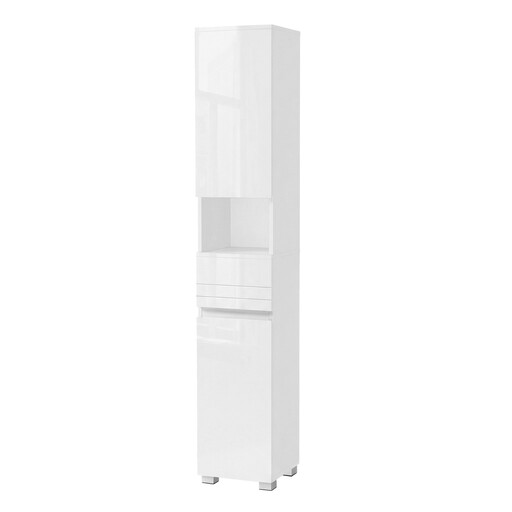
Why we chose it: Ideal for those looking to leverage vertical space in a small bathroom or toilet. Its tall, narrow design optimises floor space while offering significant storage volume.
It overcomes the lack of versatility: its reversible doors and adjustable internal shelves allow you to adapt the space for tall bottles as well as stacks of towels.
Its MDF construction makes it more suitable for humid environments than standard particleboard. The included anti-tip kit ensures stability.
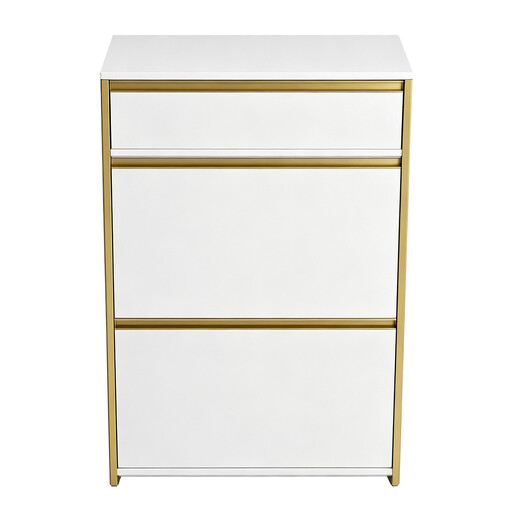
Why we chose it: Perfect for those who want a functional piece of furniture without compromising the aesthetics of their entryway. Its extremely shallow depth (24 cm) is a decisive advantage in narrow hallways.
It avoids the rigid design pitfall by being multifunctional: it stores shoes, offers a drawer for keys, and has a top surface for decor. The internal shelves are adjustable.
Its minimalist white and gold design makes it a true decorative element that blends into a modern interior, combining form and function.
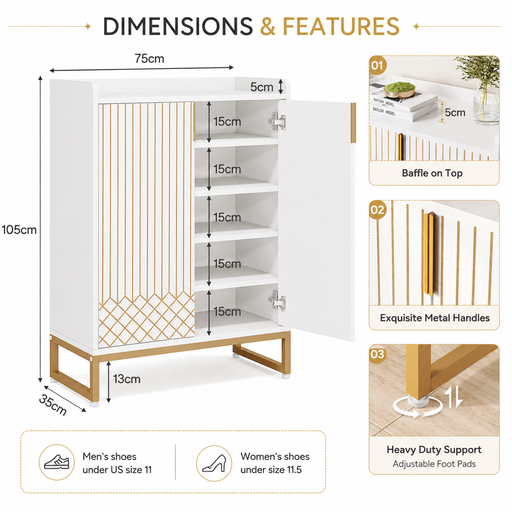
Why we chose it: Designed for those with a large shoe collection or who need to conceal clutter in an entryway, living room, or bedroom. It maximises storage while maintaining a clean, streamlined look.
It bypasses the misleading dimensions pitfall by clearly stating its storage capacity (up to 25 pairs) and hiding everything behind doors for a clean, visually uncluttered result.
Its large storage capacity is its main asset. The wood panel structure with metal legs ensures good stability for a unit of this size.
We have compiled a complete, up-to-date list of products that meet these strict selection criteria and safety standards.
Most tall cabinets come with an anti-tip kit. This usually consists of one or two straps or brackets that you screw into the cabinet (often into pre-drilled holes) on one end and into the wall on the other, using anchors appropriate for your wall type (drywall, brick, etc.). This step, though sometimes overlooked, is crucial for the safety and stability of the furniture.
Particleboard is made from wood particles compressed with a resin. It is budget-friendly but more susceptible to moisture and less dense. MDF (Medium-Density Fibreboard) is composed of very fine wood fibres, making it denser, smoother, and more durable, especially against moisture if properly treated. For a long-lasting piece of furniture, especially in a kitchen or bathroom, MDF is often a wiser choice.
A piece of furniture is truly "space-saving" if it offers an excellent storage capacity to footprint ratio. It should utilise vertical space (a tall cabinet), make use of awkward areas (like under a sink), or have a very shallow depth to fit into a narrow passageway. Internal modularity (adjustable shelves) also helps to maximise every available square inch.