
Livraison le jour même ou le lendemain

Qualité garantie

Débloquez vos offres de bienvenue: Livraison GRATUITE | Jusqu'à -80 % | 30 jours d'essai gratuits à JoyPlus
Téléchargez l'application
Whether you're facing a cold snap or dealing with a room poorly served by central heating, a space heater seems like the perfect solution. But be careful: the market is flooded with models making tempting promises that can quickly turn into costly disappointments. Before you decide, it's best to know the most common pitfalls so you can find the device that truly fits your needs.
As a Product Expert at Joybuy, I'm here to help you see things more clearly. Let's forget the marketing jargon and focus on what really matters. Here are the most common mistakes to avoid:
To avoid making a mistake, focus on a few key parameters. These will determine the effectiveness and suitability of your space heater.
Power, expressed in watts (W), must be appropriate for the room's size and insulation level. A common rule of thumb is 100W per m? for a normally insulated room with a 2.5m ceiling height. However, this rule should be adjusted based on the type of device:
A portable heater must be truly portable. Check its weight, the presence of handles, and the length of the power cord. Features like oscillation help distribute heat more evenly. A timer or a remote control (or even a mobile app) provides significant convenience and, most importantly, allows you to better control your energy consumption.
To illustrate these criteria in practice, here are a few models that meet very different needs.
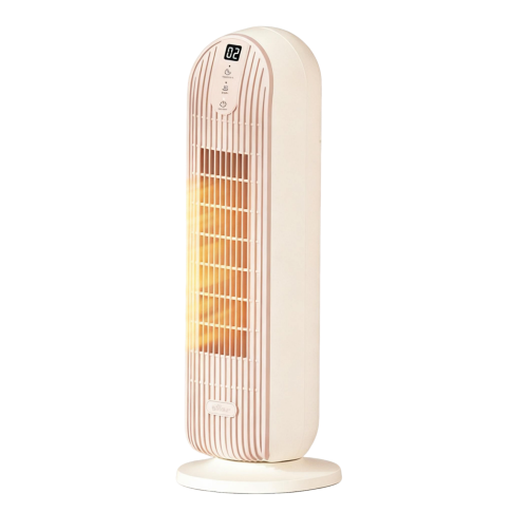
Why this profile? Perfect for quickly and quietly heating a living room, bedroom, or office. Its compact design and handle make it easy to move wherever you need it.
It bypasses the "low consumption" myth by offering precise control: two power levels (1200W/2000W) and a 12-hour smart timer allow you to adjust consumption to your actual use.
Its 90° oscillation and upward-tilted airflow ensure wide and even heat distribution, avoiding the cold spots typical of static devices.
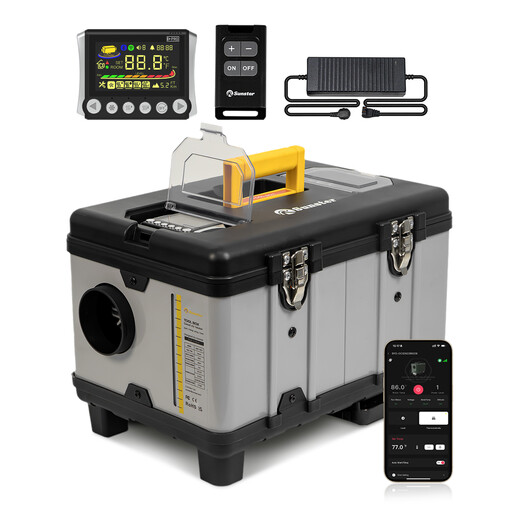
Why this profile? Designed for demanding situations: heating a garage, workshop, tent, or RV. Its power and fuel-based operation make it autonomous and incredibly effective in large, cold, or poorly insulated spaces.
It solves the "wrong technology for the wrong use" problem. Where an electric space heater would be insufficient, its 8kW power and diesel technology are perfectly suited.
Its versatility is remarkable: it runs on mains power (230V) and battery (12V/24V). Control via LCD screen, remote, or Bluetooth app offers maximum user flexibility.
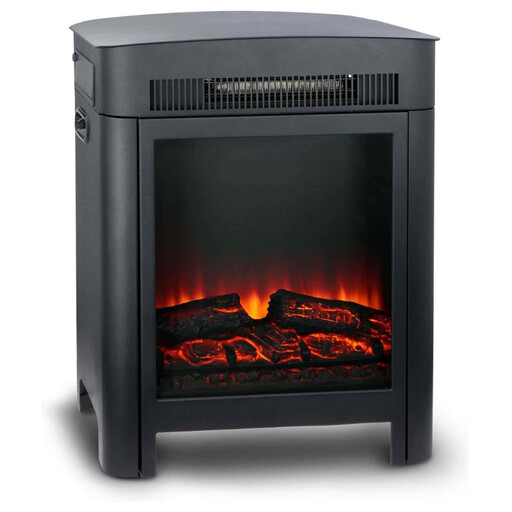
Why this profile? For those who want to combine function with style. This model is not just a heater; it's also a decorative element that creates a cosy and inviting atmosphere in a living room or bedroom.
It doesn't claim to be the most economical solution for heating an entire house. Its value lies in its dual function. It naturally includes overheat protection, an essential safety guarantee.
The realistic LED flame effect can be used independently of the heating function, allowing you to enjoy the "fireplace" ambiance even on cooler evenings without necessarily turning on the heat.
From garage heaters to solutions for your patio evenings, discover our selection of products designed for the outdoors.
For a standard living space (well-insulated, 2.5m ceiling), a power of 100W per square meter is a good starting point. For a 12m? bedroom, a 1200W device is therefore often sufficient. For a garage or workshop, where insulation is poor and the volume is larger, you need to aim higher, and a technology like a diesel heater will be more suitable.
Consumption depends directly on the power (in kW) and the duration of use (in hours). A 2000W (or 2kW) device running at full power for one hour will consume 2 kWh. To limit costs, choose models with an adjustable thermostat, multiple heat settings, and a timer. The goal is to heat up quickly and efficiently, then maintain the temperature, not to run continuously.
It is strongly advised against leaving a space heater running unattended, especially overnight. Even devices with multiple safety features pose a residual risk. For nighttime use, opt for a model with a programmable timer that will automatically turn off the device after one or two hours, just enough time to fall asleep warm. Also, ensure the device is unobstructed and far from any flammable materials (duvets, curtains, etc.).