
Livraison le jour même ou le lendemain

Qualité garantie

Débloquez vos offres de bienvenue: Livraison GRATUITE | Jusqu'à -80 % | 30 jours d'essai gratuits à JoyPlus
Téléchargez l'application
Is there a room that stays stubbornly cold despite your central heating?? A freezing home office that's killing your productivity?? With soaring energy prices, the very idea of turning on a space heater can seem counterintuitive. Yet, when used wisely, the right device can not only provide targeted comfort but also help you control your overall energy bill.
The real challenge is navigating the gap between marketing promises and technical reality. Too many users end up with a device that is power-hungry, noisy, or simply ill-suited to their needs. Here are the common pitfalls to avoid.
To avoid buyer's remorse, focus on the key technical specifications that truly make a difference in efficiency, comfort, and safety.
The technology you choose directly impacts the feeling of warmth and how quickly the temperature rises.
Power, measured in watts (W), must be perfectly matched to the room's volume. A simple but effective rule of thumb is to allow for approximately 100W per square metre for a room with a standard ceiling height (2.5 m) and decent insulation.
Choosing the right power level is the best way to avoid excessive consumption while enjoying a stable and pleasant temperature.
Far from being mere gimmicks, the following features are essential for both safe and economical operation.
Rather than an endless list, we've matched specific use cases with products that check all the boxes for performance and safety.
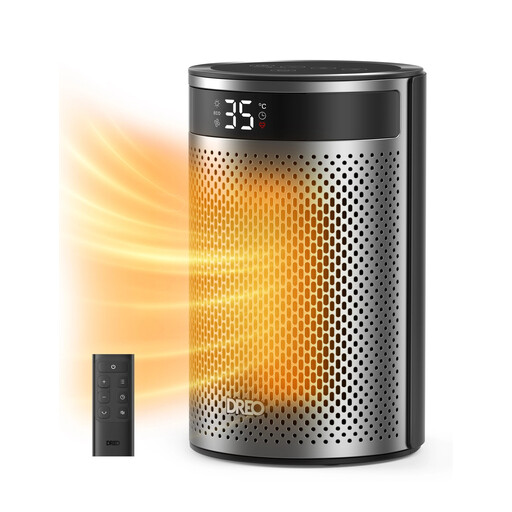
Why this choice? When working from home, silence is golden. This model was designed to be exceptionally quiet, allowing you to stay focused without the noise of a conventional fan. Its compact size and rapid heating make it the perfect companion for warming up your personal workspace.
It tackles the noise problem head-on. According to the manufacturer, its brushless DC motor keeps the noise level below 34 dB—a remarkable achievement for a fan heater.
Precise thermostat (5–35°C) for fine temperature control and an eco mode. Full suite of safety features (tip-over, overheat).
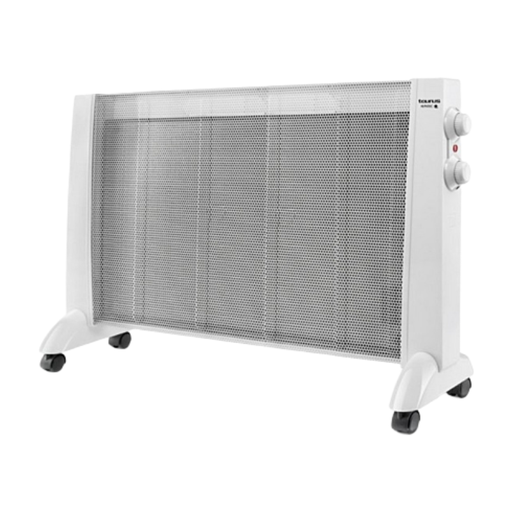
Why this choice? Perfect for a living room or large bedroom, this radiant panel emits a gentle, enveloping heat, without the sometimes unpleasant blast of a fan. Its 2400W output allows it to heat large spaces, and its casters make it a portable radiator that's easy to move as needed.
It avoids the pitfall of harsh, localised heat common in fan-based models. Its MICA panel technology ensures uniform heat distribution for overall comfort throughout the room.
Three power levels and a mechanical thermostat to fine-tune the heat output. Completely silent operation, inherent to radiant technology.
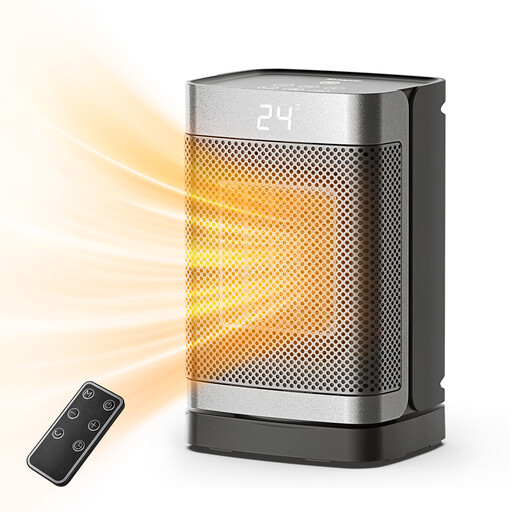
Why this choice? For a student in a studio apartment or for occasionally heating a guest room, this model is an excellent compromise. It's compact, delivers rapid heat thanks to its PTC technology, and covers the essentials by including key features (thermostat, timer, safety) without any frills.
It doesn't fall into the trap of budget models that skimp on safety. It properly includes overheat and tip-over protection, two essential safety features.
Timer (up to 12 hours) and remote control for added convenience. Oscillation function to better distribute heat in the room.
To take control of your energy consumption even further, consider optimising your central heating system with a smart thermostat: the savings can be substantial.
We have compiled a complete, up-to-date list of products that meet our demanding selection criteria and European safety standards.
Consumption depends directly on its power (in watts) and its duration of use. The calculation is simple: multiply the power in kilowatts (kW) by the number of hours of operation. For example, a 1500W (or 1.5 kW) device running for 3 hours will consume 4.5 kWh (1.5 x 3). To reduce this consumption, using an adjustable thermostat and an ECO mode is the most effective solution, as the device only heats when truly necessary.
It is possible, but only with a device designed for this purpose and equipped with all the required safety features. It is crucial to check for overheat protection, a tip-over switch, and the use of fire-retardant materials. A model equipped with a thermostat and a timer is highly recommended for scheduling an automatic shut-off. Finally, for obvious reasons, opt for a silent space heater so as not to disturb your sleep.
Its longevity largely depends on manufacturing quality and maintenance. Ceramic heating elements (PTC) are known to be more durable than older metal coils. Simple maintenance, such as regularly dusting the air vents to ensure good airflow, can significantly extend its lifespan. As a general rule, a quality model will easily last you for many winters.