Parents of a baby starting complementary feeding
If you’re considering a soy drink for your child, first distinguish it from milk feeds. According to ameli, complementary feeding adds foods alongside milk, which remains the basis of a baby’s diet.


If your baby is starting complementary feeding, don’t buy a soy drink to replace breast milk or infant formula: ameli reminds parents that milk should remain the basis of their diet, and Anses warns against this type of substitution before the age of one. For family cooking, check the recipe, allergens and packaging: a stated volume of 3 L doesn’t necessarily mean there’s a single 3 L bottle.
If you’re considering a soy drink for your child, first distinguish it from milk feeds. According to ameli, complementary feeding adds foods alongside milk, which remains the basis of a baby’s diet.
For family cooking, compare the recipe, nutritional information per 100 ml, number of cartons and storage instructions. Product listings from Auchan and E.Leclerc describe options with different ingredients and packaging.
A soy drink contains soy, but its name doesn’t tell you whether it contains other allergens. Read the label for each product and follow the avoidance advice given for the identified allergen, as ameli reminds us.
First decide who the drink is for and how it will be used. Then check its ingredients and consider how much your household can realistically use.
| What to consider | What to check | Who this matters to |
|---|---|---|
| The role of milk during complementary feeding | Check your child’s age and how the drink will be used: according to ameli and Anses, a shop-bought soy drink must not replace breast milk or infant formula for a baby under one. | If my child is starting to eat other foods, I want to avoid confusing this stage with stopping their usual milk. Around 36% of consumers would put this first. |
| Allergens | Read the ingredients list for your chosen product to identify soy and any other declared allergens; follow the avoidance advice specific to your child. | If someone in my family has an allergy or needs to avoid certain foods, I need to know exactly what each carton contains. Around 29% of consumers would put checking allergens first. |
| Ingredients and recipe | Compare the ingredients and nutritional information per 100 ml, particularly sugars and declared calcium. A plain recipe and a fortified one may differ. | When cooking with or serving this drink at home, I want to choose a recipe based on its ingredients, not just its name. Around 21% of consumers would prioritise the ingredients. |
| Volume and storage | Check the capacity of each carton, the number of units and the instructions for use after opening: a total volume of 3 L doesn’t mean there’s a single bottle. | In a household that regularly uses soy drink, I want to buy an amount we can store and use in line with the label. Around 14% of consumers would put pack size first. |
Complementary feeding doesn’t replace milk feeds. Ameli says that milk remains the basis of a baby’s diet and that infant formula should be continued until the age of one; Anses warns against replacing it with an ordinary plant-based drink.
Before buying in bulk, check your child’s age and how you plan to use the drink. For advice about a specific dietary situation, speak to a healthcare professional.
The products listed by Carrefour and Auchan contain soy. Their name doesn’t prove that they contain milk, or that each recipe is free from other allergens.
Read the ingredients list and allergen information on the pack you buy. If your child has a diagnosed allergy, follow the avoidance advice given for them.
Product listings from Carrefour, E.Leclerc and Auchan describe 1 L cartons. An offer labelled as 3 L doesn’t, by itself, tell you the capacity of each unit.
Check the number of cartons and the volume of each one, then read the storage instructions for after opening.
If you can’t use an opened carton within the stated time, buying in bulk could lead to waste.
Soy drink recipes can differ in their sugars, ingredients and fortification. These features don’t make a supermarket drink suitable for replacing a baby’s milk.
Compare the ingredients and nutritional values per 100 ml for the specific products you’re considering.
Alpro offers several soy drink recipes, including flavoured and Barista options.
Sojasun offers a 1 L plain soy drink and a calcium-fortified option.
Bjorg soy drinks are listed by Carrefour and Auchan, with different recipes and pack formats to distinguish between.
Carrefour offers a plain organic soy drink in a 1 L carton under this brand.
E.Leclerc lists Bio Village plain organic soy drink in a 1 L carton.
Auchan lists a plain organic soy drink and a separate soy drink with calcium under its own brand, each in a 1 L carton.
This multipack of soy drinks could suit a household looking for several cartons for cooking. It shouldn’t be chosen as a replacement for breast milk or infant formula for a baby.
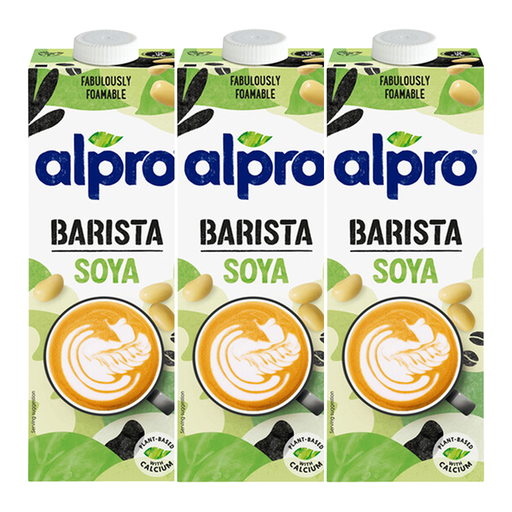 Image unavailable
A pack to consider for regular cooking at home, not as a replacement for a baby’s milk feeds.
The pack contains three 1 L cartons, not one 3 L bottle. The drink contains soy, so check the allergens and storage instructions on the packaging you receive.
No. A shop-bought soy drink shouldn’t replace breast milk or infant formula for a baby. Ameli explains that milk remains the basis of a baby’s diet during complementary feeding and that infant formula should be continued until the age of one; Anses warns against substituting it with drinks not designed for this purpose.
Check the ingredients list for each product and follow the avoidance advice for the identified allergen. A soy drink contains soy, but its name alone doesn’t tell you whether it contains other allergens. If you suspect a reaction, speak to a healthcare professional rather than trying it again at home.
Not necessarily: check the size of each carton and the number of cartons before buying. Listings from Carrefour, E.Leclerc and Auchan describe 1 L cartons, while an offer labelled as 3 L doesn’t, by itself, tell you how it’s packaged.
Follow the storage time and temperature shown on the carton you buy. For the products listed, Auchan and Sojasun recommend keeping them in the fridge and using them within five days of opening; instructions may vary by product.
If soy is going to be a regular part of your child’s diet, ask for advice tailored to their age and circumstances. In 2025, Anses recommended not serving soy-based foods in collective catering to limit isoflavone consumption; this recommendation isn’t a general ban on families buying these products.