People keeping an eye on sugar
Whether you’re using it in coffee, cereal or cooking, you want to compare the sugars and energy content per serving rather than relying on the word ‘plant-based’ alone.


If you’re choosing a soya drink as part of your weight-management approach, compare the sugars and energy content per serving, then consider the protein content in the context of your diet. An enriched recipe may meet different needs from a plain one, but it isn’t necessarily lower in sugar. And lactose-free drinks still contain soya.
Whether you’re using it in coffee, cereal or cooking, you want to compare the sugars and energy content per serving rather than relying on the word ‘plant-based’ alone.
You also look at the protein content and, if it matters to you, the calcium and vitamins listed on the label. A drink described as high in protein can still contain sugar.
You distinguish between being lactose-free and being free from allergens: soya drinks contain soya and aren’t suitable if you’re allergic to it.
Start with the nutrition information per 100 ml, then take into account how much you drink. Check the ingredients and allergens separately: nutrition figures can’t replace reading the label.
| Criteria | What to check | Who it matters to |
|---|---|---|
| Sugars and energy | Compare ‘of which sugars’ and the energy per 100 ml, then consider how much you usually drink. | If I drink it regularly, I want to know how much sugar and energy I’m getting in the amount I pour. Around 36% of consumers put this at the heart of their choice. |
| Protein and fortification | Check the protein content and, if needed, the calcium and vitamins listed. Check the sugars too. | When I have the drink with breakfast or a snack, its nutritional content matters beyond the ‘plant-based’ label. Protein and fortification are the priority for around 29% of consumers. |
| Lactose and allergens | Check the ingredients list and allergen information, especially if you’re switching to a different product. | I avoid lactose, but I also need to know whether the drink meets my needs around soya. This is the main concern for around 21% of consumers. |
| Recipe and availability | Check the ingredients, nutrition information and availability at your chosen retailer. | For cooking, I’m mainly looking for a simple recipe or a product I can find at my usual retailer. Around 14% of consumers prioritise these factors. |
A soya drink contains soya, even if it’s lactose-free. The European Commission lists soya among the allergens that must be declared on prepacked foods.
If you’re allergic to soya, avoid soya drinks. Check the allergen information again if you switch to a different product.
Product listings from E.Leclerc, Auchan and Joybuy show different sugar levels across soya drinks: the Sagiko product we checked lists 8.44 g per 100 ml, compared with 0 to 0.7 g per 100 ml for several plain or unsweetened recipes we reviewed.
Compare the ‘of which sugars’ figures on the same basis before choosing based on taste or pack size.
The Alpro product featured on Joybuy lists 5 g of protein, but also 2.5 g of sugars per 100 g.
Check the protein, sugars, energy and ingredients together, using the same unit for comparison.
Instructions vary by product: Auchan says to keep the Bjorg drink we checked chilled for four days, and its Auchan Bio drink for five days.
Choose a pack size that suits how much you’ll drink, and follow the instructions on the carton you buy.
An opened carton you can’t finish within the stated time may go to waste.
These examples refer to specific products. Check the label of the drink you’re thinking of buying, as recipes can vary within the same brand.
The Alpro soya drink featured on Joybuy lets you compare protein and fortification with the sugar content listed.
The organic plain soya drink described by Carrefour contains organic soya juice made with water and soya beans.
The organic plain soya drink described by E.Leclerc is made with organic soya juice, according to its product listing.
The organic plain soya drink featured by Auchan contains organic soya juice sourced from France.
The unsweetened organic soya drink featured by Auchan can be compared with plain recipes using the information on its label.
These products suit different needs: an everyday soya drink, a Barista version for coffee and individual cartons. Their inclusion here doesn’t indicate how their sugar content compares or whether they’re suitable for a weight goal. Check the label of each product.
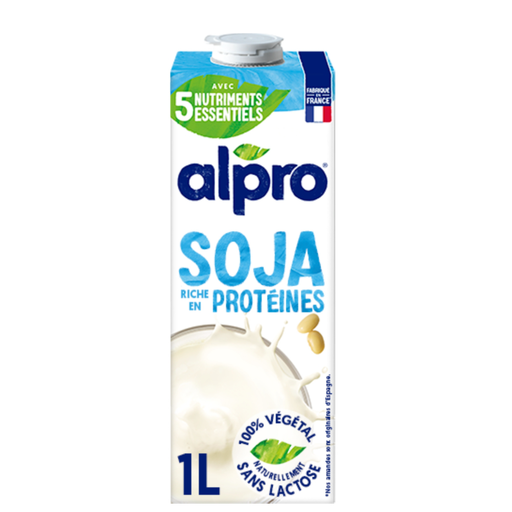 Image unavailable
Worth considering if you also want to compare protein and calcium: the Joybuy listing gives 39 kcal, 2.5 g of sugars, 5 g of protein and 120 mg of calcium per 100 g. This drink contains soya and sugar.
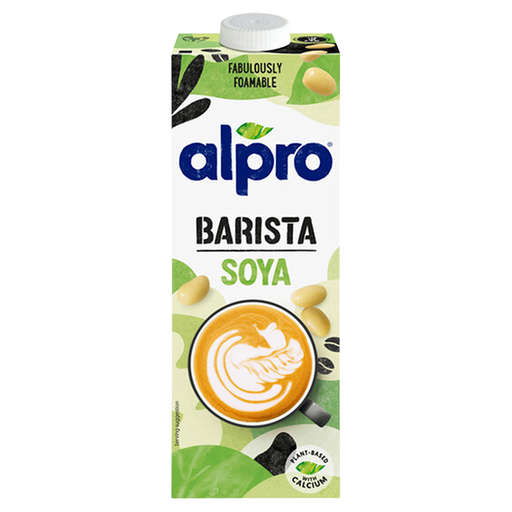 Image unavailable
A product to consider if you’re looking for a soya drink for coffee. To compare it with a plain version, check the sugars and energy per 100 ml on the pack.
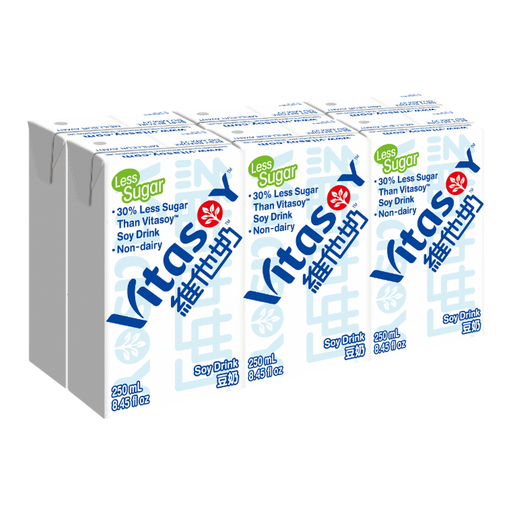 Image unavailable
The pack of six 250 ml cartons is handy if you’re looking for individual portions. The ‘Less Sugar’ claim alone doesn’t tell you how much sugar the drink contains overall: check the nutrition information per 100 ml and the allergen list before choosing.
No. ‘Lactose-free’ doesn’t mean ‘allergen-free’, and a soya drink contains soya. The European Commission lists soya among the allergens that must be declared on prepacked foods. If you’re allergic to soya, choose a different type of drink.
Compare their nutrition information on the same basis, including energy, sugars, protein and fat per 100 ml, then consider how much you drink. If a product listing gives figures per 100 g, don’t treat them as figures per 100 ml.
Don’t use an ordinary soya drink as infant formula. E.Leclerc specifically states that its Bio Village product isn’t suitable as a replacement for breast milk or infant formula for babies under one year old.
Follow the storage instructions and use-by period on the pack you buy. For these specific products, Auchan says to keep the Bjorg drink we checked chilled for four days after opening, and its Auchan Bio drink for five days.
No. The recommendation published by ANSES in March 2025 concerns serving soya-based foods in collective catering, with the aim of limiting isoflavone exposure. It isn’t a general ban on selling soya drinks to consumers.