For children aged 3 and over, choose a mild or vanilla soya drink if taste is your priority, a no-added-sugar option if you’re focused on sugar, or a fortified variety if you’re looking for calcium and vitamin D. Check these features separately for each product. Before the age of 3, an ordinary plant-based drink is not a substitute for infant formula or growing-up milk. Anses distinguishes these drinks from formula made for infants, while Assurance Maladie provides specific guidance up to the age of 3.
Who is this choice for?
Parents of children aged 3 and over looking for a mild taste
If your child doesn’t enjoy an unflavoured recipe, ‘mild’ and vanilla versions offer different flavour profiles. However, the name alone doesn’t tell you how much sugar it contains or whether it’s fortified, so compare the exact product.
Families who want to compare sugar content
The ‘of which sugars’ figure per 100 ml lets you compare an unflavoured recipe with a mild or flavoured version. Check the ingredients too if the drink’s composition is important to your choice.
Shoppers who pay close attention to calcium and vitamin D
Check whether each product is fortified, regardless of its flavour. For a child, this alone doesn’t make an ordinary soya drink a substitute for infant formula or growing-up milk.
What should you compare before ordering?
For a child aged 3 or over, start with the feature that matters most to you, then check the other details on the product page for your chosen variety. A mild taste, sugar content and fortification don’t necessarily go together.
| Criterion |
What to check |
Who is it for? |
| Mild taste |
A ‘mild’ or flavoured recipe; the ‘of which sugars’ figure per 100 ml. |
If my child refuses an unflavoured drink, I look for a flavour they’ll enjoy rather than choosing based on the product name alone. Around 31% of consumers would put taste first. |
| Sugars |
The ‘of which sugars’ figure per 100 ml; the ingredients for the exact product. |
If a drink is going to be used regularly, I prefer to compare sugar levels before deciding on a flavour. Limiting sugar would be the main consideration for around 38% of consumers. |
| Declared composition |
Calcium and vitamin D per 100 ml; protein per 100 ml. |
If I’m looking for a fortified option, the flavour doesn’t tell me what figures are on its label. Around 31% of consumers would put the composition first. |
Common pitfalls to avoid
-
Assuming ‘mild’ means ‘low in sugar’
A mild or vanilla flavour doesn’t tell you the sugar content on its own. For example, Sojasun lists 4,2 g of sugars per 100 ml for its Vanilla Soya Drink.
Compare the ‘of which sugars’ figure per 100 ml with the unflavoured or no-added-sugar recipe you’re considering.
-
Assuming all soya drinks are fortified
Sojasun offers a separate Calcium + Vitamin D variety alongside its Vanilla version. You can’t infer the composition of one recipe from the brand or the word ‘soya’ alone.
If fortification is important to your choice, look for the calcium and vitamin D figures on the product page or packaging for the exact variety.
-
Using it instead of milk for children under 3
According to Anses, ordinary plant-based drinks are not formulated in the same way as infant formula. Assurance Maladie recommends continuing with infant formula until the age of 1, then provides guidance on growing-up milk up to the age of 3.
Before the age of 3, don’t use an ordinary soya drink as a child’s main drink instead of these milks.
-
Relying on a product page without checking your local basket
A product shown in an online range isn’t necessarily available with the same collection or delivery options at every store.
Before placing your order, check the product, pack size and options available in your basket.
Brands and ranges to compare
Bjorg
Bjorg offers ‘Mild’ and ‘No Added Sugar’ soya drinks, among others. Compare these two varieties according to whether taste or sugar content matters most to you.
- Bjorg describes its Mild Soya Drink as delicately sweet.
- This description doesn’t specify whether each variety is fortified, so check the product page for the one you’re ordering.
Sojasun
The Vanilla and Calcium + Vitamin D versions let you compare a flavour with a fortified option without confusing the two.
- Sojasun lists 120 mg of calcium and 3,3 g of protein per 100 ml for its Calcium + Vitamin D Soya Drink.
- Its Vanilla Soya Drink contains 4,2 g of sugars per 100 ml. Check the figures separately for the recipe you choose.
Alpro
The range includes different flavours, including a vanilla soya drink listed by Carrefour for online orders.
- If taste is your top priority, you can compare a flavoured variety with an unflavoured one.
- Check the sugar content and any fortification for each product; you can’t infer these details from the range alone.
Carrefour Bio / Carrefour Sensation
The Carrefour range includes Carrefour Bio unflavoured, mild and vanilla soya drinks, making it easy to compare several recipes in one order.
- These names help you identify the flavour profiles to look into.
- Check the ingredients and nutritional information for each product rather than assuming the details of one recipe apply to the others.
Auchan Bio
Auchan offers an unflavoured Auchan Bio soya drink, as well as flavoured soya options in its online range.
- The product page for the unflavoured version lists organic soya juice of French origin.
- The composition of this unflavoured version doesn’t tell you what’s in the flavoured recipes or whether they’re fortified.
An option on Joybuy
This option is a multipack of individual Vitasoy soya drinks in the ‘Less Sugar’ variety. When choosing a drink for a child, compare the sugar content per 100 ml and check separately whether it’s fortified.
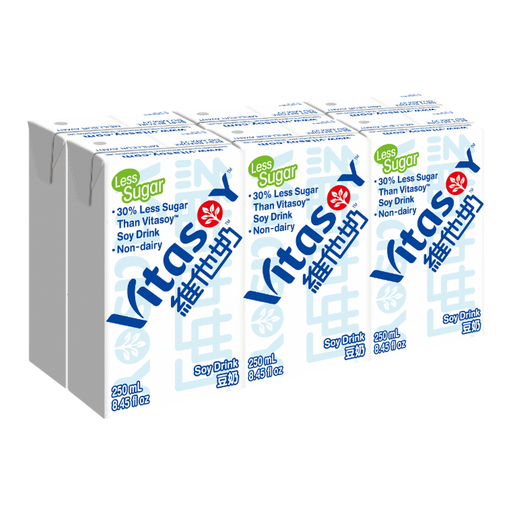 Image unavailable
Vitasoy Soya Bean Milk with Less Sugar, 6 × 250 ml
This multipack may suit shoppers looking for individual cartons of soya drink. It contains 6 cartons of 250 ml. The ‘Less Sugar’ label is no substitute for checking the ‘of which sugars’ figure per 100 ml or whether the drink is fortified.
View on Joybuy
Frequently asked questions
Can a mild soya drink replace infant formula?
No. An ordinary plant-based drink is not a substitute for infant formula. Anses says these drinks are not formulated to meet infants’ needs. Assurance Maladie recommends continuing with infant formula until the age of 1, then provides guidance on growing-up milk up to the age of 3.
For a child over 3, should you choose ‘mild’ or ‘no added sugar’?
Choose according to what matters most: a ‘mild’ recipe if you’re looking for that flavour, or a no-added-sugar option if you want to prioritise sugar content. Either way, check the ‘of which sugars’ figure per 100 ml and check fortification separately.
How can you compare nutritional information online?
Compare the figures per 100 ml for the exact product, particularly sugars and protein. If calcium and vitamin D are important to your choice, look for those figures too. The DGCCRF states that the nutrition declaration for prepacked foods includes, among other things, sugars, protein and fat.
What should I check if the presence of soya matters to my purchase?
Check the ingredients list and allergen information for your chosen product, then check the packaging when it arrives. The name of a range doesn’t tell you what other ingredients it contains or which statements apply to each variety.


