Anyone making a savoury breakfast
Whether you’re making savoury porridge, a sauce or a hot drink, you’ll want a base without a hint of vanilla. The ingredients list and sugar content per 100 ml can help you compare different recipes.


For a savoury breakfast, start by comparing unsweetened soya drinks with no added sugar or flavourings in the ingredients list. They’re a more straightforward choice if you’re looking for a neutral taste than a vanilla version. A drink fortified with calcium and vitamins meets a different need, but you should also check its ingredients before using it in savoury dishes. If it’s for a child, a mild taste alone doesn’t tell you whether it’s suitable for regular consumption.
Whether you’re making savoury porridge, a sauce or a hot drink, you’ll want a base without a hint of vanilla. The ingredients list and sugar content per 100 ml can help you compare different recipes.
You might be considering a milder flavour for your child. It’s important to distinguish whether they like the taste from whether the drink is suitable for them: their age, any possible soya allergy and the other soya foods they eat all matter.
If you usually drink something else, compare the protein content per 100 ml and check whether calcium and vitamins are listed. If you’re using the drink in savoury cooking, check the sugars and flavourings separately.
For savoury dishes, check the ingredients first, then the nutritional information per 100 ml. Taste and suitability for a child are separate questions, so check each one carefully.
| Criterion | What to check | Who it matters to |
|---|---|---|
| Neutral taste | Compare the ingredients lists and sugar content per 100 ml; a ‘plain’ label doesn’t mean you can skip checking for flavourings. | When I’m making a savoury dish, I don’t want a hint of vanilla to change the flavour; around 36% of consumers would put a neutral taste at the top of their list of priorities. |
| Mild taste for a child | Check the ingredients in the flavoured version, then take into account your child’s age, any possible allergy and their other sources of soya. | For a child, I’m looking for a taste they’ll enjoy, without assuming that means the drink is suitable for regular consumption; around 29% of consumers would make this a priority. |
| Protein and added nutrients | Compare the protein content for the same volume and check whether calcium and vitamins are actually listed for the product you’ve chosen. | If I’m switching from my usual drink, I want to know exactly what the new one contains; around 21% of consumers would prioritise this nutritional profile. |
| Availability and storage | Check that the product is available at your shop and follow its storage instructions once opened. | I’m looking for a product I can buy again and use according to the instructions on the carton; around 14% of consumers would prioritise these practical considerations. |
Bio Village’s vanilla version, as described by E.Leclerc, contains grape concentrate, cane sugar and vanilla flavouring, among other ingredients. E.Leclerc lists 4,6 g of sugars per 100 ml, compared with 0,7 g for its plain version with no added sugar.
For savoury dishes, compare both ingredients lists rather than relying on how sweet the drink tastes.
The Alpro soya drink described by Carrefour contains calcium and vitamins, but also sugar and flavouring. Fortification and a neutral taste are two different things.
If you’re looking for added calcium or vitamins, check the sugars and flavourings too before using the drink in a savoury dish.
Anses advises caution about exposure to isoflavones from soya foods, particularly for prepubertal children. A flavour your child enjoys isn’t enough, on its own, to determine whether the drink is suitable for regular consumption.
Take into account your child’s age, any possible allergy and the other soya foods they eat. If you’re thinking of making it their regular drink, ask a healthcare professional for advice.
The Sans Sucres product described by Carrefour is presented as suitable for both sweet and savoury dishes.
E.Leclerc describes an organic plain soya drink and a vanilla version with different ingredients.
Auchan describes its organic plain soya drink as containing organic soya juice from France.
The organic unsweetened soya drink described by Auchan lists water and organic soya beans as its base ingredients.
Carrefour describes an Alpro soya drink with added calcium and vitamins B2, B12 and D2.
This selection features a 1 L soya drink to consider for savoury recipes. If you’re mainly looking for a base without a sweet taste, compare its ingredients list with that of a plain product.
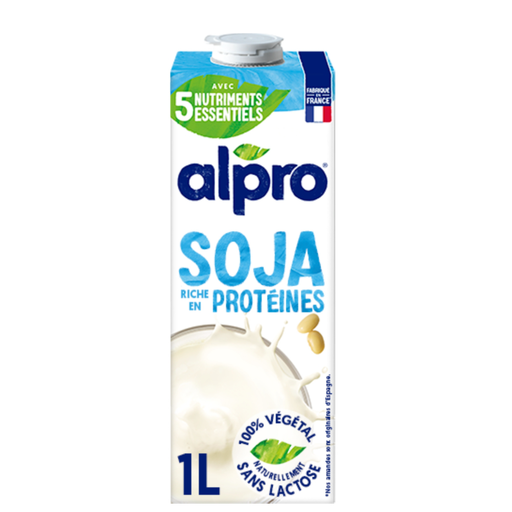 Image unavailable
For a savoury breakfast, check that the flavour and ingredients of this product suit your recipe. It comes in a 1 L carton; if it’s for a child, don’t assume that liking the taste means it’s suitable for regular consumption.
Start with a plain version whose ingredients list doesn’t mention vanilla flavouring or added sugar. Carrefour lists soya juice in Sojasun Sans Sucres; E.Leclerc and Auchan also describe plain Bio Village and Auchan Bio products that you can compare by checking their labels.
No. A milder flavour doesn’t determine whether the drink is suitable for regular consumption. The Bio Village vanilla version described by E.Leclerc contains grape concentrate, cane sugar and vanilla flavouring; for the child in question, also take into account their age, any possible allergy and the other soya foods they eat.
No. A standard soya drink shouldn’t be used as a substitute for breast milk or infant formula for a baby. Anses’ guidance on feeding from birth to one year specifically addresses the risks of using drinks other than these suitable products.
Follow the instructions on the carton you’ve bought and observe the storage period specified for that product. Instructions can vary between soya drinks.