If you’re looking for a low-fat soya drink for a large family, start by comparing the nutritional values per 100 ml for each recipe. Regulation (EC) No 1924/2006, published on EUR-Lex, sets the maximum for this claim on a drink at 1.5 g per 100 ml. A claim about sugars or added calcium won’t answer this question. When buying in larger quantities, also check the pack size, ingredients and how long the drink can be kept after opening.
Who is this choice for?
Families buying several litres a week
When you go through carton after carton, pack size and how much your family actually drinks both affect how you plan your shopping. Compare specific recipes, then work out how many cartons you’ll have open at once.
People comparing fat and sugar content
Sugar content and fat content answer two different questions. Check the values per 100 ml for both on the same label before choosing a recipe.
Households keeping an eye on ingredients and added nutrients
Depending on whether you’ll drink it or use it in cooking, you may want to compare the ingredients list, protein content and whether calcium or vitamins have been added.
What should you look for first?
If fat content is your main priority, start with the exact recipe’s fat content. You can then compare pack size, sugar content and added nutrients to find the right drink for your household.
| What to consider |
What to check |
Who is it for? |
| Buying in larger quantities |
The volume of each carton or small carton, and the storage instructions after opening. |
When I’m shopping for the whole family, I want to plan when to open each carton based on how much we’ll drink. Around 36% of consumers put managing quantities this way at the top of their list. |
| Fat and sugar content |
Both values per 100 ml. For a drink to carry the ‘low fat’ claim, the regulatory limit is 1.5 g of fat per 100 ml. |
I first want to distinguish fat content from sugar content, rather than relying on a single claim on the pack. Around 36% of consumers check this first. |
| Recipe and intended use |
The ingredients, protein per 100 ml and whether calcium or vitamins have been added. |
Whether I’m drinking it or using it in cooking, I choose a recipe that suits the way I’ll use it. The recipe and added nutrients are the top consideration for around 28% of consumers. |
Common mistakes to avoid
-
Confusing a sugar claim with low fat content
These claims relate to different nutrients. The Bio Village drink featured by E.Leclerc contains 1.8 g of fat per 100 ml, above the 1.5 g per 100 ml limit set by Regulation (EC) No 1924/2006 for a drink to carry the ‘low fat’ claim.
Check the ‘fat’ and ‘sugars’ values per 100 ml separately on the recipe you’re planning to buy.
-
Assuming an organic label or added nutrients mean it is low in fat
An organic label and added calcium tell you about other characteristics. The Carrefour Bio product listing gives 2.1 g of fat per 100 g, while the Alpro product featured by Auchan contains 2.8 g per 100 ml: these values use different units.
Check the unit and nutritional information for each product before comparing recipes. Don’t assume you know the fat content from these claims alone.
-
Opening several cartons without checking storage instructions
The recommended time to consume a drink after opening can affect how many cartons it makes sense to open at once. The instructions listed for Auchan and Sojasun drinks say to refrigerate them and consume them within five days of opening.
Check the instructions on each pack and open only as many cartons as your household needs.
-
Using an ordinary plant-based drink as infant formula
Anses distinguishes ordinary plant-based drinks from formula specially made for infants. A soya drink for general consumption must not be used as a substitute for breast milk or infant formula.
For an infant, choose food that is appropriate for their age, and ask a healthcare professional for advice if needed.
Soya drink brands to consider
Bio Village (Marque Repère / E.Leclerc)
The organic plain soya drink featured by E.Leclerc comes in a 1 L carton.
- The E.Leclerc product listing gives 0.7 g of sugars and 3.7 g of protein per 100 ml.
- Its fat content of 1.8 g per 100 ml is above the regulatory limit of 1.5 g per 100 ml for the ‘low fat’ claim on drinks.
Carrefour Bio
The Carrefour Bio product featured is an organic plain soya drink.
- Its ingredients list includes organic soya juice.
- The Carrefour product listing gives 2.1 g of fat per 100 g. Check the unit before comparing it with a value given per 100 ml.
Sojasun
The plain soya drink featured by Auchan is suitable for drinking and cooking.
- The ingredients list for this product states ‘100% soya juice’.
- To check its fat content, look at the nutritional information for the exact product and note the unit shown.
Alpro
The Alpro product featured by Auchan has added calcium and vitamins.
- Its product listing gives 5 g of protein and 120 mg of calcium per 100 ml, as well as vitamins D, B2 and B12.
- It also contains 2.8 g of fat and 2.5 g of sugars per 100 ml. Added nutrients alone don’t tell you either of these values.
Auchan
The Auchan product featured is a plant-based soya drink in a 1 L carton.
- The Auchan product listing gives 3.2 g of protein per 100 ml.
- It contains 1.9 g of fat and 2.5 g of sugars per 100 ml. The storage instructions say to consume it within five days of opening.
Soya drinks available on Joybuy
This pack of individual cartons could be a convenient way to portion out soya drinks for different family members or occasions. Check its nutritional information and the instructions on the pack before adding it to your regular shop.
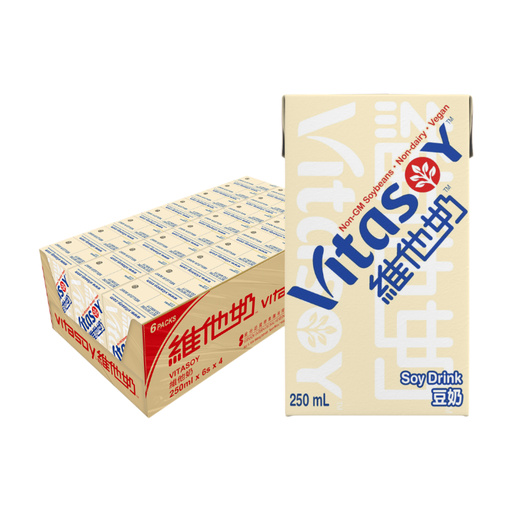 Image unavailable
VITASOY REGULAR, 24 × 250 ml
The 24 cartons of 250 ml make it easy to plan individual portions for the household. If fat content is your top priority, compare the value per 100 ml shown on the pack with those of other drinks you’re considering.
The instructions for this product say to refrigerate it and consume it within 24 hours of opening. It contains soya, which is important to bear in mind if anyone in your household has an allergy.
View on Joybuy
Frequently asked questions
When can a soya drink carry the ‘low fat’ claim?
For a drink, the fat content must not exceed 1.5 g per 100 ml under Regulation (EC) No 1924/2006, published on EUR-Lex. Check the value per 100 ml for the exact recipe: a claim about sugars doesn’t tell you its fat content.
Do all the plain soya drinks featured here meet this limit?
No. The E.Leclerc listing for Bio Village gives 1.8 g of fat per 100 ml, while the Auchan listing for the Alpro product featured gives 2.8 g per 100 ml. Both values exceed the 1.5 g per 100 ml limit for a drink to carry the ‘low fat’ claim. Always check the exact product.
How should you manage opened cartons in a large family?
Follow the storage conditions and time limit shown on each pack. The instructions listed for the Auchan and Sojasun products say to refrigerate them and consume them within five days of opening, so it’s best to open only the cartons you need.
Can an ordinary soya drink be given to an infant instead of infant formula?
No. Anses distinguishes ordinary plant-based drinks from formula specifically made for infants. A soya drink for general consumption must not replace breast milk or suitable infant formula.
Where can you check for soya if someone in your household has an allergy?
Check the ingredients list on each pack. EU consumer information rules require allergens, including soya, to be clearly highlighted in the ingredients list on prepacked foods.


