Households that cook with soya drink
For a sauce, mash or pancake batter, look for an unsweetened product labelled as suitable for cooking. The ingredients list matters just as much as the carton size.


For a family dinner, choose an unsweetened soya drink labelled as suitable for cooking. If you want to keep an unopened carton in the cupboard, check that it is UHT. Compare the ingredients and nutritional information per 100 ml: fortification and sugar content vary between products, as do the instructions for use after opening. Soya drink is not a substitute for infant formula. Public Health France also recommends taking particular care during pregnancy and breastfeeding, and for children under 3.
For a sauce, mash or pancake batter, look for an unsweetened product labelled as suitable for cooking. The ingredients list matters just as much as the carton size.
If calcium, vitamins, protein or sugar content influence your choice, compare products on an equal basis. A fortified drink should not automatically be considered equivalent to dairy milk.
Using an ingredient in dinner does not mean it is suitable for every member of the household. As a precaution, Public Health France recommends avoiding soya during pregnancy and breastfeeding, and for children under 3.
Start with the recipe you have in mind, then compare the ingredients and storage instructions on the carton you plan to buy. If the term “filtered” appears in your search, check the product details rather than assuming it is UHT.
| What to consider | What to check | Who is it for? |
|---|---|---|
| Cooking suitability | Check the ingredients and whether the product is recommended for savoury or sweet recipes. For a savoury dish, look in particular for sugar or flavourings. | For a sauce or pancakes, I want an unsweetened drink that won’t change the intended flavour of the recipe; around 42% of consumers prioritise this cooking use. |
| Nutritional composition | Compare the sugar and protein content per 100 ml, then check whether calcium and vitamins are listed on each label. | If I’m also serving the drink at the table, I want to compare its nutritional content before choosing a fortified product; around 33% of consumers prioritise this nutritional consideration. |
| Storage | Check the best-before date and the instructions for storage before and after opening. The Sojasun Nature and Auchan product pages consulted recommend refrigeration and consumption within five days of opening. | I want to keep a carton for an unexpected dinner without leaving a large opened carton for too long afterwards; around 25% of consumers prioritise managing storage this way. |
Plant-based drinks do not have the same composition as food intended for babies. Public Health France says they are not suitable for infants.
Do not replace infant formula with soya drink, even if you are serving it to the adults at the same meal.
UHT products can be stored as directed on the packaging before opening, but this does not extend their shelf life once opened.
Choose a quantity that suits the recipes you have planned and follow the instructions on the carton you buy. The Sojasun Nature and Auchan product pages consulted recommend refrigeration and consumption within five days of opening.
An opened carton that your household cannot finish within the stated time may go to waste.
Recipes vary: the Auchan product page for Sojasun Nature lists “100% SOYA Juice”, while the Carrefour Bon Appétit! and Auchan products described include sugar.
If you want to control the flavour of a dish, read the ingredients list and compare the sugar content per 100 ml before choosing.
As a precaution, Public Health France recommends avoiding soya during pregnancy and breastfeeding, and for children under 3. This precaution applies to the people who will actually be eating the meal.
Plan an alternative for anyone concerned, and speak to a healthcare professional if you have questions about their diet.
A 1 L carton of UHT soya juice gives you a supermarket own-brand option to compare with other drinks for your household.
The brand offers a 1 L soya drink that Carrefour’s product page says can be used in sweet and savoury recipes.
Auchan describes Sojasun Nature 1 L as a UHT soya drink suitable for sweet and savoury dishes.
Auchan’s 1 L plant-based soya drink is another UHT option to compare by its ingredients and nutritional values.
These two Alpro products are options for cooking with soya drink. If you mainly want to keep an unopened carton in reserve, check that your chosen product is labelled UHT. Also check the instructions for use after opening and the pack size.
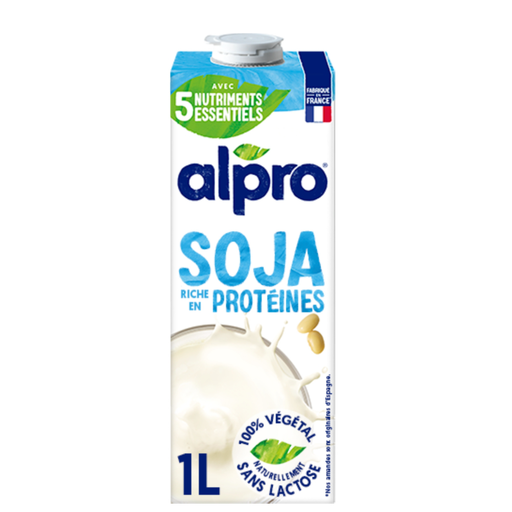 Image unavailable
Worth considering for sweet or savoury recipes if you’re looking for a fortified soya drink. The carton is shown in a 1 L size; check whether it is labelled UHT if storage before opening is important to you.
After opening, the instructions for this product say to refrigerate it at between +1 °C and +7 °C and consume it within five days.
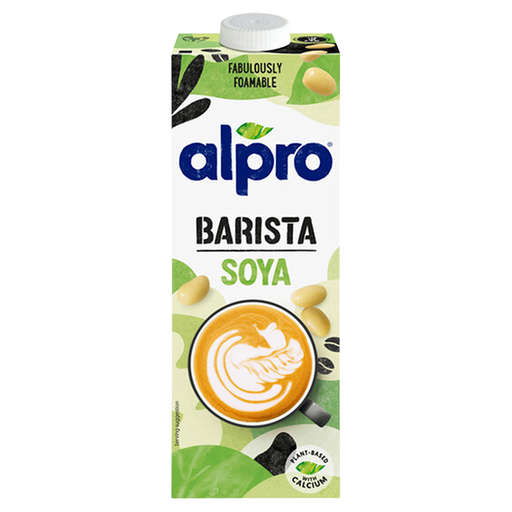 Image unavailable
Consider this if you’d like to use a drink from the Barista range in sweet or savoury recipes. The listed size is 1 L per carton, but check how many cartons are included in the pack before ordering.
Also check the packaging for the UHT label and the storage instructions after opening.
No. Ordinary soya drink is not suitable food for infants. Public Health France distinguishes plant-based drinks from milk formulated for babies. Do not make this substitution just to serve the same meal to the whole family.
Consider who will be eating the meal: as a precaution, Public Health France recommends avoiding soya during pregnancy and breastfeeding, and for children under 3. This recommendation does not mean that everyone else in the household needs to make the same dietary choice.
Follow the instructions on the carton you buy, as the UHT label alone does not tell you how long it will keep after opening. The product pages consulted for Sojasun Nature and Auchan recommend refrigeration and consumption within five days.
Read the ingredients list, check which allergens are highlighted and look at the nutritional information for the specific product. To compare two drinks, use the values per 100 ml rather than servings of different sizes. This is also the approach recommended by the Directorate-General for Competition, Consumer Affairs and Fraud Control for presenting nutritional values.