Organisers of regular savoury buffets
If you regularly host savoury breakfasts, a 5 L BIB can help reduce the need to restock. First, make sure you can follow the storage instructions for your chosen product once it’s opened.


For a group savoury breakfast, choose the volume according to how often you hold events and how you can store the sauce once opened. A 1 L bottle or a multipack lets you open bottles as needed, while a 5 L BIB is best suited to regular use. Check the variety you’re serving too: the Kikkoman and Tables du Monde classic sauces covered here contain wheat, whereas Autour du Riz’s 5 L shoyu and tamari products are described as gluten-free.
If you regularly host savoury breakfasts, a 5 L BIB can help reduce the need to restock. First, make sure you can follow the storage instructions for your chosen product once it’s opened.
A 1 L bottle means you don’t have to open a large container straight away. A pack of 6 × 1 L bottles lets you keep some sealed in reserve if you’re planning several sittings.
Check the variety and the product label: the Kikkoman classic sauce covered by Carrefour contains wheat, while some Autour du Riz shoyu and tamari products are described as gluten-free.
Work out how much you’ll be able to use, then check the storage instructions after opening and the ingredients of each product you plan to serve at the buffet.
| Criteria | What to check | Who it matters to |
|---|---|---|
| Keeping service running | The amount needed for your planned sittings; whether to open 1 L bottles as you go or use a 5 L BIB. | I want to serve several buffets without opening all my stock at the first one. Around 42% of consumers would put this ability to keep serving at the top of their list. |
| Storage | Instructions for storing your chosen product after opening, and the space you have available. | If some sauce is left over after the event, I need to be able to store it as instructed. This would be a priority for around 33% of consumers. |
| Ingredients and variety | Ingredients and allergens on the pack you buy; the difference between classic soy sauce, sweet soy sauce, shoyu and tamari. | I need to cater for guests who avoid gluten without assuming all soy sauces have the same ingredients. Around 25% of consumers would make this compatibility their priority. |
Storage instructions after opening vary by product. Aventure Bio says the 5 L Autour du Riz tamari keeps for three months in its original packaging after opening. This timeframe doesn’t automatically apply to other shoyu or tamari products.
Before choosing this size, check the product instructions and estimate how much you’re realistically likely to use at your events.
The Kikkoman and Tables du Monde classic sauces covered here contain wheat. Gluten-free labelling applies to specific varieties, not the whole category.
If your buffet needs to cater for gluten-free guests, choose a product explicitly labelled gluten-free and check the allergens on the item delivered.
These names refer to different products. ALDI France, for example, sells a 250 ml sweet soy sauce. So, simply looking for “soy sauce” isn’t enough to identify the variety you want for your buffet.
Check the product name and ingredients of the option you’re considering before planning your buffet.
A 20 L container calls for careful planning: consider how much you’ll actually use and where you’ll store it between events.
Choose this size only if your event schedule and storage conditions are a good fit for the product.
The range includes classic sauces, reduced-salt varieties and tamari described as gluten-free. Products covered here include a 1 L bottle, a pack of 6 × 1 L bottles and a 20 L format.
The brand offers organic, fair-trade shoyu and tamari in 5 L BIBs for higher-volume needs.
The range includes a 125 ml bottle of soy sauce listed by E.Leclerc. It’s a small format rather than a high-volume option.
These products are listed in an editorial order based on their intended uses: regular buffets, a flexible stock of bottles, then very high-volume use. This isn’t a quality ranking or a comparative test.
| Rank | Product | Features | When to consider it | Platform |
|---|---|---|---|---|
| 1 | Autour du Riz Organic Fair-Trade Shoyu 5 L | 5 L BIB; described as gluten-free. | For regular events if you can use and store this volume in line with the product instructions. The format and feature are listed by Autour du Riz. | Autour du Riz |
| 2 | Kikkoman Soy Sauce 6 × 1 L | Six 1 L bottles; contains soya and wheat. | For opening bottles as you need them, rather than using one large container. The Joybuy listing says to refrigerate the bottles after opening. | Joybuy |
| 3 | Kikkoman Shoyu Soy Sauce 20 L | 20 L format. | Consider this only if your expected use and storage arrangements allow you to manage such a large volume; the 20 L product is listed on Joybuy. | Joybuy |
For several savoury breakfast sittings, this multipack of 1 L bottles lets you open only as many as you need, when you need them.
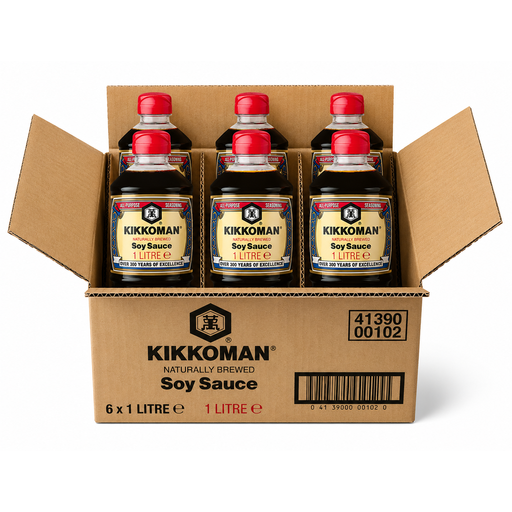 Image unavailable
For a buffet running over several sittings, you can open the bottles as you go.
Pack of six 1 L bottles, making 6 L in total. Contains soya and wheat; refrigerate opened bottles and check their storage instructions.
Not necessarily. The 1 L Kikkoman and Tables du Monde classic sauces covered by Carrefour and E.Leclerc respectively contain wheat. If your buffet needs a gluten-free sauce, check the labelling and allergens for the exact variety and pack you’ll be serving.
Check the allergens on the label of each product, particularly soya and wheat if they’re listed in the ingredients. The Directorate-General for Competition, Consumer Affairs and Fraud Control states that allergenic ingredients must be highlighted on pre-packed foods.
Follow the instructions for the product you’ve bought rather than assuming the same timeframe applies to every soy sauce. Aventure Bio says the 5 L Autour du Riz tamari keeps for three months in its original packaging after opening; the Joybuy listing for the Kikkoman 6 × 1 L pack says to refrigerate the bottles after opening.
The best-before date can help you plan unopened stock, but it doesn’t replace the storage instructions for after opening. The Directorate-General for Competition, Consumer Affairs and Fraud Control distinguishes the best-before date from the conditions that apply once a pack is opened. Check those conditions before choosing a size.