For Easter lunch, choose a croissant explicitly described as ‘sourdough’ if fermentation is your priority, then check the ingredients: sourdough does not necessarily mean there’s no baker’s yeast. If serving time is the priority, ready-to-bake croissants let you plan to bake them at home; already-baked croissants save you that step, provided you arrange collection. In all cases, check the allergens and availability for your chosen date.
Who are these options for?
Hosts who care about fermentation
You’re looking for a croissant that’s clearly labelled as containing sourdough. Check the ingredients and ask the baker whether the recipe also uses baker’s yeast: for example, the Maison Kayser Academy recipe uses both.
Anyone planning a meal at a set time
If you need to serve several guests at the same time, collecting baked croissants and baking them at home require different kinds of planning. For a frozen, ready-to-bake option, allow the time specified in its own instructions.
Shoppers who need to check allergens
If a guest needs to avoid an ingredient, check the exact product before serving it. The product information for EPI D’OR and Bridor croissants highlights ingredients or allergens to look out for, including wheat and milk and, for Bridor, eggs.
What should you check?
First decide whether sourdough, serving time or a dietary requirement will determine your choice. ‘All-butter’ and ready-to-bake croissants do not, on their own, meet a requirement for sourdough fermentation.
| Criteria |
What to check |
Who is this for? |
| Sourdough fermentation |
Whether sourdough is mentioned and whether baker’s yeast is also listed in the ingredients. |
I want to know what ‘sourdough’ means for the croissants I serve my guests. Around 40% of consumers prioritise this check. |
| Serving time |
Whether the product is already baked or ready to bake, and the baking instructions for the chosen product. |
To serve croissants at lunchtime, I need to be able to coordinate collection or baking. This comes first for around 30% of consumers. |
| Allergens |
Allergens in the exact product and the information provided in store. |
If a guest needs to avoid an allergen, I check the product before ordering or serving it. Around 20% of consumers put this precaution first. |
| Availability |
Whether the product is available on the date you need it, and the collection or delivery arrangements. |
I need to be able to get the croissants for the meal I’m planning, without assuming that a product I’ve seen will be available at my local store. For around 10% of consumers, this is the main priority. |
Common misunderstandings to avoid
-
Assuming ‘sourdough’ means ‘no yeast’
The recipe published by Maison Kayser Academy contains both liquid sourdough starter and baker’s yeast. So the label ‘sourdough’ alone doesn’t tell you whether the croissant is made using sourdough fermentation only.
Read the ingredients or ask the baker whether the recipe also contains baker’s yeast.
-
Confusing ‘all-butter’ with sourdough fermentation
‘All-butter’ describes the fat used. E.Leclerc lists its EPI D’OR croissants as frozen, all-butter croissants that are ready to bake; their ingredients include yeast, but they are not described as sourdough croissants.
Check the stated fat content and fermentation information separately.
-
Leaving allergen checks until serving time
‘Organic’ or ‘sourdough’ doesn’t mean allergen-free. According to the DGCCRF, allergenic ingredients in prepacked foods must be highlighted in the ingredients list.
Check the information for your chosen product before buying. For unpackaged products, ask the seller.
-
Treating all ready-to-bake croissants alike
Storage and preparation depend on the individual product. If lunch is at a set time, there’s little room for manoeuvre if baking takes longer than expected.
Check the instructions for the exact product before deciding when to bake and how many batches you’ll need.
Brands and retailers to know
These examples help you distinguish between an option explicitly described as sourdough, a documented recipe and ready-to-bake formats. Their inclusion here doesn’t guarantee they’ll be available for your lunch.
Sain Boulangerie
Fou de Pâtisserie features an ‘Organic sourdough croissant’ attributed to Anthony Courteille for Sain Boulangerie.
- The product page explicitly describes it as ‘organic sourdough’.
- Check the ingredients and whether collection is possible on your chosen date and at your preferred location.
Maison Kayser
The recipe published by Maison Kayser Academy shows how liquid sourdough starter and baker’s yeast can be used together.
- The recipe lists these ingredients and explains the preparation steps.
- A published recipe doesn’t necessarily describe the croissant sold at a particular shop.
Bridor
Bridor’s product sheet for its 80 g croissant provides details about a ready-to-bake product and its allergens.
- The product sheet gives baking instructions for this particular product, helping you plan ahead.
- This product isn’t described as a sourdough croissant; its product sheet lists gluten, milk and eggs.
Carrefour
Carrefour’s croissant range can help you find something to buy alongside the rest of your meal.
- The range includes several croissant options and store-specific purchasing arrangements.
- A category name or the label ‘all-butter’ doesn’t confirm that a particular product contains sourdough.
E.Leclerc / EPI D’OR
E.Leclerc lists EPI D’OR croissants in packs of six, frozen and ready to bake.
- The product information specifies the pack size and includes an ingredients list.
- The ingredients include yeast, but the product isn’t described as a sourdough croissant; check availability at your chosen store.
A filled croissant to consider on Joybuy
This selection features a hazelnut and cocoa-filled croissant, which may suit your lunch if that’s the filling you’re after. If sourdough fermentation is your main consideration, check the product’s ingredients rather than relying on its name alone.
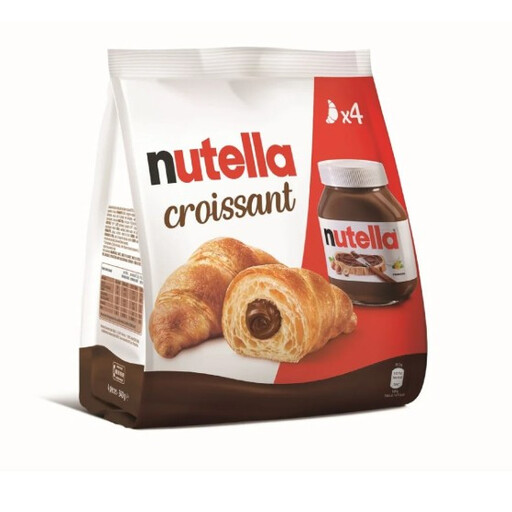 Image unavailable
NUTELLA hazelnut and cocoa-filled croissants, x4, 340 g
Worth considering if you’d like to serve filled croissants rather than plain ones. The pack contains four croissants weighing 340 g in total. If sourdough is essential to your choice, check how it features in the ingredients and whether baker’s yeast is also included. Check the allergens and preparation instructions before lunch, too.
View on Joybuy
Frequently asked questions
Does a ‘sourdough’ croissant always contain no baker’s yeast?
No. The croissant recipe published by Maison Kayser Academy uses both liquid sourdough starter and baker’s yeast. If you’re looking for a recipe without baker’s yeast, check the ingredients or ask the baker directly.
Which allergens should I check in a sourdough croissant?
Check the allergens in the exact product you plan to serve: sourdough doesn’t mean allergen-free. The EPI D’OR and Bridor product sheets highlight ingredients or allergens related to wheat and milk, while the Bridor sheet also mentions eggs. Check the label or ask for information in store.
Can an all-butter, ready-to-bake croissant replace a sourdough one?
It meets a different need if your priority is planning when to bake for lunch. The EPI D’OR product sheet describes a frozen, all-butter croissant that’s ready to bake. Its ingredients include yeast, but it isn’t labelled ‘sourdough’. Check the fermentation separately if it matters to you.
Can you buy croissants several days before Easter?
That depends on the product and its storage instructions. Frozen, ready-to-bake croissants and fresh, already-baked croissants need different kinds of planning. Follow the instructions for your chosen product or ask the baker for advice, then confirm collection for the date of your meal.


