For holiday breakfasts, first choose a format that suits your accommodation: a ready-to-eat croissant means you won’t need an oven, while a frozen croissant ready to bake requires a freezer and careful adherence to storage instructions. If sourdough is your priority, check that it appears in the ingredients and look for the proportion if one is given. A sourdough recipe can also contain yeast, while ‘all-butter’ refers to a different aspect of the recipe.
Who are these formats for?
Those looking for sourdough in the recipe
If sourdough is the reason you’re buying, look for it in the ingredients rather than relying on the product name alone. Brioche Pasquier’s croissant recipe lists both sourdough starter and yeast: the two can be used together.
Holidaymakers without a fully equipped kitchen
If your accommodation doesn’t have an oven or freezer, a croissant that’s already baked saves you the hassle of a frozen, ready-to-bake product. Lidl describes its all-butter croissant as ready to eat; check the details of the product you’re buying.
Groups making breakfast at their accommodation
If you have an oven and freezer, a pack of frozen, ready-to-bake croissants makes it easy to plan enough for everyone. Check the number of croissants, storage instructions and allergens for the product you choose.
What should you check before buying?
For a holiday, start with the facilities available, then compare the recipe and how the croissants are served. An all-butter croissant isn’t necessarily a sourdough croissant.
| What to consider |
What to check |
Who it’s for |
| Sourdough in the recipe |
Whether sourdough starter is listed in the ingredients, its proportion if stated, and whether yeast is also included. |
If sourdough is your main priority, seeing it on the packaging doesn’t tell you whether it’s the only leavening agent used. Around 33% of consumers prioritise checking the recipe. |
| No-equipment preparation |
Whether the product is already baked or frozen and ready to bake, as well as its storage instructions. |
In a rental without a usable oven or freezer, being able to serve croissants without any preparation comes first. This is the priority for around 25% of consumers. |
| Serving hot croissants to a group |
The number of croissants, freezer space, and cooking and storage instructions. |
To serve several hot croissants at breakfast, some people are happy to plan ahead for storage and cooking. Serving them at their accommodation is the main priority for around 25% of consumers. |
| Allergens and ingredients |
Declared allergens, any ‘may contain’ statements, and the ingredients of the exact product. |
If an allergy or an ingredient to avoid affects your purchase, the ingredients matter more than the format or presence of sourdough. Around 17% of consumers put checking this information at the top of their list. |
Common misunderstandings to avoid
-
Assuming ‘sourdough’ means it’s fermented using sourdough alone
Brioche Pasquier’s croissant recipe lists 7% sourdough starter, as well as yeast, rapeseed oil and an emulsifier.
Read the full ingredients list if the fermentation method or type of fat matters to you.
-
Assuming ‘all-butter’ means ‘sourdough’
The ingredients for the Lidl all-butter croissant described by the retailer don’t list sourdough, whereas Auchan’s all-butter version includes dried spelt wheat sourdough starter and yeast.
Check the fat used and whether sourdough is included separately for the product you’re interested in.
-
Choosing a frozen product without checking your accommodation
Carrefour says its Classic’ ready-to-bake croissants should be stored at −18 °C and should not be refrozen once defrosted.
Before buying a pack to bake during your stay, make sure you have access to a freezer and an oven.
-
Overlooking allergens in a familiar recipe
Ingredients and allergen information vary from one product to another. You can’t tell what a croissant contains just by looking at it.
Check the label on the exact product, including any ‘may contain’ statements. If you’re buying an unpackaged bakery product, ask about allergens before you buy.
Brands and products to know
These examples show why it’s worth comparing the recipe and preparation requirements of each product, rather than assuming it contains sourdough because of the brand or an ‘all-butter’ label.
Brioche Pasquier
A product whose ingredients list lets you identify and check the proportion of sourdough.
- Brioche Pasquier’s croissant recipe lists 7% sourdough starter.
- It also contains yeast, rapeseed oil and an emulsifier, so it isn’t fermented using sourdough alone.
Auchan
An all-butter product that the retailer says should be stored at room temperature.
- The recipe we checked lists 21.5% butter and dried spelt wheat sourdough starter.
- It also contains yeast, and the proportion of sourdough isn’t stated for this product.
Carrefour
Carrefour Classic’ offers frozen, ready-to-bake all-butter croissants for stays with the right facilities.
- The product described contains six croissants and lists 24% butter.
- Carrefour says to store them at −18 °C and not to refreeze them after defrosting. The recipe we checked doesn’t list sourdough.
E.Leclerc / Epi d’Or
A pack of frozen, ready-to-bake all-butter croissants sold under the Epi d’Or brand.
- The product featured by E.Leclerc contains six croissants and lists 23% butter.
- The ingredients we checked don’t list sourdough. Check whether the product is available at your local store or for Drive collection.
Bridor
An unbaked croissant ready to prove, worth considering if you can manage the proving and baking.
- For its 71 g croissant, Bridor provides proving and baking instructions.
- The stated direct proving time is 2 h 15 to 2 h 30 at 27–28 °C. The recipe we checked contains yeast and doesn’t list sourdough.
Lidl
An all-butter croissant that’s already baked, ideal if you’re not planning to bake anything during your stay.
- Lidl describes the croissant we checked as ready to eat and lists 27% butter.
- Its ingredients list includes baker’s yeast but doesn’t declare sourdough. Check the allergen information for the croissant you buy.
Aldi
A product of frozen, ready-to-bake all-butter croissants.
- Aldi offers a pack of six croissants with a stated total weight of 360 g.
- Before choosing this product, check the packaging for ingredients, allergens and whether sourdough is included.
A selection of croissants on Joybuy
This selection features filled croissants to consider for a stay where you have access to an oven and freezer. If you’re looking for a plain or ready-to-eat croissant, check that the format and recipe are right for your breakfast.
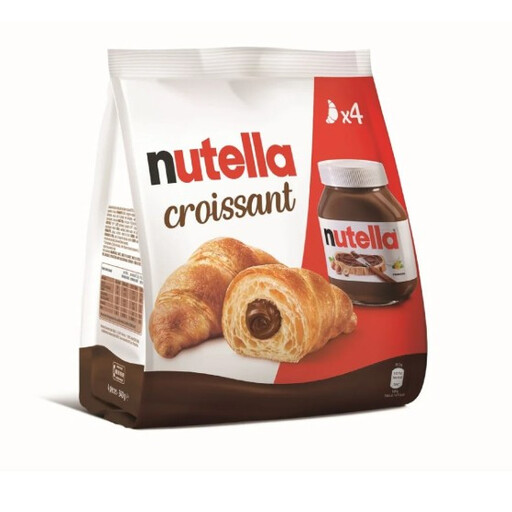 Image unavailable
NUTELLA-filled croissants with hazelnut and cocoa, x4, 340 g
This pack of four filled croissants is a good choice for breakfast if you have an oven and freezer at your accommodation. If you’re looking for sourdough, a plain recipe or an all-butter croissant, check the ingredients for this product. Follow the baking instructions too, and check the packaging for allergen information.
View on Joybuy
Frequently asked questions
How can you tell if a croissant recipe contains sourdough?
Look for sourdough starter in the ingredients list and check its proportion if one is given. Brioche Pasquier’s croissants list 7% sourdough starter, but also contain yeast. The presence of sourdough doesn’t prove that sourdough alone was used for fermentation.
Is an all-butter croissant necessarily made with sourdough?
No. These labels describe different aspects of the recipe. The Lidl all-butter croissant we checked doesn’t list sourdough, whereas Auchan’s includes dried spelt wheat sourdough starter and yeast. Check the ingredients of each product.
Can you take frozen croissants to a holiday rental?
Yes, as long as you can store them correctly during your journey and stay, then bake them according to the product instructions. For the Classic’ croissants we checked, Carrefour says to store them at −18 °C and not to refreeze them after defrosting.
How can you find out which allergens are in a croissant sold at a bakery in France?
Ask for allergen information before buying if it isn’t clearly displayed. Service-Public.fr explains that this information must also be provided for unpackaged processed foods sold at places such as bakeries. Check the details for the exact product you’re being offered.


