When choosing soup as part of a shop planned around diabetes, compare the carbohydrates, sugars and salt in the portion you intend to serve, then check the ingredients and allergens. Ready-to-eat soup saves you having to reconstitute it; with a sachet, you’ll need to take the stated preparation method and exact recipe into account. Neither format, on its own, is enough to determine whether a soup is suitable for your meal.
Who is this guide for?
People who count the carbohydrates in their meals
If you take carbohydrates into account when planning your meals, compare the nutritional values with the amount of soup you’ll actually serve, rather than relying on the recipe name alone. The French Diabetes Federation points out that diet is part of diabetes management.
People keeping an eye on salt
If you’re watching your salt intake when shopping, work out the amount in your bowl rather than relying on the figure per 100 ml. Anses lists soups and broths among the foods that contribute to salt intake.
People looking for a quick meal with no waste
An individual sachet, a small carton and a large pack won’t suit the same mealtime routine. Choose an amount you can use while following the preparation and storage instructions for that particular recipe.
What should you compare?
When shopping for meals with diabetes in mind, start with the portion and nutritional values, then check the recipe and format. Carton soups and dehydrated mixes should be compared based on the product you’ll actually eat.
| Criteria | What to check | Who it matters to |
|---|
| Carbohydrates and portion size |
Carbohydrates and sugars in the portion served; fibre, if listed in the nutritional information. |
If I’m planning the carbohydrates in my meal, I need to know how much soup will go in my bowl. This could be the top priority for around 40% of consumers. |
| Salt per bowl |
Salt per 100 ml and in the amount you’ll actually eat. |
I want to take the soup’s salt content into account without forgetting the salt in the rest of the meal. Around 30% of consumers could make this their priority. |
| Format and storage |
Volume, number of portions and instructions for storage after opening. |
Whether I’m eating soup alone or with others, I want a container whose contents I can use as directed. For around 20% of consumers, the format could be the main consideration. |
| Ingredients and preparation |
Allergens in the recipe; water to add and preparation instructions if the soup is dehydrated. |
I need to avoid an ingredient that doesn’t suit me, or choose a soup that fits the way I cook. This could be the main consideration for around 10% of consumers. |
Mistakes to avoid
-
Assuming all ‘vegetable soups’ have the same recipe
A ready-to-eat carton and a sachet containing vermicelli or starch may have different ingredients and nutritional values.
Check the format, then compare the ingredients and nutritional information for the exact product you’re thinking of buying.
-
Relying on the Nutri-Score alone
Manger Bouger presents the Nutri-Score as a way to compare products within the same category. On its own, it doesn’t tell you about your portion or the ingredients you want to avoid.
When comparing similar soups, also check the carbohydrates, sugars, fibre where listed, salt and portion size.
-
Comparing salt per 100 ml without checking your bowl size
If your bowl holds more than 100 ml, the figure per 100 ml doesn’t represent the amount of salt you’ll consume. Anses lists soups and broths among the contributors to salt intake.
Work out the salt content for the amount you’ll serve and compare like-for-like portions.
-
Choosing a large pack without planning for the remaining portions
Storage instructions after opening vary by product. For its 2 × 30 cl cartons of vegetable soup, Auchan recommends keeping the soup in an airtight container in the fridge and using it within two days of opening.
Choose a volume that suits the portions you have planned, and follow the instructions on the packaging you buy.
Any portions not used within the stated time may need to be thrown away.
Soup brands to know when comparing recipes
Royco
Carrefour lists, among other products, individual sachets of Royco dehydrated chicken soup with vermicelli and carrots.
- The individual sachet lets you prepare one portion at a time.
- The recipe listed by Carrefour contains vermicelli, potato starch and glucose syrup, among other ingredients. Check the ingredients for each product.
Carrefour Classic'
Carrefour lists vegetable soups in cartons, including a 1 L product and another sold as 2 × 30 cl.
- These sizes let you choose according to the number of portions you’re planning.
- Check the ingredients and nutritional values for the recipe and format you choose.
Auchan
Auchan lists ready-to-eat soups, including vegetable soups in 2 × 30 cl cartons.
- The product details for the vegetable soup studied give nutritional information per 100 ml and per portion, as well as storage instructions after opening.
- This recipe contains milk and celery; its ingredients don’t represent all Auchan soups.
Marque Repère / Régal Soupe
E.Leclerc lists several carton soups in this range, including vegetable soups.
- The range includes different sizes, including a 1 L product listed by E.Leclerc.
- Check the ingredients, nutritional values and storage instructions for each carton.
Sachet soups on Joybuy
These two products are examples of the sachet format covered in our selection criteria. To compare them with tinned or carton soup, take account of the prepared portion and the recipe shown on each pack.
 Image unavailable
Royco, dehydrated soup with noodles, carrot and mushroom, 3 × 20 cl
This sachet format may suit you if you’d like to prepare each portion separately.
The product name indicates three 20 cl portions. Before including it in a meal, check the nutritional values per prepared portion and the ingredients list on the packaging.
View on Joybuy
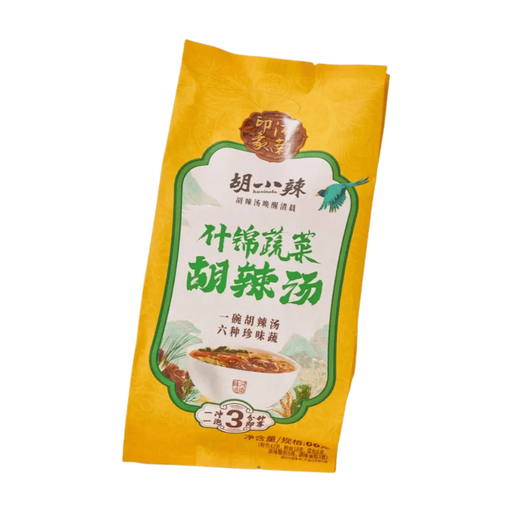 Image unavailable
Haoxiangni, spicy mixed vegetable soup, 66 g
This sachet soup is for anyone who wants to prepare their soup just before eating.
The stated pack size is 66 g. Check the preparation instructions and nutritional values for the amount you’ll serve; don’t compare values per 100 g of dry product directly with those per 100 ml of ready-to-eat soup.
View on Joybuy
Frequently asked questions
Is tinned or carton soup automatically suitable for someone with diabetes?
No. The packaging alone can’t tell you whether a meal is suitable. Compare the carbohydrates and other nutritional values for the portion you’ll serve, then consider the rest of the meal and any guidance specific to you.
Is the Nutri-Score enough to choose between two soups?
No. Manger Bouger presents it as a tool for comparing products in the same category, and displaying it is voluntary. When choosing soup, also check the nutritional values, portion size and ingredients for each recipe.
Where can I check the allergens in a soup?
Check the ingredients list for the exact product. The French Directorate-General for Competition, Consumer Affairs and Fraud Control says that allergenic ingredients must be highlighted on the labels of prepacked foods. Which allergens are present varies from one soup to another.
How long can you keep soup after opening?
Follow the instructions on the packaging. For its vegetable soup in 2 × 30 cl cartons, Auchan recommends keeping it in an airtight container in the fridge and using it within two days of opening. This guidance doesn’t apply to every soup.


