If you have lunch on your own at work
If you want to take one serving without opening a large container, cartons sold in packs of two 30 cl units let you keep the second one sealed.


If you’re having lunch on your own at work and want to avoid leftovers, an individual 30 cl carton is easier to portion than a 1 L carton. The larger size means planning for several servings and following the storage instructions after opening, while dehydrated sachets require access to hot water. The term ‘tinned soup’ doesn’t guarantee that it comes in a metal tin or as a multipack, so check the exact packaging before you buy.
If you want to take one serving without opening a large container, cartons sold in packs of two 30 cl units let you keep the second one sealed.
A 1 L carton can be divided between several meals, provided you can follow the storage instructions for after opening.
Dehydrated sachets can be stored separately and prepared when you need them. Some Royco products come in packs of three or four sachets, and several have a stated serving volume of 20 cl.
Start by working out how many lunches you need to plan for and what facilities are available at work, then compare the details for each recipe.
| What to consider | What to check | Who is this for? |
|---|---|---|
| A serving with no leftovers | The volume of each carton or sachet and the number of units. | If I’m having lunch on my own, I prefer to open only the amount I need for that meal; around 31% of consumers prioritise a serving with no leftovers. |
| Planning your supplies | How many meals the format provides and, for an opened carton, its storage instructions. | If I’m preparing several lunches, I want to be able to portion the contents without leaving an opened carton unused; this is the top priority for around 31% of consumers. |
| Salt, ingredients and allergens | The nutritional information for the serving you’ve chosen, plus the ingredients and allergen information for the specific recipe. | Before switching recipes, I want to check the ingredients rather than rely on the name ‘vegetable soup’ alone; around 23% of consumers put this check at the top of their list. |
| Preparing it at work | Whether sachets need hot water, and the instructions for consuming or reheating the products you choose. | Without the right facilities at work, I might not be able to prepare the lunch I’ve planned; preparation requirements are a priority for around 15% of consumers. |
This term doesn’t tell you whether the soup comes in a tin, carton or sachet, or how many units are in the pack.
Check the type of container, the number of units and the volume of each one before stocking up for work.
Salt levels and allergens can vary from one soup to another, even within the same brand.
Read the nutritional information and ingredients list for the exact product you plan to take with you.
The DGCCRF advises that once a pack has been opened, the date printed on it is no longer enough to guide you on whether it’s safe to eat.
Before choosing a 1 L carton, plan how you’ll use the contents and follow the storage conditions and time limit after opening shown on the pack.
Dehydrated soups in sachets, including products sold in packs of three or four at Carrefour.
A range that includes 1 L soup cartons and packs of 2 × 30 cl.
Soups and smooth soups, available in sizes including 1 L and 500 ml.
Liquid soups, including packs of two individual 30 cl cartons.
These products suit three ways of planning lunch at work: making up a sachet with hot water, taking an individual carton with you, or having several portions of a konjac preparation. The last option isn’t a conventional liquid soup.
 Image unavailable
The three sachets make separate 20 cl servings. Make sure you have access to hot water at work, and check the packaging for the ingredients and allergens in this recipe.
 Image unavailable
The two 30 cl cartons let you keep one serving sealed for another lunch. Check the packaging for instructions on consuming or reheating the soup, as well as allergen information.
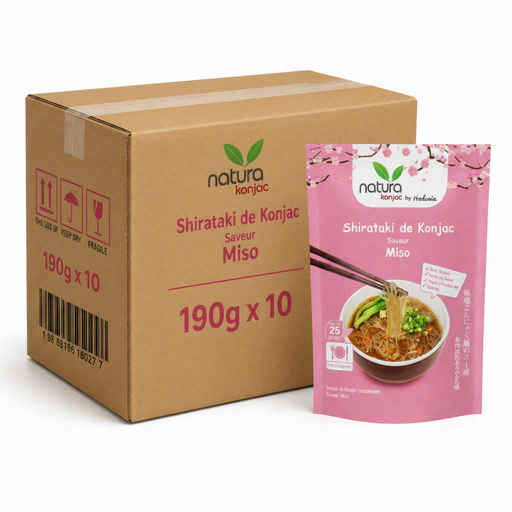 Image unavailable
This pack of ten portions can help you plan several lunches, but the konjac noodles with miso sauce aren’t a like-for-like substitute for liquid soup. The stated reheating method requires a microwave, so check the instructions on the pack before use.
Yes, if you can divide the contents between several meals and follow the instructions for after opening. Otherwise, an individual carton means you don’t have to open 1 L for a single lunch.
No. The DGCCRF states that once the packaging has been opened, the printed date is no longer enough: follow the product’s storage instructions and the time limit for use after opening.
No: the recipe name doesn’t tell you how much salt it contains. Anses lists soups and broths among the foods that contribute to salt intake; compare the ‘salt’ figures in the nutritional information for the servings you’re considering.
Read the ingredients and allergen information for the exact product, including any warnings about possible traces. The Liebig recipes featured at Carrefour have different allergen information depending on the product, so the brand name alone isn’t enough to determine what’s in it.