
Livraison le jour même ou le lendemain

Qualité garantie

Débloquez vos offres de bienvenue: Livraison GRATUITE | Jusqu'à -80 % | 30 jours d'essai gratuits à JoyPlus
Téléchargez l'application
By our product experts, July 22, 2026
Is your outdoor security camera out of battery… again? Tired of balancing on a ladder to take it down, recharge it, and reinstall it? It's a chore we could all do without. Fortunately, there's a simple and sustainable solution: the solar panel for security cameras.
This smart accessory converts sunlight into a continuous power source for your equipment. The result? Uninterrupted surveillance and a lower electricity bill. This guide is here to help you make an informed decision and choose the model that perfectly fits your needs, based on essential criteria like compatibility, power, and ease of installation.
Before you dive in, let's review a few technical criteria to ensure maximum compatibility and efficiency.
Your first step: check for compatibility with your camera model. Manufacturers like Arlo or Reolink often offer solar panels specifically designed for their ecosystem. The crucial factor is your camera's charging port. Most current models use a micro-USB or USB-C connection. A universal micro-USB solar panel will work for many cameras, but it's essential to check the specifications before any purchase. Some models even include adapters for increased flexibility.
A solar panel's power, measured in watts (W), determines its charging speed. A power output of 3 to 6W is generally sufficient to maintain the charge of a standard security camera. Of course, actual efficiency will depend directly on sun exposure. For best results, choose a south-facing installation (in the Northern Hemisphere) without any shade cast by trees, a building, or a roof overhang. To be effective, even in winter, a good outdoor solar camera charger must capture several hours of direct sunlight each day.
An outdoor accessory must be robust. Check the Ingress Protection (IP) rating, such as an IP65 certification, which guarantees it is dust-tight and protected against water jets. Don't underestimate the importance of cable length, either. A 3 or 4-meter cable will give you the flexibility to place the camera in the ideal spot for surveillance (even in the shade), while positioning the solar panel where the sun is strongest.
To guide you, here are three popular options that meet different needs.
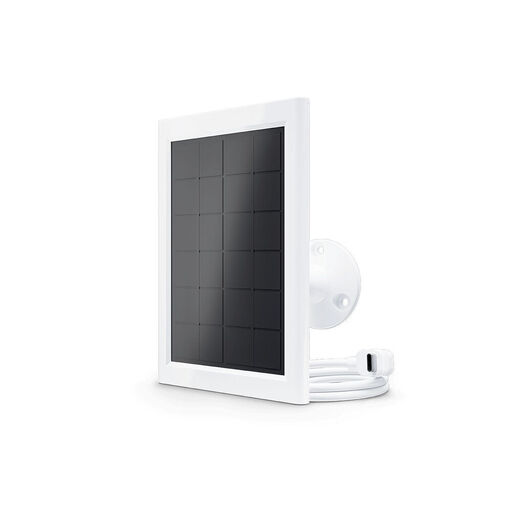
Why it stands out: This panel is designed to integrate perfectly into the Arlo ecosystem. It focuses on simplicity of installation and guaranteed compatibility with the brand's cameras. It's the "peace-of-mind" solution for Arlo equipment owners.
Key features:
Who is it for? The obvious choice for owners of Arlo cameras equipped with a micro-USB charging port. If you're looking for a 100% plug-and-play solar power solution for your Arlo camera, look no further.
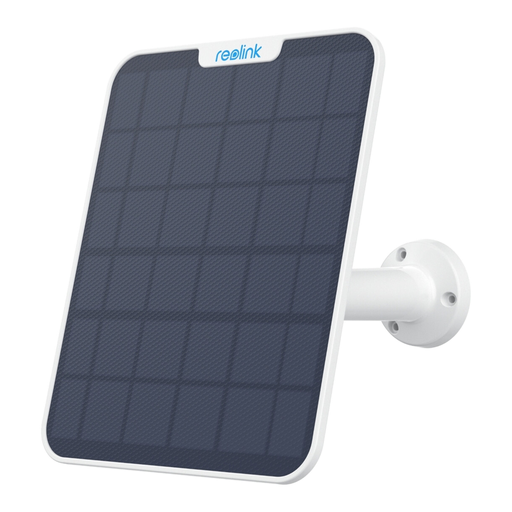
Why it stands out: The Reolink Solar Panel plays in the big leagues with its high power output (5.8W) and impressive versatility. Shipped with a USB-C connector and a micro-USB adapter, it fits a vast number of cameras, even those from other brands.
Key features:
Who is it for? Ideal for users of Reolink cameras (Argus, Go series, etc.), but also for anyone looking for a high-performance, versatile solar panel. Its power and long cable make it a safe bet, especially if your setup is complex or in a less sunny area.
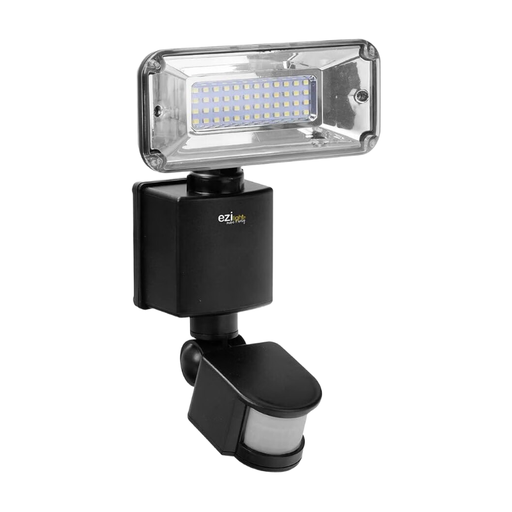
Why it stands out: Note that we're switching gears here. The EZIlight Solar Pro 1 is not a camera accessory, but a complete, self-contained security solution. It is a powerful LED floodlight with a motion detector, powered by its own solar panel.
Key features:
Who is it for? For those who primarily want a deterrent security light for a driveway, garage, or garden, without necessarily installing a camera. A simple, effective, and autonomous prevention solution.
If your camera's power needs are sorted and you now want to elevate your outdoor space, take a look at decorative solar lighting. To create a magical atmosphere and decorate your garden after dark, discover our selection of twinkling solar garden lights.
1. Does a solar panel for a camera work in winter or on cloudy days? Yes, but let's be clear: its efficiency will be reduced. A modern solar panel continues to produce some energy in overcast weather, but far less than in direct sunlight. In winter, its main role will be to maintain the charge level or slow the battery's discharge, rather than fully recharging it to 100%. Proper orientation and regular cleaning of its surface are therefore crucial.
2. What power rating should I choose for a camera solar panel? For the majority of battery-powered cameras, a 3 to 6-watt panel is sufficient to maintain a charge with average sun exposure. If your camera is heavily used (frequent recordings) or if the area is not very sunny, opting for a slightly more powerful model (around 6W) is a wise precaution.
3. Is it difficult to install an outdoor solar camera charger? Not at all. The installation is actually quite simple and requires only a few basic tools (a drill, a screwdriver). Most kits include the mounting bracket, screws, and wall anchors. The only real point of caution is your safety if you need to use a ladder. Just make sure the bracket is securely fastened to withstand wind and weather.