
Livraison le jour même ou le lendemain

Qualité garantie

Débloquez vos offres de bienvenue: Livraison GRATUITE | Jusqu'à -80 % | 30 jours d'essai gratuits à JoyPlus
Téléchargez l'application
Solar outdoor lighting lets you illuminate a garden, patio or entrance without running any electrical cables. But some models disappoint quickly: light that's too dim, a battery that runs flat before the evening is over, or a solar panel installed in a spot that's constantly in the shade. Before you buy a solar lantern or a solar garden light, it's worth looking at a few key criteria.
A soft-glow solar LED lamp fits perfectly on a table, balcony or in the middle of a flower bed. It won't necessarily replace a path light designed to make moving around safe. For a warm, cosy atmosphere, a few lumens can be enough. To spot a step or mark out an entrance, you really need to multiply the light points and space them evenly.
The solar panel needs to receive enough direct light during the day. An outdoor solar bollard placed under a tree, against a north-facing wall or behind a hedge is likely to run for less time in the evening. In autumn and winter, the amount of daylight and the weather conditions also have a direct impact on charging.
This phrase doesn't always correspond to a clearly defined level of protection. For a solar terrace light or a waterproof solar lamp, look for an IP rating if possible. This tells you the level of protection against dust and water. An IP66 product, for example, is protected against dust and powerful water jets, but it isn't necessarily designed to be submerged.
Battery life depends on the battery capacity, charging time and lighting mode. A solar lantern intended to create ambient light won't have the same needs as a light fixture designed to illuminate a path.
Make sure you check:
These values are still closely linked to the installation conditions. A clean, well-exposed panel will encourage more consistent charging.
For outdoor use, look at the product's construction: stainless steel, glass, metal, ABS or plastic designed for the outdoors. An IP66 rating offers documented protection against dust and rain. That doesn't mean you can ignore common-sense precautions: avoid hard knocks, don't submerge a product that isn't designed for it, and install the light on a stable surface.
A solar lamp designed to sit on a table doesn't meet the same need as a bollard to be planted in the ground. Measure the available space and observe the traffic around the light. For a path, stake-mounted models let you keep a regular spacing. On a patio, a lantern with a handle can be easily moved around as you eat meals and relax. On a balcony, choose a compact model that won't block a door opening or get in the way.
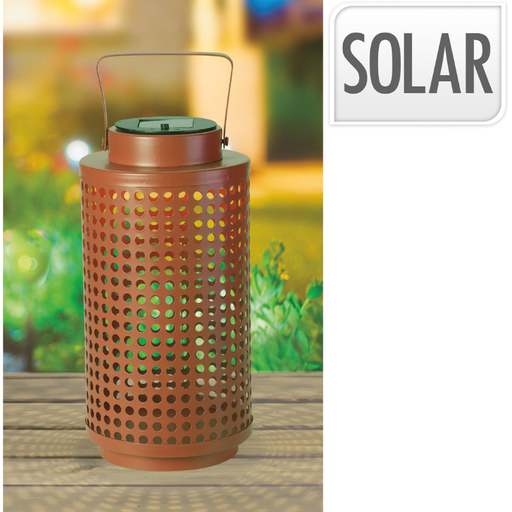
Why this choice suits this profile: Its compact size makes it ideal for a first solar decoration on a patio, terrace or near a flower bed. The automatic on/off feature avoids complicated installation.
The listing mentions a rechargeable AA Ni-MH battery of 250 mAh and up to 6 hours of light after a full charge. That gives you a more realistic idea of its capabilities.
Purple metal finish, 145 × 145 mm base, amorphous solar panel and warm white light produced by an LED.
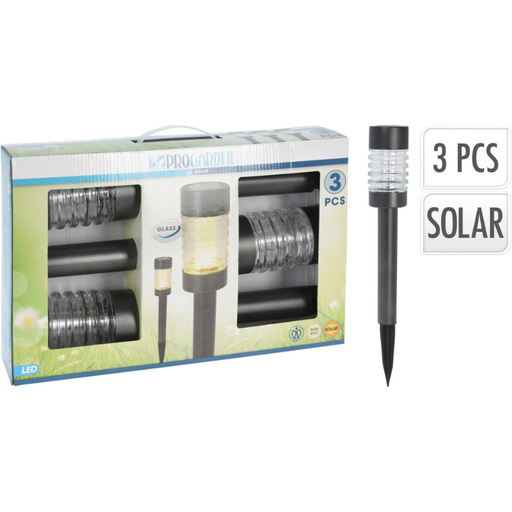
Why this choice suits this profile: This set of three lights lets you mark out a path, entrance or garden border harmoniously, with a more refined aesthetic.
The specifications state an intensity of 5 lumens and a colour temperature between 2,700 and 3,000 K: so you should expect gentle path marking, not floodlight-level illumination.
Stainless steel structure, glass lampshade, total height of 540 mm and integrated AA Ni-MH battery.

Why this choice suits this profile: Its flat design is ideal for walkways, patios and near an entrance when you want a wireless, space-saving installation.
The IP66 rating is clearly stated. The product is resistant to dust and water splashes, but must be placed on a stable surface and should not be submerged.
0.6 W panel, 500 mAh lithium battery, warm light at 3,200 K and dimensions of 121.4 × 121.4 × 24.5 mm.
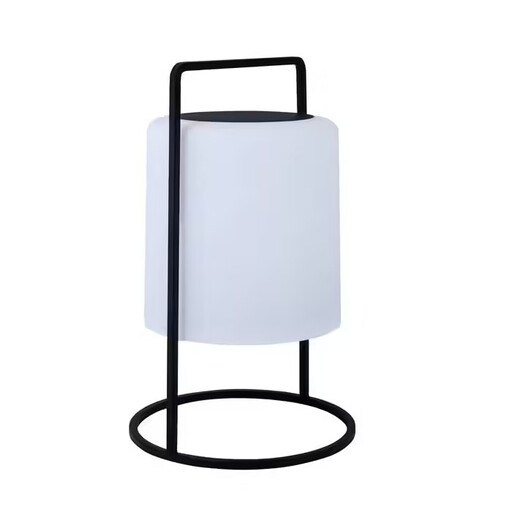
Why this choice suits this profile: Its handle and cordless operation make it easy to move from the table to the balcony and then to the garden.
The integrated panel and automatic dusk-to-dawn lighting reduce the amount of handling needed. However, you should avoid shaded spots and not submerge the lantern.
Opalescent lampshade, warm LED light, metal base and materials combining ABS, polycrystalline silicon and metal.
We've put together a complete selection, updated in real time, of products that meet these demanding criteria and European safety standards.
To enjoy reliable cordless lighting every day:
The running cost remains low because charging relies on daylight. However, performance varies depending on the weather, the season, shade and the condition of the battery.
The time depends on the panel, the battery and the amount of sunlight. To achieve the stated performance, the lamp needs direct exposure during the day. On first use, follow the manufacturer's recommendations and avoid installing it in a shaded area.
It all depends on its materials, its IP rating and the precautions stated by the manufacturer. A lamp designed for outdoor use can withstand rain, but not all models are designed to be submerged or to withstand heavy knocks. In severe weather, putting it under cover temporarily can extend its lifespan.
Daily charging uses solar energy and doesn't require any connection to the mains electricity supply. However, you do need to consider the purchase price, panel maintenance and, eventually, the replacement or recycling of the battery, depending on the model.