
Livraison le jour même ou le lendemain

Qualité garantie

Débloquez vos offres de bienvenue: Livraison GRATUITE | Jusqu'à -80 % | 30 jours d'essai gratuits à JoyPlus
Téléchargez l'application
Solar outdoor lighting has it all: incredibly simple installation, no cables to run through the garden, and a lower electricity bill. Sounds like a dream, right? The problem is, the market is flooded with products making dazzling promises that often struggle to last a single season in our climate. To ensure your bright idea doesn't turn into a disappointment, it's essential to know the pitfalls to avoid.
Before you make a purchase, let's look at the three key weaknesses that too often turn these lights into useless gadgets after just a few months:
To avoid making a mistake, you need to read between the lines on product descriptions and focus on the technical specs that truly matter. These are what separate a short-lived gadget from a long-lasting investment in your solar garden light.
The Ingress Protection (IP) rating is an international standard that assesses a device's resistance to solid objects (the first digit) and liquids (the second digit). For outdoor use, it's the second digit that is, of course, paramount.
A solar light's real-world runtime depends on a precise balance between three pillars: the battery's capacity (in milliampere-hours, mAh), the solar panel's power to recharge it, and the LED's energy consumption.
A high-capacity battery (2200 mAh or more) is a good start, but it's useless if the solar panel is too small to fully charge it in a single day. An undersized panel will struggle to top up the battery, especially in autumn or winter, making the promised runtime purely theoretical.
Not all light is created equal—far from it. There are two units of measurement to understand to make the right choice:
Instead of a soulless catalogue, here are solutions designed for specific uses that tick all our boxes for durability and performance.
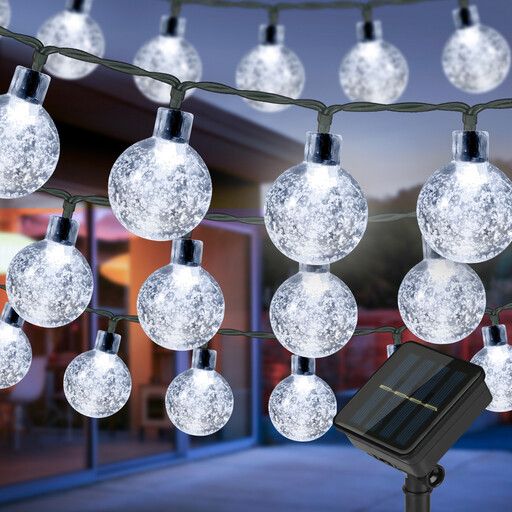
Who is it for? Ideal for those looking to create a magical atmosphere in their garden, on their balcony, or for an evening event. Installation is a breeze, and the visual effect of the crystal bubbles is instant.
Designed for year-round outdoor use, this string light boasts a runtime of 8 to 14 hours after a full charge. A realistic promise, given its solar panel technology.
Its 8 lighting modes allow you to vary the ambience, while the automatic on/off function makes it completely self-sufficient day-to-day.
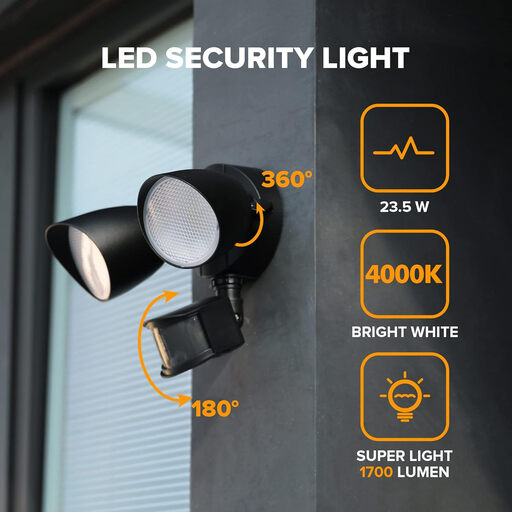
Who is it for? Designed for those whose priority is to secure a driveway, a garage entrance, or the areas around the home. Its motion sensor (PIR) triggers a powerful light only when needed, combining effectiveness with discretion.
Made from aluminium alloy, it is far more robust than entry-level plastic models. Its 1700-lumen output is clearly stated and perfectly calibrated for security, light-years away from the feeble glow of some gadgets.
Its two light heads are 360° adjustable, allowing you to direct the beam with surgical precision for optimal area coverage.
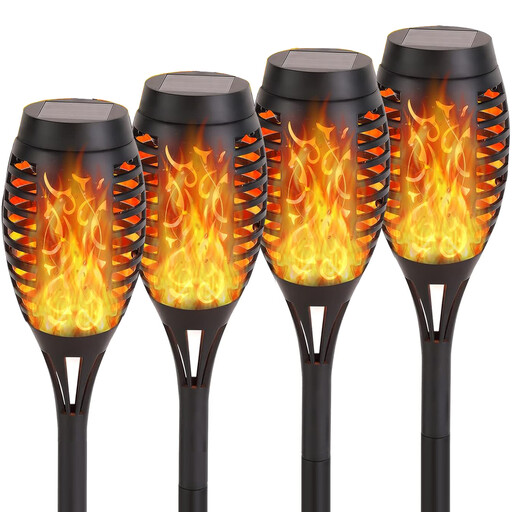
Who is it for? Perfect for marking out a path, a flowerbed, or the edges of a patio with a touch of exotic flair. The flickering flame effect creates a warm ambience, without the risks or hassle of a real torch.
These torches feature an IP65 protection rating, a certification that guarantees their resistance to heavy rain. The automatic on/off function ensures reliable operation without any intervention on your part.
The dancing flame effect is surprisingly realistic and creates a unique atmosphere. Installation, meanwhile, is incredibly simple: just stake them into the ground.
We have put together a comprehensive selection of products that meet our demanding selection criteria and current safety standards.
It mainly depends on the components. While the LEDs themselves have a virtually unlimited lifespan (often over 25,000 hours), the weakest link is the rechargeable battery. Its performance typically starts to decline after 2 to 3 years. Prioritise models with a replaceable battery: it's a guarantee of longevity for your setup.
Yes, but expect reduced performance. In winter, the days are shorter and the sunlight is weaker, which logically reduces the charging capacity. The night-time runtime will therefore be shorter than what you'd see in the middle of summer. A tip: to maximise the charge, point the panel due south and ensure no obstacles (foliage, walls) are casting a shadow on it.
Maintenance is minimal, but crucial. Simply remember to regularly clean the surface of the solar panel with a soft, damp cloth. Dust, pollen, or plant debris can create an opaque film that drastically reduces its efficiency. A clean panel is the guarantee of an optimal charge.