
Livraison le jour même ou le lendemain

Qualité garantie

Débloquez vos offres de bienvenue: Livraison GRATUITE | Jusqu'à -80 % | 30 jours d'essai gratuits à JoyPlus
Téléchargez l'application
As night falls, your garden, patio, or even your balcony can be transformed into a magical space that is both welcoming and secure. Solar garden lighting has emerged as the clear solution: it's practical, eco-friendly, and won't cause any surprises on your electricity bill. These self-sufficient lights capture the sun's energy during the day to beautify your evenings.
With an overwhelming number of options on the market, it can be difficult to know where to start. Spotlights for lining a path, string lights for a festive vibe, torches for a decorative touch... how do you make the right choice? This guide is here to help you understand the key criteria and find the products best suited to your needs.
Before you begin, a few technical details are worth considering. This is your guarantee of a successful purchase that will deliver on its promises for years to come.
An outdoor light is, by its nature, exposed to the elements. Its Ingress Protection (IP) rating is therefore crucial: it measures its resistance to dust and water. An IP65 waterproof outdoor light, for example, guarantees total protection against dust (the number 6) and against water jets from all directions (the number 5). It's an essential mark of reliability for an installation that needs to withstand rain without issue.
Brightness, measured in lumens (lm), and battery life, in milliampere-hours (mAh), are the other two pillars of your decision.
Battery life, on the other hand, depends on the battery's capacity and, most importantly, on the amount of sunlight received during the day. As a general rule, a battery of 800 mAh or more will provide light for a good portion of the night after a full day's charge.
Each type of solar light has a primary function:
To help you make your choice, here are a few products that caught our eye, each suited for a specific use.
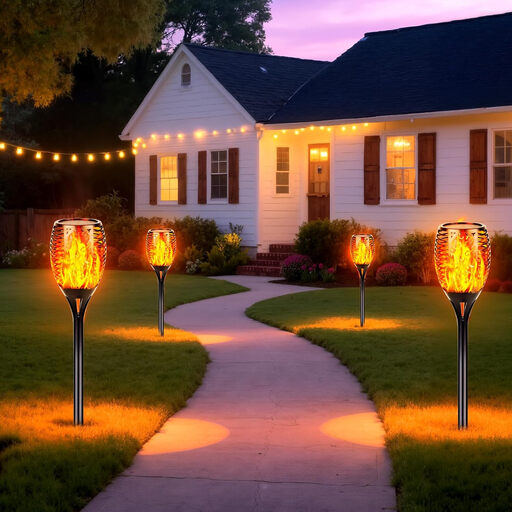
What sets them apart: These torches create the perfect illusion of a dancing flame thanks to their 96 LEDs. The effect is stunningly realistic and instantly creates a welcoming and exotic atmosphere in your garden.
Advantages:
Who is it for? For anyone looking to create an intimate, warm ambiance around a patio, a pool, or along a pathway, without needing purely functional lighting.
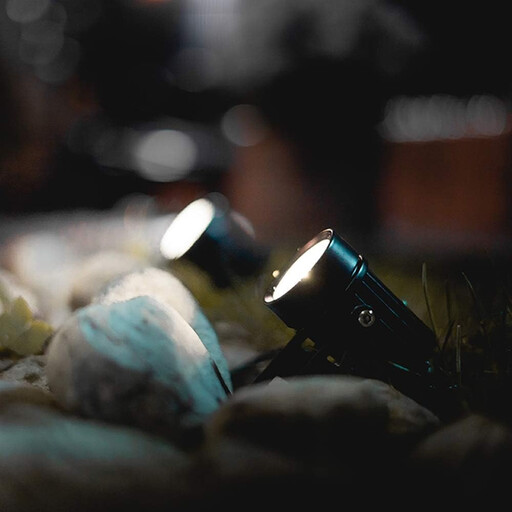
What sets it apart: The Solar MultiSpot is a very clever solution: multiple adjustable spotlight heads, all connected to a single, remote solar panel. This setup allows you to place the panel where it can get the most sun, while precisely illuminating areas that might be in the shade.
Advantages:
Who is it for? Ideal for those who need precise accent lighting: to showcase plants, a sculpture, the facade of a house, or to make a few steps safer.
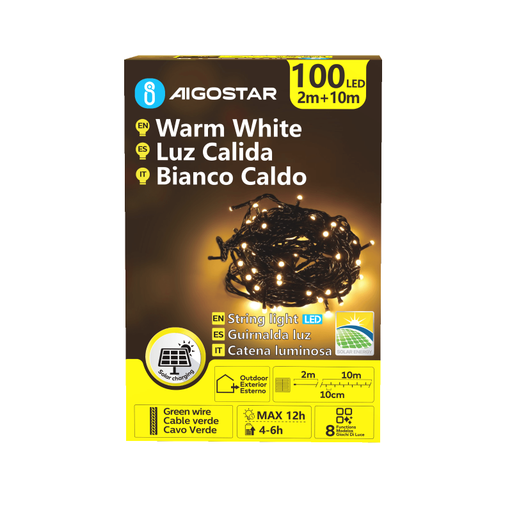
What sets it apart: At 10 metres long with 100 warm white LEDs, this string light is a classic for decorative garden lighting. It offers 8 lighting modes (steady, flashing, waves, etc.), allowing you to change the mood to suit your fancy.
Advantages:
Who is it for? Perfect for those looking for a ready-to-use wireless solar garden light solution for summer evenings, parties, or simply to add a touch of magic to their daily life.
Solar lighting isn't just for open-air spaces. Is your project for a sheltered area without electricity, like a conservatory, a garden shed, or a garage? Specific solutions with a remote solar panel are available.
Discover our range of solar lights for indoor sheds.
The brightness depends on the use. For a purely decorative ambiance (string lights, torches), 10 to 50 lumens per light point is plenty. To mark a pathway, aim for 100 to 300 lumens. Finally, for security lighting or to majestically illuminate a large tree, a powerful solar spotlight of 400 lumens or more will be necessary.
Yes, modern solar panels can capture diffuse light, even on overcast days. Of course, charging will be less efficient than in direct sunlight. In winter, with shorter days and weaker sun, the battery life of your lights will naturally be reduced. They will turn on, but they won't last as long through the night.
This is one of the greatest advantages of a wireless solar garden light: its installation is stunningly simple. Most models, like the solar stake light, are simply pushed into the ground. For others, a few screws are all it takes to fix the wall mount or the panel. The only requirement: make sure the solar panel is placed in an area that receives maximum direct sunlight during the day.