Joybuy Insights

How to Choose the Right Solar Garden Light and Avoid the Pitfalls

Lighting up your garden without increasing your electricity bill or running a single cable?: the promise is appealing. The solar garden light has logically emerged as the obvious solution, both practical and eco-friendly. The problem?: the market is flooded with products making enticing promises, which often turn out to be poor-quality gadgets after just a few weeks of use.

As the head of product selections at Joybuy, my mission is to help you see things more clearly. Let's forget the marketing jargon and focus on what really matters. Here are the pitfalls to avoid and the objective criteria for making a truly informed choice.

The 3 Mistakes to Avoid When Buying

Too many buyers end up with lights that give up the ghost after the first heavy downpour or that only stay lit for an hour or two. Here's how to avoid these disappointments.

  1. Trusting a "waterproof" claim without checking the rating. The term "water-resistant" is a marketing catch-all. A light that is merely "splash-proof" will not survive a season of intense rain. The only reliable indicator is the Ingress Protection rating, the famous IP code.
  2. Ignoring the battery capacity. An "8-hour" runtime displayed on the packaging is a very optimistic estimate, calculated under perfect sunlight conditions. A low-capacity battery (measured in mAh) will drain at lightning speed, especially as the days get shorter in autumn and winter.
  3. Confusing decoration with functional lighting. A pretty decorative solar stake is perfect for creating ambiance, but it will be completely inadequate for securing a dark pathway. The light output, measured in lumens, is a critical criterion that is too often sacrificed at the altar of aesthetics.

Key Criteria for a Successful Purchase

To ensure you choose a solar garden light that will live up to its promises, you need to look at a few technical specifications. They are far more reliable than any sales pitch.

The IP Rating?: Your Guarantee Against Rain

This rating consists of two numbers. The first relates to protection against solids (dust) and the second against liquids (water). For outdoor use in our climate, here are the benchmarks?:

  • IP44?: Protection against water splashes from all directions. This is the absolute bare minimum. Acceptable only for a solar wall light installed in a sheltered area (under an awning, a porch, etc.).
  • IP65?: Totally protected against dust and water jets. A light with this rating can be directly exposed to rain without risk. This is the standard we recommend for an outdoor solar post light or a pathway marker placed directly in the ground.
  • IP66 and higher?: Enhanced protection against powerful water jets. Ideal for highly exposed areas or ground-level installations.

Lumens and Colour Temperature?: The Lighting Atmosphere

Forget watts, which measure consumption. The actual brightness of a lamp is measured in lumens (lm).

  • For pathway marking and decoration (5 to 50 lumens)?: Sufficient to define a path or highlight a flower bed with ambient light.
  • For lighting a pathway (50 to 200 lumens)?: Allows you to see where you're stepping and move around safely.
  • For security and area lighting (300 to 800+ lumens)?: A powerful solar spotlight in this range is essential for effectively lighting an entrance, a patio, or a garage, often paired with a motion sensor.

The colour temperature, in kelvins (K), defines the appearance of the light?: a warm white (around 2700-3000K) creates a cosy atmosphere, while a neutral or cool white (over 4000K) offers a clearer, more secure-feeling light.

Battery and Solar Panel?: The Power Duo

The performance of your solar garden lighting depends on the balance between these two components. A large solar panel is useless if the battery is too small to store the energy.

  • The battery?: Lithium-ion (Li-ion) batteries generally offer a longer lifespan and better charge management than older Ni-MH batteries. Look at the capacity, expressed in milliamp-hours (mAh). A 1200 mAh battery will store more energy than a 300 mAh one, logically providing a longer runtime.
  • The solar panel?: Its size and technology (amorphous, polycrystalline, monocrystalline) influence its ability to capture energy, even on cloudy days. Monocrystalline panels are known to be more efficient.

Our Recommended Solar Lights

Rather than a random list, we have selected products that meet specific needs, based on the objective criteria we've just discussed.
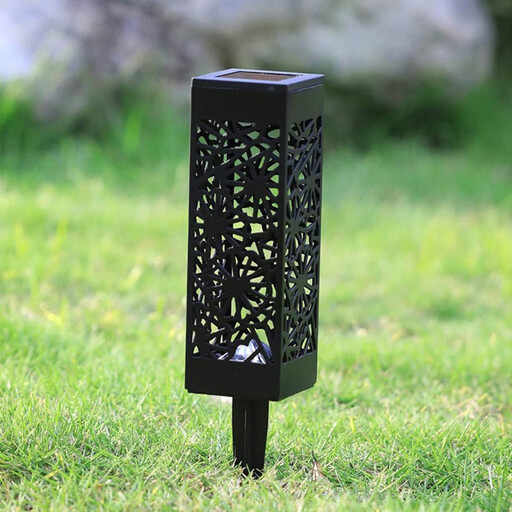
IDEAL FOR : DECORATIVE AND BUDGET-FRIENDLY PATHWAY LIGHTING
VIVREAL Solar Garden Lights 6 Pack

VIVREAL Solar Garden Lights (6-Pack)

Why we chose it ? Perfect for adding an aesthetic touch to pathways or flower beds without breaking the bank. The 6-pack offers excellent value for money to create a light path or decorate a large area.

How it avoids the pitfall

It counters the pitfall of poor waterproofing with an IP65 rating. This is a surprisingly robust feature for this price range, ensuring good resistance to bad weather.

The key advantage

Its cutout lampshade projects elegant floral patterns onto the ground, offering a much more sophisticated visual effect than a simple beacon light.
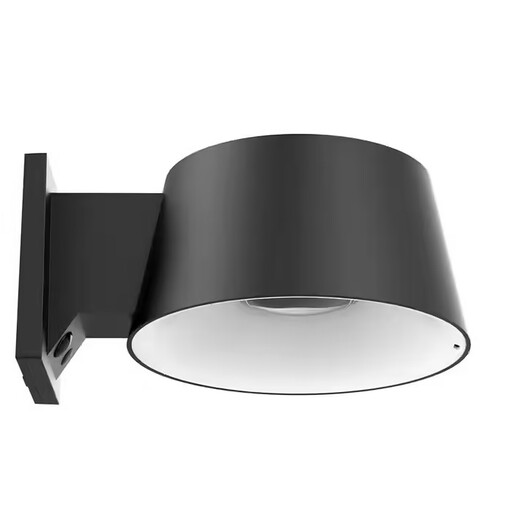
IDEAL FOR : MODERN WALL LIGHTING
ezilight Solar Wall S28

ezilight Solar Wall S28

Why we chose it ? Perfect for lighting an entrance, patio, or balcony with a modern touch. Its minimalist design complements contemporary architecture, and its wall mounting is simple and wireless.

How it avoids the pitfall

It avoids the trap of disappointing brightness thanks to a concentrated, downward-facing LED beam. This maximises light efficiency on the target area, instead of scattering it into a faint glow.

The key advantage

Its robust design is built to withstand the elements, providing a reliable and durable lighting solution all year round, completely hassle-free.
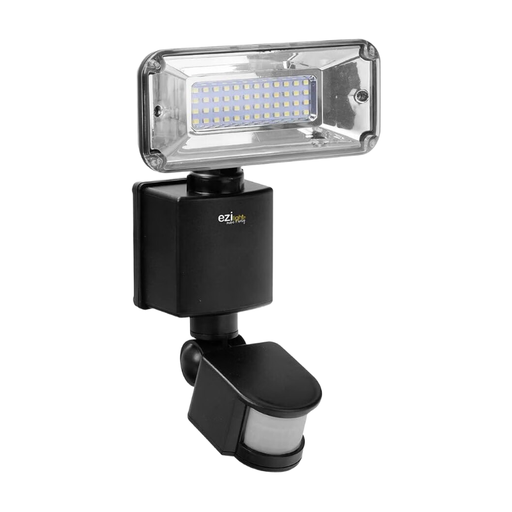
IDEAL FOR : SECURITY AND POWERFUL ILLUMINATION
EZIlight Solar Pro 1

EZIlight Solar Pro 1

Why we chose it ? This is the top choice for anyone seeking truly powerful security lighting for an entrance, garage, or driveway. It combines an intense LED spotlight with a motion sensor for maximum efficiency.

How it avoids the pitfall

It bypasses the unrealistic runtime trap: its motion sensor only activates full power when needed, thus preserving the battery for reliable operation until dawn.

The key advantage

The adjustable lamp head allows you to direct the light beam precisely where you need it, whether on a door, a staircase, or a dark passage.

Looking for more options ?

We've compiled a full selection of products that meet our selection criteria and safety standards.

Your Questions About Solar Lights Answered

What power level should I choose for a solar garden light??

The power depends entirely on your needs. To give you some benchmarks?:

  • Ambiance and decoration?: 5 to 50 lumens per light is sufficient for a decorative solar stake or a pathway marker.
  • Functional pathway lighting?: Aim for 50 to 200 lumens for an outdoor solar post light that needs to clearly illuminate a path.
  • Security?: A powerful solar spotlight, especially one with a motion sensor, should offer between 300 and 800 lumens, or even more, to deter intruders and properly light an area.

What is the lifespan of a solar light??

The lifespan of a solar light is dictated by its weakest link?: the battery. The LEDs themselves can operate for tens of thousands of hours. A rechargeable battery, however, has a limited number of charge/discharge cycles. On most models, expect to replace it every 2 to 3 years. Of course, the robustness of the materials and a high waterproof rating (IP65+) are also essential for extending the life of the entire unit.

My solar light won't turn on, what should I do??

Before declaring it dead, here are a few simple checks?:

  1. The switch?: Check that the switch is in the "ON" position. On some models, it's not very visible, or you may need to remove a protective tab during the first use.
  2. The solar panel?: Clean it with a damp cloth. Dust, pollen, or debris can significantly reduce its efficiency.
  3. Sunlight exposure?: Has the light been exposed to direct sunlight for at least 6 to 8 hours?? A location that is too shady will never allow for a full charge.
  4. The battery?: If the light is more than two years old, the battery is likely at the end of its life. Check if its compartment is accessible for replacement.