
Livraison le jour même ou le lendemain

Qualité garantie

Débloquez vos offres de bienvenue: Livraison GRATUITE | Jusqu'à -80 % | 30 jours d'essai gratuits à JoyPlus
Téléchargez l'application
A dead battery: every driver's nightmare, especially when it strikes at the worst possible moment—on a freezing winter morning, late at night, or in the middle of nowhere. The emergency starter, or jump starter, has become an essential accessory. The problem? The market is flooded with models making enticing marketing promises that often hide deal-breaking flaws. To help you see things more clearly, we've broken down the pitfalls to avoid and the technical criteria to check before you buy.
Making the wrong choice means not only throwing money down the drain but, more importantly, risking being stranded when you need it most. Here are the main traps to be aware of:
To avoid these traps, let's focus on the technical specifications that truly make a difference.
The fundamental distinction today is between lithium batteries and the new generation of sodium-ion starter batteries. The latter offer significant advantages:
Don't be fooled by the "peak amps" plastered on the box. The value that truly matters is the starting current (or cranking current). This determines the booster's real ability to start a stubborn engine. Check that the model is compatible with your vehicle's engine type (gasoline or diesel) and its displacement, especially if you're looking for a jump starter for SUVs and vans.
A true Swiss Army knife for drivers must offer useful and high-performing tools. A jump starter with a built-in compressor is a perfect example, provided the compressor is powerful enough. A good indicator is its ability to reach high pressure (expressed in PSI). For instance, a 150 PSI portable tire inflator will be able to quickly reinflate a car tire. Likewise, a car power bank feature with fast-charging ports (like PD60W) to recharge your electronic devices is a real asset.
To illustrate how these criteria apply in practice, here are a few models tailored to different user profiles.
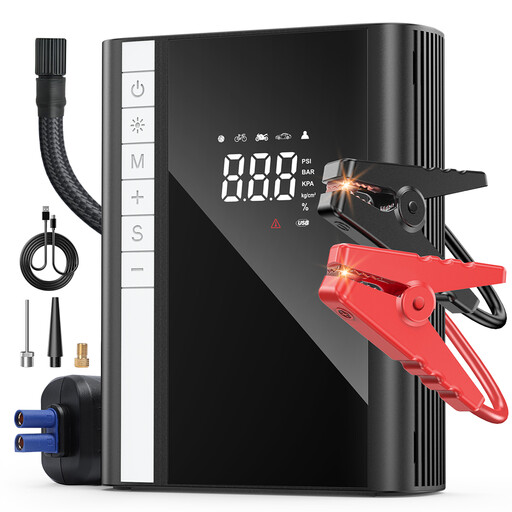
Why it's a match: Ideal for drivers seeking a reliable all-in-one tool for everyday mishaps. It combines starting power suitable for cars, SUVs, and RVs with an effective air compressor to handle a slow leak or a simply under-inflated tire.
It sidesteps the "gadget" trap by integrating a genuinely effective air compressor. This makes it a true 2-in-1 emergency tool, not just a starter with trivial add-ons.
Key Advantage: The versatility of a true 2-in-1 (starter + compressor). Strengths: High starting power, efficient compressor, practical emergency light for nighttime use.

Why it's a match: Designed for those who make no compromises on reliability. Its sodium-ion technology guarantees operation in the most extreme conditions and retains its charge for years. Absolute peace of mind.
It directly counters the two biggest traps: the fragility of lithium (in cold and regarding safety risks) and self-discharge. A single charge is enough for years of standby. It will always be ready the day you need it.
Key Advantage: Sodium-ion technology for maximum safety and durability (-40°C to 80°C). Strengths: Near-zero self-discharge (stays charged for years), record-breaking lifespan (up to 6,000 cycles).
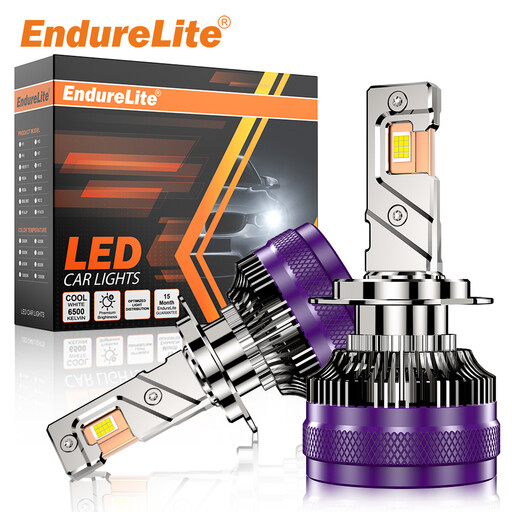
Why this product is a match: For those who see safety as a complete picture. In addition to a reliable jump starter, optimizing your night visibility is a logical next step. These LED bulbs provide super-powerful lighting to see and be seen better.
This holistic approach to safety avoids focusing solely on breakdowns. Poor visibility is an equally critical, and often underestimated, danger.
Key Advantage: A drastic improvement in nighttime visibility. Strengths: Ultra-simple "Plug & Play" installation as a direct replacement for original bulbs.
Discover our full selection of products that meet our strict selection criteria and current safety standards.
1. What is the lifespan of a sodium-ion jump starter? This is one of their biggest strengths. While a conventional lithium booster handles between 400 and 800 charge cycles, sodium-ion models can reach up to 6,000 cycles, or even more. Combined with their negligible self-discharge, this means a single device can last you for the entire life of your vehicle, and even the next one.
2. How do I know if a booster is compatible with my vehicle (SUV, van, etc.)? Rely on the compatibility stated by the manufacturer, often expressed in liters of engine displacement for gasoline and diesel engines (e.g., "up to 8.0L Gas / 6.0L Diesel"). Most importantly, look at the starting current (in amps, A) rather than the marketing-hyped peak current. This value guarantees the power needed to crank the engine. A starting current of 600A is a good starting point for most cars and SUVs.
3. Can a booster really start a car with a completely dead battery (0V)? Excellent question, which reveals another fundamental difference. Most lithium boosters are unable to start a vehicle if its battery is at 0V. Worse, they can be damaged if they themselves remain discharged for too long. Conversely, some sodium-ion jump starter models can be "woken up" with a simple recharge even after a complete discharge, and are capable of starting vehicles with totally dead batteries. It's an extra layer of security that makes all the difference.