
Livraison le jour même ou le lendemain

Qualité garantie

Débloquez vos offres de bienvenue: Livraison GRATUITE | Jusqu'à -80 % | 30 jours d'essai gratuits à JoyPlus
Téléchargez l'application
A dead battery. It's every driver's nightmare, especially when you're short on time or the temperature plummets. While lithium jump starters have become ubiquitous, a new technology is emerging with the promise of rock-solid safety and reliability: the sodium-ion jump starter.
We're breaking down this promising alternative, giving you the keys to choosing the right equipment, and presenting our selection of the best models to help you make an informed decision.
Before you buy, there are a few criteria to consider to ensure your device will be there for you when you need it most.
Safety is non-negotiable. Lithium batteries, while effective, are known for their risk of overheating or even thermal runaway if damaged or exposed to extreme temperatures. A safe jump starter must be able to stay in your vehicle year-round, whether in scorching summer heat or bitter winter cold. Technologies like sodium-ion shine with their excellent chemical stability, operating flawlessly across an extreme temperature range (e.g., from -40°C to 80°C) with no risk of fire, even if punctured. This is a decisive advantage for a jump starter designed for extreme cold.
What good is a jump starter if its own battery is dead when you need it most? Its ability to hold a charge over the long term is therefore essential. This is known as the self-discharge rate: the lower, the better. A good long-standby jump starter is characterized by a near-zero self-discharge rate, sparing you the chore of quarterly recharging. Its longevity, meanwhile, depends on the number of charge/discharge cycles it can handle. A high number (several thousand cycles) guarantees an investment that will last for years.
Be sure to check the jump starter's compatibility with your vehicle's engine type (petrol or diesel) and displacement. The starting power, expressed in peak amps (A), is the crucial factor. A jump starter for a diesel engine will naturally require more power than one for a small petrol city car. Another critical technical point is the booster's ability to revive a completely dead battery. Some advanced models can work even if your battery's voltage has dropped to 0V—a feature sometimes called 0V forced start—whereas most conventional boosters require some residual voltage to even activate.
Here are three devices that caught our eye, each with its own strengths, but all with reliability and performance as the main focus.
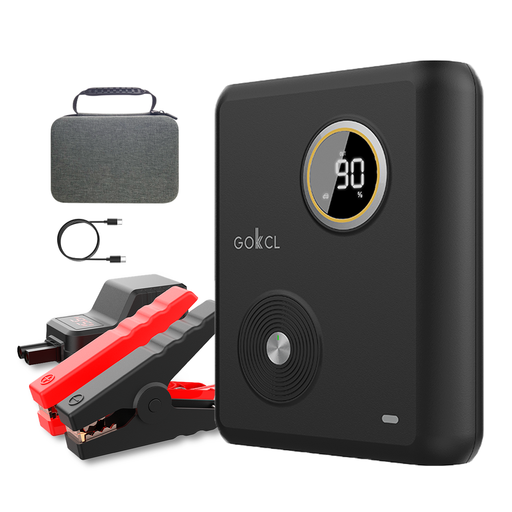
Why It Stands Out
The GOKKCL GK03 leads the charge by integrating the groundbreaking sodium-ion technology. It's designed for those who prioritise safety and peace of mind above all else. Its intrinsically stable chemistry eliminates the fire risks associated with lithium, and its ability to remain operational for years without recharging makes it a true "set it and forget it" piece of equipment.
Key Features
Who Is It For?
For drivers seeking the safest and most durable solution on the market. Ideal for those living in regions with extreme climates or who want a hassle-free device to keep permanently in their trunk.
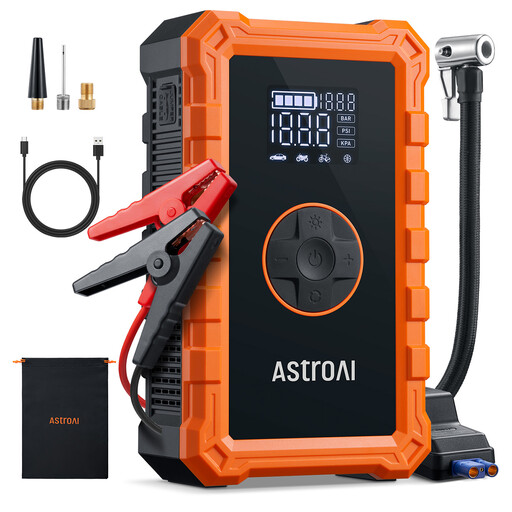
Why It Stands Out
The AstroAI S8 is the driver's Swiss Army knife, combining a lithium jump starter with a portable air compressor. It's a pragmatic solution for handling the two most common roadside hassles: a dead battery and an underinflated tyre.
Key Features
Who Is It For?
For drivers who value versatility and want to save trunk space by combining multiple emergency tools into one compact unit.
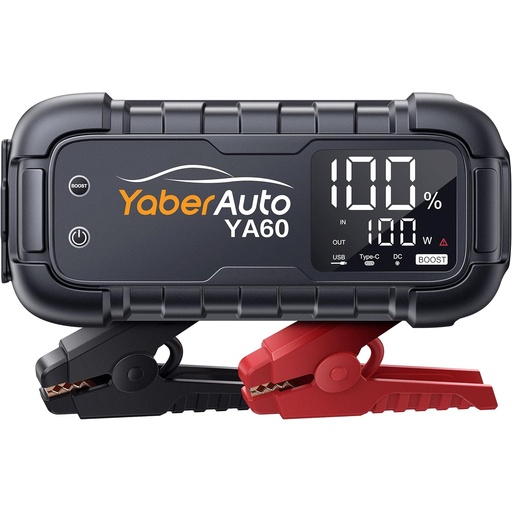
Why It Stands Out
With the YaberAuto YA60, it's all about raw power. Boasting an impressive 8000A peak current, it's built to start the most demanding vehicles, including large diesel engines in vans and RVs. Its two-way fast-charging capability also makes it a formidable everyday ally.
Key Features
Who Is It For?
For owners of large vehicles (pick-up trucks, RVs, large SUVs, and diesel vans) who need maximum starting power to ensure they're never left stranded.
Sodium-ion technology marks a real turning point in safety and durability. However, if you're looking for even more colossal starting power or features specific to lithium models, feel free to explore our complete selection.
Discover our category of the most powerful lithium jump starters
It all comes down to battery chemistry. Sodium-ion is intrinsically more stable and doesn't contain materials that can release oxygen when overheated, which virtually eliminates any fire risk. It also supports a much wider operating temperature range and a significantly longer lifespan (number of cycles), all with a slightly lower energy density than lithium, which can result in slightly bulkier casings.
Absolutely. Models like the GOKKCL GK03 are designed for this. They include a forced start function that allows you to start the engine even when the vehicle's battery is completely dead. This is a major advantage, as most lithium boosters need a minimum residual voltage to activate.
Thanks to their extremely low self-discharge rate (around 1% per month for good models), you can leave it in your trunk for several years without touching it. A simple annual check is all that's needed. It's the very definition of a "set it and forget it" device.