
Livraison le jour même ou le lendemain

Qualité garantie

Débloquez vos offres de bienvenue: Livraison GRATUITE | Jusqu'à -80 % | 30 jours d'essai gratuits à JoyPlus
Téléchargez l'application
A socket and wrench set can quickly become cumbersome, incomplete or impractical if you rely solely on the number of pieces advertised. Whether you're maintaining a car, assembling furniture or carrying out a repair job, it's the technical details that make the real difference day to day.
A 50 or 100-piece kit isn't necessarily more useful than a more compact set. The figure may include adapters, extensions or sizes you'll almost never use. Instead, check for the common metric wrench sizes, sockets compatible with your drive square, and the sizes you actually need.
On a European car, metric sizes 8, 10, 13, 17 and 19 mm crop up regularly. However, imperial sizes can prove essential for certain vehicles, imported equipment or older machinery.
A ratchet wrench makes tightening and loosening easier thanks to its reversible mechanism. It does not measure or automatically control the torque applied. For jobs that require a precise value, such as tightening certain wheels or mechanical components, use a torque wrench set according to the vehicle or equipment documentation.
A torque wrench designed for a bicycle, for example, won't necessarily cover the needs of a car. Check its range in N·m, its drive square and the bits supplied separately.
A straight wrench can become difficult to manoeuvre around an engine or behind a body panel. A kit without extensions, deep sockets or offset wrenches will therefore quickly show its limitations when access gets tricky.
Wrenches for tight spaces, flexible-head models, and box or offset wrenches each suit different situations. Their usefulness depends on the shape and location of the fastener, not on a general promise of versatility.
Chrome-vanadium steel wrenches are very common in mechanics and DIY tools. However, heat treatment, machining quality and corrosion protection matter just as much as the alloy name. A chrome or matt finish can make cleaning easier after a dirty job, but it doesn't replace storing tools in a dry place.
For sockets used with an impact wrench, look for a design explicitly intended for that purpose. The WORKPRO model shown below uses, according to its specification, chrome-molybdenum steel with a rust-resistant black finish.
Ratchet wrench and socket sets are available in 1/4", 3/8" and 1/2". The 1/4" suits small fasteners and tight spots, while the 1/2" is more for nuts requiring significant force. The 3/8" is a practical compromise for everyday maintenance tasks.
Also examine the socket shape. A 6-point model doesn't grip the same way as a 12-point socket. This difference can affect how well it holds onto the bolt head and how easily it engages.
A good wrench set case or clearly labelled pouch helps prevent size mistakes and lets you work faster. Sizes engraved or printed on both sides are particularly handy when light is poor. For a vehicle, a rigid case is easy to carry in the boot. In a workshop, a roll-up pouch can take up less space in a tool chest.
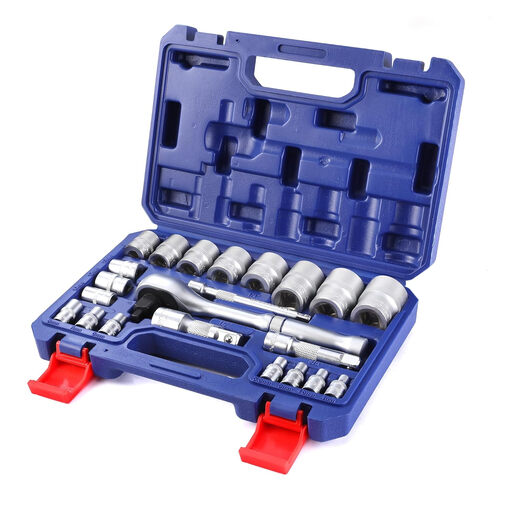
Why this choice suits this profile: This kit is suitable for everyday car maintenance and DIY jobs that need several ratchet sizes. It comes with a storage case.
The specification mentions impact sockets in 17, 19 and 21 mm, with marking and colour coding to quickly identify sizes. Still, check the exact contents of the kit before ordering.
Chrome-molybdenum steel stated, 1/2" drive for impact sockets, extensions and storage included according to the description.
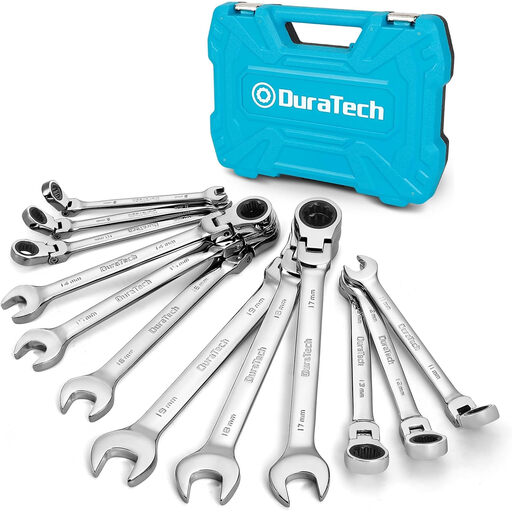
Why this choice suits this profile: Its 180° flexible head is aimed at users who want more adaptable access in car mechanics and for complex assemblies.
The pivoting head reduces the access difficulties posed by a fixed spanner. The stated 72-tooth mechanism requires only a 5° working angle.
12 sizes from 8 to 19 mm, chrome-vanadium steel, storage box and 12-point polygon end as stated in the specification.
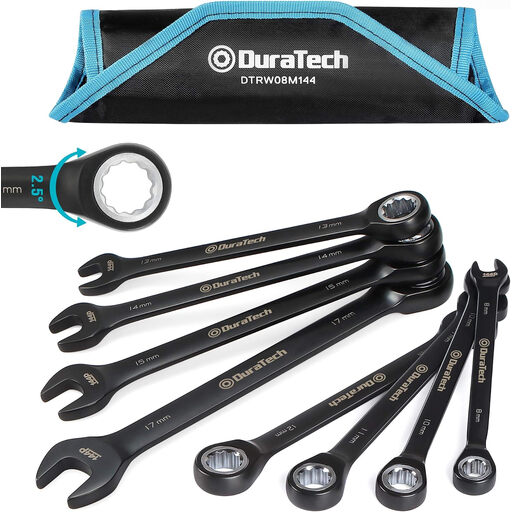
Why this choice suits this profile: This set is aimed at workshops and repeated jobs in areas where space to manoeuvre is limited.
The stated 2.5° working arc is suited to very tight spaces, without relying solely on a long handle.
Stated 144-tooth mechanism, chrome-vanadium steel, black chrome finish and storage pouch. Sizes available: 8, 10, 11, 12, 13, 14, 15 and 17 mm.
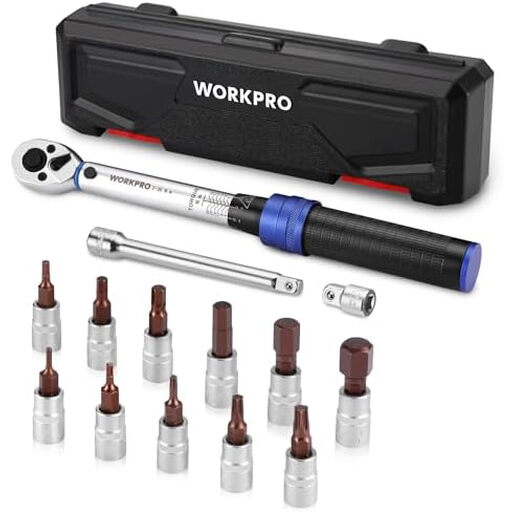
Why this choice suits this profile: Its stated range of 2 to 26 N·m is suitable for precise bicycle adjustments and some light maintenance work.
The torque is set directly on the wrench and a click signals when the selected value is reached. After use, return the collar to its minimum setting and always stay within the intended range.
Stated accuracy of ±3%, 8 hex sockets, 3 screwdriver bits, 102 mm extension and 1/4" to 3/8" adapter.
We've put together a comprehensive, real-time updated selection of products that meet these demanding criteria as well as European safety standards.
Go for a set in metric sizes, with 1/4", 3/8" or 1/2" sockets depending on the jobs you need to do. An extension, a reversible ratchet wrench and a few open-end or combination spanners are enough for everyday tasks. For wheels and components that need a precise torque, add a suitable torque wrench.
An open-end wrench has two open ends, whereas a combination wrench typically pairs an open end with a box end. The box end grips the nut better and often offers a more secure hold. Ratchet wrenches speed up repetitive jobs, while box or offset wrenches are sometimes better suited to recessed fasteners.
Wipe tools clean after any use involving grease or moisture, then return each piece to its place. Also avoid using a standard socket with an impact wrench. Never force beyond the intended use and regularly check the condition of ratchet mechanisms, sockets and handles.