
Livraison le jour même ou le lendemain

Qualité garantie

Débloquez vos offres de bienvenue: Livraison GRATUITE | Jusqu'à -80 % | 30 jours d'essai gratuits à JoyPlus
Téléchargez l'application
A socket set with ratchet wrench is just as useful for maintaining a car as it is for assembling furniture, repairing an appliance or working on a bike. But the biggest kit isn’t necessarily the most practical. Some cases are packed with bits you almost never use, while a vital socket is missing just when you need to loosen a stubborn nut.
Before you head to the checkout, it’s worth checking socket compatibility, the quality of the mechanism and how the case is organised. Here are the criteria to examine when comparing different sets, without being swayed by the piece count alone.
A 123-piece set might seem far better value than a 22-piece set. Yet that total can include plenty of bits, hex keys or accessories that don’t match your needs. For car maintenance, metric sockets from 10 to 19 mm, a few extensions and a suitable drive size will often prove more useful than rarely-used items.
Look at the actual contents of the set rather than the number on the box.
The 1/4, 3/8 and 1/2 inch formats are not interchangeable without an adaptor. As a rough guide:
A versatile socket set should clearly state which drive sizes it supports.
A 72-tooth ratchet typically works with a return angle of around 5°, where this is specified. With 90 teeth, the angle can drop to about 4°, making it easier to work in an engine bay or against a wall.
The tooth count mainly affects manoeuvrability. It doesn’t mean the ratchet can handle any amount of torque. Always respect the manufacturer’s limits and avoid using improvised extensions.
Sockets made from chrome-vanadium steel, often abbreviated to Cr-V, are very common for DIY work. A chrome or polished finish makes cleaning easier after contact with grease and helps limit oxidation under normal use. For wheel nuts or use with an impact wrench, choose sockets explicitly compatible with that tool, usually made from Cr-Mo steel.
A black or matte finish alone doesn’t guarantee better resistance. Check the material, socket type and intended use instead.
Six-point sockets grip the faces of the nut more fully than a poorly-suited profile. They reduce the risk of slipping on a fastener in good condition and make regular loosening easier. Always choose the exact size: a socket that’s too large can damage the edges.
A case intended for car repairs should hold each tool in a dedicated slot. Clear markings, a sturdy box and reliable catches help prevent losses, whether the kit is stored in a workshop, garage or car boot. Extensions are also invaluable for reaching fixings tucked behind a component or deep inside a compartment.
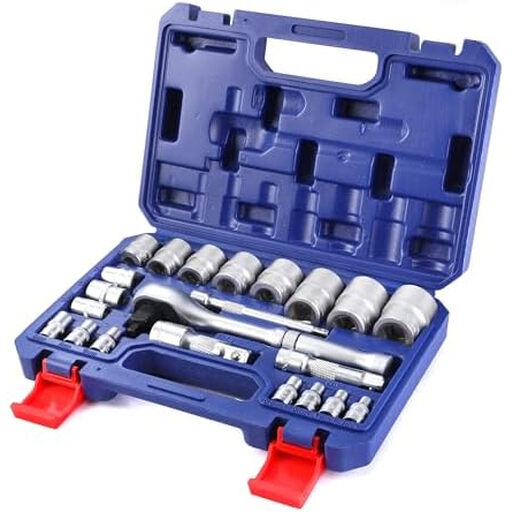
Why this choice suits this profile: This compact set combines 1/4, 3/8 and 1/2 inch drives in a single ratchet handle, with metric sockets from 4 to 24 mm. It’s ideal for first home repairs, bike work and routine car maintenance.
The component list is detailed: 18 six-point sockets, three extensions and a case with dedicated slots. This makes it easier to check the contents than with a simple piece count.
72-tooth reversible ratchet, Cr-V steel sockets and easy-to-carry storage. Sizes are marked on the sockets.
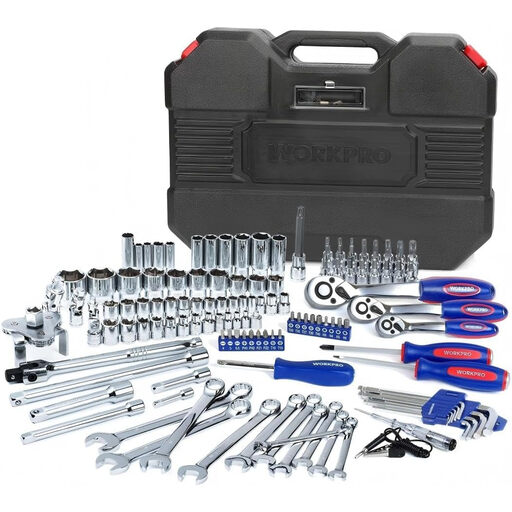
Why this choice suits this profile: This set is for those who want to gather sockets, screwdrivers, spanners, bits and hex keys in one case for both home and car use.
The contents cover several tool families, saving you from buying basic accessories separately. However, do check that the sizes offered match those used on your vehicles.
123 pieces, triple chrome finish and a moulded case with a place for every tool.
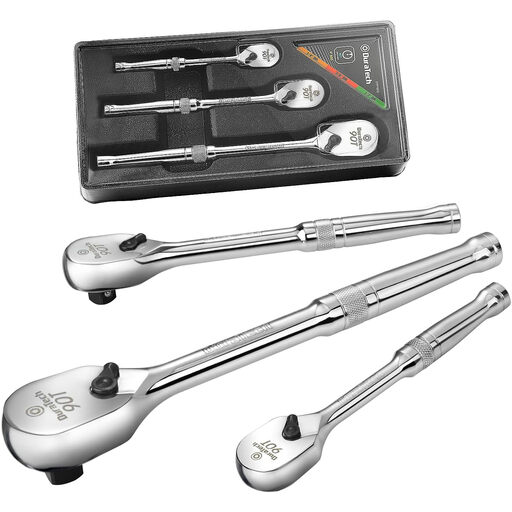
Why this choice suits this profile: This trio of independent ratchet wrenches suits users who already have their own sockets and need to work in tight spots, especially on a car.
The mechanism is rated at 90 teeth, with a 4° return angle, meeting the demands of confined spaces. The closed head is presented as resistant to dust ingress.
1/4, 3/8 and 1/2 inch sizes, chrome alloy steel, polished finish and storage case.
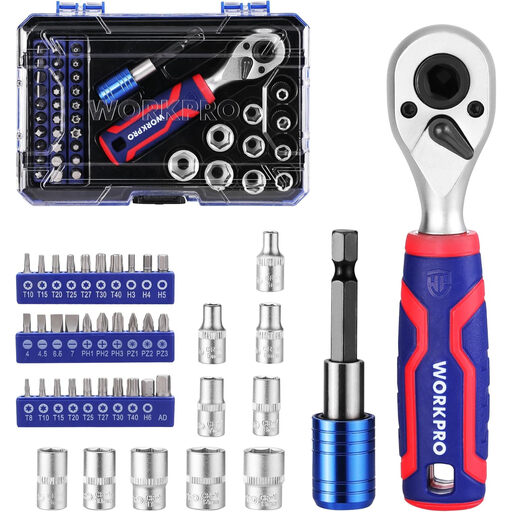
Why this choice suits this profile: Its 1/4 inch format and magnetic bit holder are ideal for small household jobs, non-live electronics and repairs in tight spaces.
The product page details the 10 metric sockets, bits and quick-change system. This lets you check the contents match your needs before buying.
72-tooth mechanism, stated 5° angle, 42 pieces and compact case.
We’ve put together a comprehensive, real-time updated list of products that meet these demanding selection criteria and European safety regulations.
3/8 inch is suitable for many routine jobs. 1/4 inch is more manoeuvrable for small fixings, while 1/2 inch is used with larger sockets, particularly on certain suspension components. A set that includes all three drive sizes will cover a wider range of situations.
Yes. For DIY and everyday maintenance, a 72-tooth ratchet offers practical operation, with a stated return angle of around 5°. A 90-tooth model can be more comfortable when hand movement is very restricted. Your choice should also consider the maximum torque and the quality of the grip.
Clean the sockets after any contact with oil or grease, dry them before storing and return each piece to its place. Don’t use the ratchet as a hammer and never exceed the stated maximum torque. For seized nuts, use a suitable loosening tool and penetrating oil rather than forcing it excessively.