
Livraison le jour même ou le lendemain

Qualité garantie

Débloquez vos offres de bienvenue: Livraison GRATUITE | Jusqu'à -80 % | 30 jours d'essai gratuits à JoyPlus
Téléchargez l'application
Choosing a socket set might seem simple, but with an overwhelming number of options, it's easy to get lost. Between oversized cases and questionable durability claims, a bad investment is always just around the corner. As a product expert at Joybuy, my mission is to help you cut through the noise. This guide focuses on the objective criteria that will help you choose equipment that's truly suited to your needs, whether for everyday DIY or automotive mechanics.
Before we get into the technical details, let's review the common pitfalls that lead to buyer's remorse?:
To avoid these disappointments, focus on three essential technical points that signify the quality and relevance of a ratchet wrench set.
The drive square is the male end of the ratchet where the socket attaches. Its size, expressed in inches, determines the type of work you can undertake.
Some cases combine multiple drive sizes for ultimate versatility.
A tool's longevity directly depends on the steel it's made from. The Chrome-Vanadium steel (often abbreviated as Cr-V) label is the mark of quality to look for. This alloy is renowned for its high resistance to torsion, wear, and corrosion, especially with a chrome-plated finish. A Cr-V tool will hold its shape and grip far longer than a simple carbon steel equivalent.
The internal mechanism of a reversible ratchet wrench contains a gear wheel. Its number of teeth determines the swing arc—the minimum circular arc required to "catch" the next tooth and turn the screw or nut.
A reversible ratchet is also a must-have. It allows you to switch from tightening to loosening with a simple lever, without having to remove the socket.
Rather than an endless list, here are a few models that cater to specific user profiles, based on the quality criteria we've just discussed.
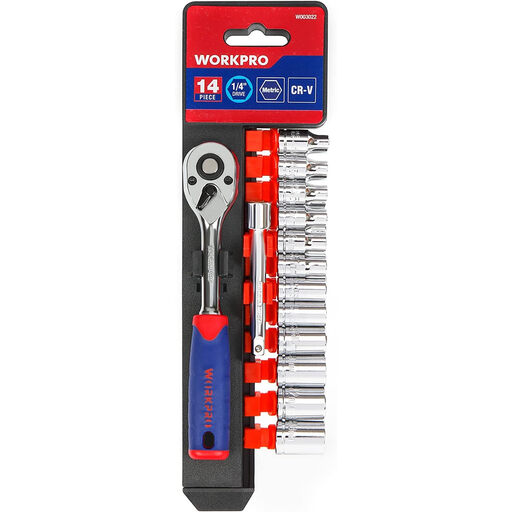
Why this choice? This compact set is perfect for common household repairs. It contains the essential metric sockets (4 to 13 mm) with a 1/4" ratchet, ideal for assembling furniture, fixing a bike, or for light everyday maintenance.
It avoids the quantity pitfall by focusing on 14 essential, high-quality pieces (Chrome-Vanadium steel, 72-tooth ratchet), without any unnecessary filler.
Compact and organized on a rail, it fits in any drawer and helps prevent losing sockets.
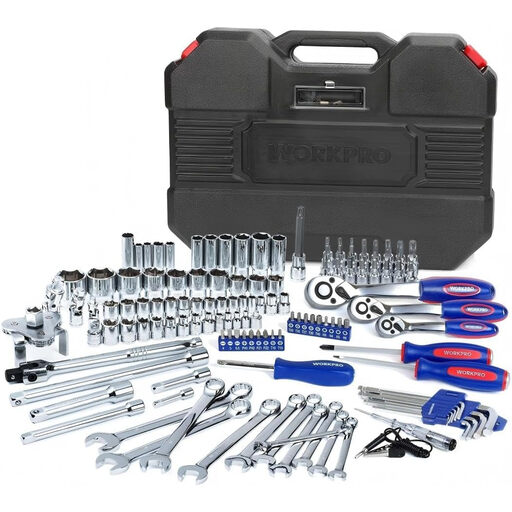
Why this choice? This comprehensive tool case is designed for those who maintain their own car and regularly tackle DIY projects at home. It includes all three drive sizes (1/4", 3/8", 1/2"), metric and SAE sockets, as well as wrenches and bits for ultimate versatility.
Far from being a mere collection of tools, this is an organized system in a sturdy case where every piece has its place. Quality is consistent across the board (Cr-V, quick-release ratchets).
The inclusion of all three ratchet sizes makes this an all-in-one solution, saving you from buying multiple sets.
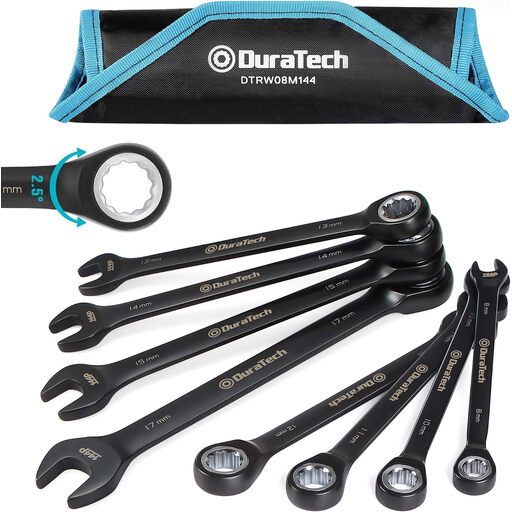
Why this choice? Note: this isn't a classic socket set, but a set of ratcheting combination wrenches. It's aimed at users working in extremely tight spaces. Its 144-tooth mechanism requires a swing arc of only 2.5°, where a standard ratchet would be completely stuck.
It directly tackles the problem of an ineffective ratchet by offering a professional-grade solution for difficult access, a level of performance that general-purpose sets simply cannot match.
Its 2.5° swing arc allows you to tighten or loosen where most other tools are unusable. As a bonus, the black chrome finish enhances corrosion resistance.
We have put together a complete selection of products that meet our quality criteria and current safety standards.
The difference lies in the size and the possible tightening force. The 1/4" is for small screws and low torque. The 3/8" is the most versatile, ideal for general mechanics. The 1/2" is reserved for heavy-duty tasks, like loosening wheel nuts. Your choice will depend on your primary use.
Even a Chrome-Vanadium steel set will benefit from minimal maintenance. After each use, give the tools a quick wipe with a dry cloth to remove grease and moisture. Always store the tools in their case, away from humidity. A drop of oil on the ratchet mechanism from time to time will keep it running smoothly.
For general DIY, no. However, for automotive mechanics, it becomes highly recommended, if not essential. A torque wrench is the only tool that guarantees tightening to the precise torque setting recommended by the manufacturer (for wheel nuts, cylinder head bolts, etc.). Over-tightening can damage threads, while under-tightening can be dangerous. It's a wise investment for the safety and longevity of your vehicle.