
Livraison le jour même ou le lendemain

Qualité garantie

Débloquez vos offres de bienvenue: Livraison GRATUITE | Jusqu'à -80 % | 30 jours d'essai gratuits à JoyPlus
Téléchargez l'application
Whether you're an amateur mechanic, a weekend DIYer, or just ready to handle your own car maintenance, a good socket set is an essential investment. The problem is, the market is flooded with offers that seem too good to be true. Faced with a 200-piece comprehensive socket case sold at a rock-bottom price, it's easy to fall into the trap.
As a Product Specialist at Joybuy, my mission is to help you see things more clearly. Let's review the common mistakes to avoid and the key criteria for choosing a ratchet wrench set that will go the distance, without failing you when you need it most.
Before we even talk specs, it's crucial to know how to spot a bad deal. Most disappointments stem from three well-known pitfalls.
To make an informed choice, focus on a few key points. These are the true guarantors of the quality and longevity of your future mechanic's tool kit.
Chrome-Vanadium (Cr-V) steel isn't just a marketing buzzword; it's a genuine quality standard. This alloy ensures superior mechanical strength, better hardness, and effective protection against rust. A Cr-V set is a promise of durability, capable of handling high torque without deforming.
The number of teeth in a ratchet's internal mechanism determines its precision. A 72-tooth ratchet only needs a 5-degree arc to engage the next tooth, compared to 10 or 15 degrees for a low-end model. This difference is critical for working in the hard-to-reach areas so common in auto mechanics.
Ratchets and sockets are connected by a drive square, with its size measured in inches. The three main sizes are:
Finally, for use in the UK and Europe, ensure the set predominantly contains metric sockets (in millimetres). SAE sockets (in fractions of an inch) will be of no use to you unless you work on American vehicles or equipment.
Rather than an endless list, here are targeted choices for different user profiles. Each of these sets meets the quality criteria we've just outlined.
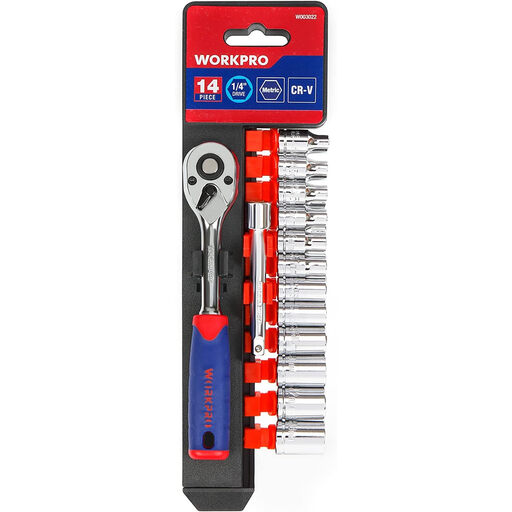
Why it's a great choice: Perfect for small home repairs and basic maintenance (bikes, furniture assembly). It gets straight to the point with the most common metric sizes, no frills attached.
This set doesn't play the quantity game. It focuses entirely on quality with Cr-V steel and a 72-tooth ratchet, steering clear of the low-end "catch-all" set pitfall.
Compact and easy to store. Its quick-release ratchet and ergonomic handle offer excellent comfort for occasional jobs.
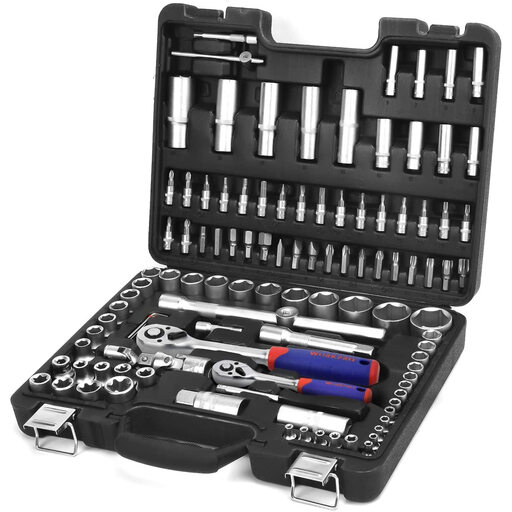
Why it's a great choice: This is the perfect socket set for auto mechanics. It combines 1/4" and 1/2" drives, covering the full spectrum of jobs, from the most delicate to the most demanding.
Here, the high piece count is justified. Every component (extensions, universal joints, deep sockets, Torx sockets...) has a specific function in mechanics. This isn't filler; it's a true portable workshop.
Its versatility, thanks to the two ratchet sizes. The sturdy, well-organised case makes it easy to transport the tools without losing anything.
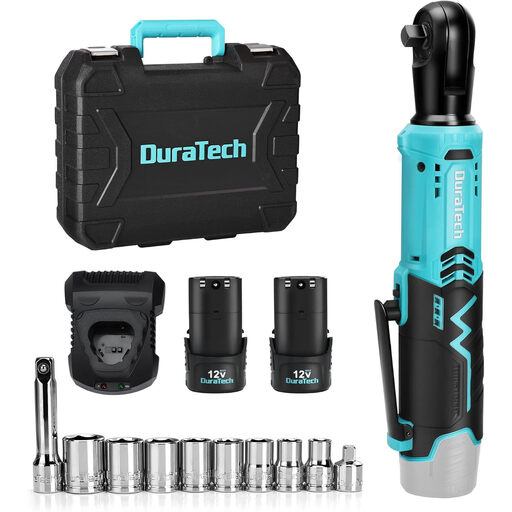
Why it's a great choice: For those who frequently assemble and disassemble parts, the electric ratchet wrench is a game-changer. It saves a huge amount of time on long bolts and repetitive nuts.
This tool doesn't claim to do everything: it's a speed specialist. It complements a manual ratchet set for final torqueing but excels at its primary mission: fastening and unfastening at high speed.
65 Nm of motor torque, supplied with two batteries and a fast charger. The integrated LED light is a real bonus for working in the dark corners of the engine bay.
We've put together a complete selection of products that meet these quality criteria and current safety standards.
The size (1/4", 3/8", 1/2") refers to the drive square that connects the ratchet to the socket. The larger the square, the more robust the tool and the more torque it can apply.
Yes, and it's a criterion that remains relevant. A Cr-V steel tool won't deform on a stubborn nut and will resist the humidity of a garage or basement much better. It's a small investment for a big gain in safety and durability.
Maintenance is very simple. After each use, wipe the tools with a dry cloth to remove grease and dust. Always store them in their case to protect them from impacts and moisture. For the ratchet mechanism, a drop of light oil once a year is enough to keep it running smoothly. Most importantly, never use an extension pipe or a hammer on the ratchet handle to apply force: you risk irreversibly damaging its internal mechanism.