Travellers without utensils
If you want to eat on the train, in the car or on foot without preparing bread, an individually wrapped filled bite means you don’t have to serve out any spread.


For a snack on the go without bread or utensils, choose a filled bite that’s individually wrapped and ready to eat. A sachet or mini pot is a good option if you have something to spread it on and would rather take a set amount of spread with you. Before you buy, compare the weight per unit, sugar and energy for the amount you’ll eat, then check the ingredients and allergens.
If you want to eat on the train, in the car or on foot without preparing bread, an individually wrapped filled bite means you don’t have to serve out any spread.
Knowing the weight of each unit tells you how much you’re taking with you. To understand the amount you’ll actually eat, check its nutritional information too.
If certain ingredients or allergens are a concern, the recipe matters more than the format alone. Check the label on the specific product, even if it’s presented as a hazelnut alternative.
Filled bites, sachets and mini pots are used in different ways, so start by choosing what best suits your needs while travelling.
Choose this if: you want to eat straight away, without anything to spread it on.
Bear in mind: it’s a complete snack, not a spread you can portion out as you like.
Choose this if: you’re already taking something to spread it on and want a separately packaged portion.
You’ll need: bread or another base, as well as the sachet, which adds individual packaging.
Choose this if: you’d rather take spread in a small pot than a ready-to-eat bite.
You’ll need: something to spread it on and a way to serve it. Check the storage instructions on the pot.
| What matters | What to check | Who this matters to |
|---|---|---|
| Eating without preparation | Whether it’s ready to eat or just spread; individual packaging and whether you’ll need something to spread it on. | If I’m eating on the go without bread or a spoon, I want to open my snack and eat it straight away. Around 42% of consumers put this kind of immediate convenience first. |
| Understanding the portion | Weight per unit; energy and sugar for the amount eaten, followed by values per 100 g to compare recipes. | When I take one unit with me, I want to know what it contains rather than rely on the word “mini”. For around 33% of consumers, understanding the portion is the main priority. |
| Choosing a suitable recipe | The ingredients list and allergens highlighted on the packaging of the product you choose. | If an ingredient is a problem for me, I need to rule out unsuitable recipes before choosing a format. This check comes first for around 25% of consumers. |
The size of the pack alone doesn’t tell you its nutritional values. For Nutella B-ready, the brand lists 115 kcal and 10,4 g of sugar per 22 g piece.
If you eat a whole piece, check the values for that piece. You can also use the per 100 g values when comparing different recipes.
In France, the DGCCRF distinguishes between the nutrition declaration required for prepacked foods, subject to applicable exceptions, and Nutri-Score, which is voluntary. So if the logo isn’t shown, you’ll still need to read the label.
Check the nutritional information, ingredients list and weight you plan to eat, whether or not Nutri-Score is displayed.
A sachet contains spread, unlike a ready-filled bite. You’ll therefore need something to spread it on or another way to eat it.
If you can’t prepare anything on your journey, choose a ready-to-eat product. Otherwise, take something to spread it on and check the storage instructions on the packaging.
Depending on how you plan to use it, bread, crackers, a spoon or a napkin can also take up space in your bag.
According to Nutella, B-ready contains hazelnuts, milk, soya, wheat and barley, among other ingredients. This list doesn’t apply to other bites or spreads.
Check the ingredients and highlighted allergens on the packaging of the product you’re buying.
Nutella describes B-ready as a wafer filled with hazelnut and cocoa spread, sold in individual packs.
Bonne Maman lists a mini version of its spread, with five 25 g pots.
Kâliner offers 30 g single-serve portions of spread, designed in part for snacks on the go.
This Joybuy selection features a ready-filled bite to take on your journey. If you’d prefer a sachet or mini pot of spread, use the format and recipe criteria above to guide your choice.
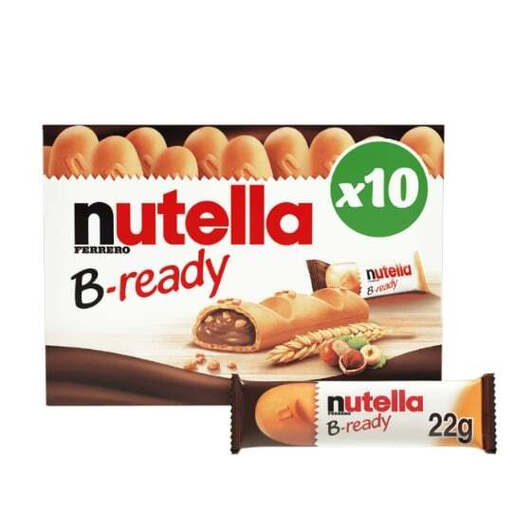 Image unavailable
A filled wafer for anyone who wants a snack on the go without anything to spread it on. This pack is listed as 220 g; B-ready isn’t a spread you can portion out from a pot. Check the packaging for the nutritional values per piece and the allergens in this product.
No. The DGCCRF says that a nutrition declaration is required for prepacked foods, subject to applicable exceptions, while displaying Nutri-Score is voluntary. If the logo isn’t shown, compare the nutritional information per 100 g with the amount you plan to eat.
Not if you have nothing to use the spread with: a sachet needs something to spread it on, while a ready-filled bite can be eaten as it is. Kâliner lists 30 g sachets; Nutella lists each B-ready piece as 22 g. These weights refer to two different types of product.
Read the ingredients and highlighted allergens on the packaging of the product you choose. Nutella lists hazelnuts, milk, soya, wheat and barley, among other ingredients, for B-ready. Any other recipe needs to be checked separately, even if it’s hazelnut-free.