Who should you choose for?

Parents whose child prefers a smooth texture

A plain recipe and a portion that’s easy to serve may matter more than a flavoured dessert. Petit Yoplait Nature in 60 g pots and Carrefour Classic’ in 100 g pots offer two different portion sizes to consider.

Families who pay close attention to age and ingredients

The type of milk and the presence of allergens matter more than the word ‘smooth’. For children under 3, Manger Bouger rules out 0%, skimmed and semi-skimmed products. A plain recipe containing milk is also unsuitable for anyone with a milk protein allergy.

Families making an Easter dessert to share

A larger tub may be a good choice if you’re planning several portions or using it in a recipe. E.Leclerc, for example, offers an 800 g tub of whipped fromage blanc and a 1 kg tub of faisselle. These are different products, so choose according to your recipe and how much you’ll actually need.

What should you check?

Start with your child’s age and the ingredients, then choose between individual portions and a larger tub to share, depending on how you plan to use it.

What to consider What to check Who it matters to
Texture and portion size Check that it’s labelled plain, along with the ingredients and the weight of each pot. ‘Smooth’ doesn’t tell you how much sugar it contains. If my child prefers a smooth texture, I mainly look for a portion that’s easy to serve. Around 40% of shoppers would put this combination of texture and portion size first.
Age and recipe Check the type of milk, fat content and allergens. For children under 3, take Manger Bouger’s guidance into account. With a child under 3, or if milk is a problem, I need to check the recipe before considering the size. This would be the priority for around 30% of shoppers.
How much you need to share Check how much you need for your dessert, the date on the packaging and the storage instructions. For a dessert served to several people, I’d rather buy an amount we can use and store properly. The size and what to do with leftovers would be the main concern for around 30% of shoppers.

Mistakes to avoid

  • Taking ‘smooth’ to mean it’s lower in sugar

    This description of taste or texture doesn’t help you compare the sugar, ingredients or fat content of two products.

    Read the ingredients and nutritional information for each product, particularly the ‘of which sugars’ figure per 100 g.

  • Choosing a skimmed version without considering your child’s age

    According to Manger Bouger, 0%, skimmed and semi-skimmed products are not suitable for children under 3.

    For this age group, check the type of milk and the exact recipe, even if the packaging highlights its smooth texture.

  • Swapping fromage blanc for petit-suisse based on size alone

    Carrefour Classic’ plain fromage blanc with 3% fat contains 3 g of fat per 100 g, compared with 10 g per 100 g for the plain petit-suisse in the same range.

    Before swapping one for the other in your dessert, compare the product description and nutritional values per 100 g.

  • Buying a large tub without planning how you’ll use it

    An 800 g or 1 kg tub suits a different purpose from a small pot and needs to be stored appropriately until serving.

    Choose an amount based on how many portions you’re planning, and follow the packaging instructions. The French Ministry of Agriculture recommends maintaining the cold chain and setting your fridge to +4 °C.

Brands to know for these sizes

Yoplait

Petit Yoplait Nature is a plain fresh cheese sold in 60 g pots.

  • According to Yoplait’s product information, it’s made with pasteurised semi-skimmed milk and contains 4 g of sugars per 100 g.
  • This product contains milk. Its semi-skimmed milk content doesn’t meet Manger Bouger’s guidance for children under 3.

Carrefour Classic’

The range includes plain fromage blanc with 3% fat in 100 g pots, and plain petit-suisse in 60 g portions.

  • Carrefour’s product information gives the fromage blanc’s fat content as 3 g per 100 g, and the petit-suisse’s as 10 g per 100 g.
  • Both products contain milk and have different compositions, so check the exact product before swapping one for the other.

Nos Régions ont du Talent / E.Leclerc

E.Leclerc offers larger tubs for sharing, including an 800 g tub of whipped fromage blanc with Bresse cream AOP and a 1 kg tub of faisselle.

  • These sizes may suit a recipe or a dessert served to several people.
  • Whipped fromage blanc and faisselle aren’t interchangeable without considering the recipe and how you plan to use them. Also check availability with your E.Leclerc store.

Product available on Joybuy

This is a plain dairy dessert for babies containing fromage blanc, sold in individual portions, rather than a regular tub of fromage blanc to share.
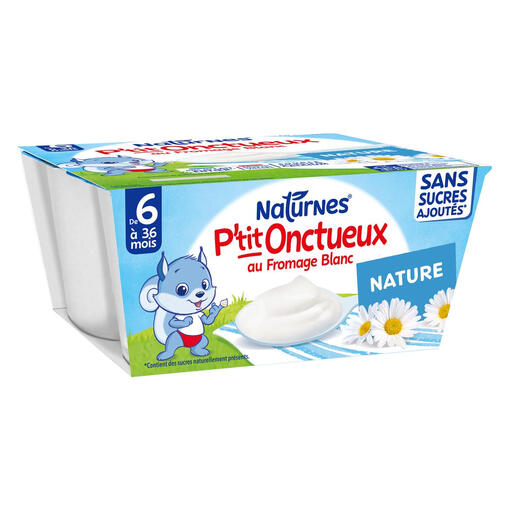
Nestlé P'Tit Smooth plain fromage blanc, four 90 g pots

Nestlé P'Tit Smooth plain fromage blanc, from 6 months, 4 × 90 g

Designed for serving a young child an individual portion, this dairy dessert is suitable from 6 months and comes in a pack of four 90 g pots.

It contains milk and isn’t suitable for anyone with a milk protein allergy. For a child under 3, check the type of milk and fat content on the label before choosing it.

Once opened, follow the storage instructions on the packaging.

View on Joybuy

Frequently asked questions

Does ‘smooth’ fromage blanc always contain less sugar?

No. ‘Smooth’ describes how it tastes or feels, not how much sugar it contains. Compare the ingredients and the ‘of which sugars’ figure per 100 g for the product you’re considering. For example, Petit Yoplait Nature’s product information lists 4 g of sugars per 100 g.

Is a 0% product suitable for a child under 3?

No. According to Manger Bouger’s weaning guide, 0%, skimmed and semi-skimmed products aren’t suitable for children under 3. Check the type of milk and the ingredients in the specific product rather than relying on the fact that it’s labelled plain.

What should I do if my child is allergic to milk proteins?

The Petit Yoplait Nature and Carrefour Classic’ products described here contain milk, so they aren’t suitable for anyone with a milk protein allergy. Always check the label on the product you buy, and ask the healthcare professional looking after your child for advice on a suitable alternative.

How should I store fromage blanc bought for Easter?

Maintain the cold chain and follow the storage instructions on the packaging, particularly after opening. The French Ministry of Agriculture recommends keeping your fridge at +4 °C. If you buy a large tub, plan to use an amount you can finish, and don’t assume that the same after-opening storage period applies to every product.