
Livraison le jour même ou le lendemain

Qualité garantie

Débloquez vos offres de bienvenue: Livraison GRATUITE | Jusqu'à -80 % | 30 jours d'essai gratuits à JoyPlus
Téléchargez l'application
Whether you're a content creator, an avid traveler, or simply trying to capture the perfect family photo, nothing ruins a memory faster than motion blur or shaky framing. To achieve professional-looking results, stabilizing your smartphone has become essential. But with so many options, from phone tripods and selfie sticks to smartphone stabilizers, it's easy to get lost.
As the Head of Product Recommendations at Joybuy, my mission is to guide you. The goal of this guide is to break down the different options and give you the keys to choosing the perfect accessory for your needs—all without the unnecessary marketing jargon.
Before you dive in, let's break down the criteria that separate a simple gadget from a true creative partner. Here are the key points to consider.
The primary mission of a phone tripod is, of course, to provide a stable base. But versatility is just as crucial. A flexible tripod, for example, can wrap around a tree branch or a pole to capture unique camera angles. For more static shots, like interviews or tutorials, a classic model with rigid, adjustable legs will be a better fit. Consider the environment where you'll be using it most often.
For videographers, stabilization goes beyond a simple fixed mount. This is where the smartphone stabilizer, better known as a gimbal, comes in. This device uses motors and sensors to compensate for hand movements, walking vibrations, and shakes in real time. The result? Stunningly smooth video worthy of a professional production. It's the ultimate vlogging accessory for capturing shots on the move.
Some models combine multiple functions for maximum versatility. A selfie stick with a built-in tripod lets you switch from a group photo to a static shot in an instant. Others include fill lights to save the day in low-light conditions, or a Bluetooth remote to trigger the shutter from a distance. Compatibility is also a key point: make sure the mount is suitable for the size and weight of your smartphone, whether you need a tripod for an iPhone or an Android model.
To help you make your choice, we've selected three products with very different profiles, each designed for specific needs.
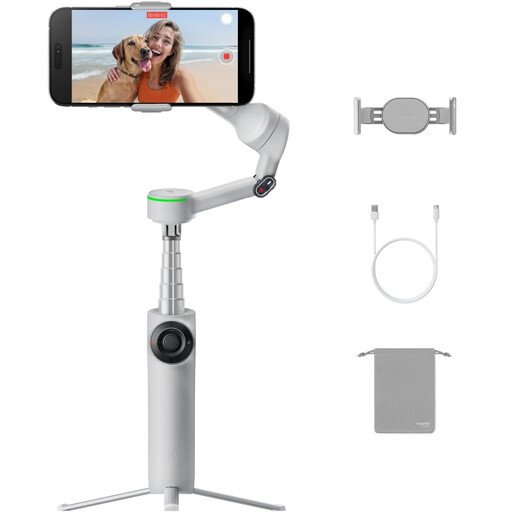
Why it stands out: The Insta360 Flow 2 Pro is much more than a simple phone gimbal. It features incredible AI tracking technology that keeps your subject perfectly in frame, even while in motion. Its foldable design makes it ultra-portable, and its 3-axis stabilization ensures impressively smooth videos.
Pros:
Who is it for? Ideal for vloggers, TikTok or YouTube creators, and professionals who demand flawless subject tracking and impeccable stabilization for their videos.
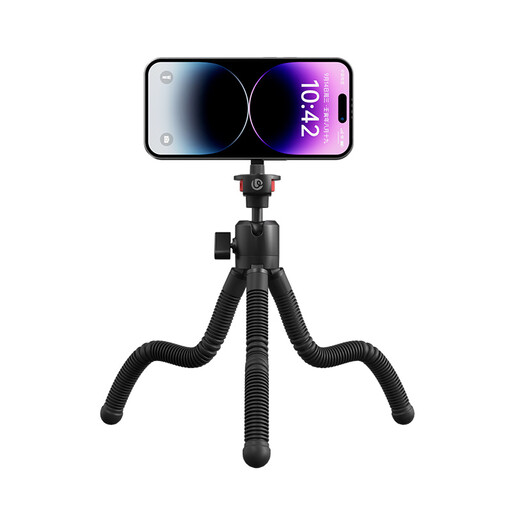
Why it stands out: This flexible tripod stands out for its versatility and the creative possibilities it unlocks. Its articulated "octopus-style" legs can wrap around any object. Even better, its magnetic feet allow you to attach it to metal surfaces for completely new camera angles. It's the ultimate compact and clever travel companion.
Pros:
Who is it for? Perfect for adventurers, creative mobile photographers, and anyone looking for an ultra-versatile and portable phone video mount to capture the moment.
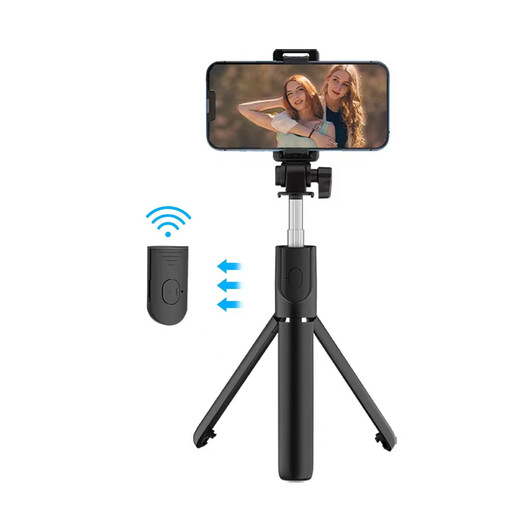
Why it stands out: The Verbex K50 is the Swiss Army knife of mobile shooting. It combines a selfie stick with a tripod, an impressive extension height, and two fill lights. It's designed for those who demand maximum flexibility, whether for a social media livestream, a group photo, or an indoor video.
Pros:
Who is it for? Recommended for streamers, families tired of leaving someone out of the picture, and anyone looking for a versatile tool to switch from selfies to livestreams in a flash.
Our selection highlights products with distinct features, but the world of smartphone accessories is vast. If your needs are different or you simply want to explore other options, feel free to browse our full catalog.
Discover All Our Tripods and Selfie Sticks
1. What's the difference between a tripod, a selfie stick, and a stabilizer? To put it simply: a phone tripod provides stability from a fixed point to prevent blur. A selfie stick extends your arm's reach for wider angles. A smartphone stabilizer (or gimbal) uses motors to cancel out your movements and create perfectly smooth videos. More and more products are now combining these functions.
2. Is a phone tripod compatible with all smartphones (iPhone, Android)? Yes, the vast majority of tripods use an adjustable, spring-loaded clamp that is compatible with almost every model on the market. However, you should always check the supported dimensions (minimum and maximum width) of the mount, especially if you have a particularly large smartphone or a thick case. A tripod for an iPhone will work just fine with a similarly sized Android model.
3. Do I really need a gimbal for vlogging? It's not mandatory, but it's a vlogging accessory that is a complete game-changer. If you're filming while walking or following a subject, a phone gimbal will deliver a professional smoothness that even the best built-in smartphone stabilization can't match. For static videos (talking-head shots, tutorials), a good tripod is more than enough.