
Livraison le jour même ou le lendemain

Qualité garantie

Débloquez vos offres de bienvenue: Livraison GRATUITE | Jusqu'à -80 % | 30 jours d'essai gratuits à JoyPlus
Téléchargez l'application
Do you have a smartphone that takes stunning photos, but your holiday videos or vlogs still look like a shaky, seasickness-inducing Blair Witch Project scene?? It's a classic problem. The market promises the world, but it's easy to fall into a trap, leaving you with an unused gadget and a significantly lighter wallet.
Before you take the plunge, watch out for these two common pitfalls:
This guide is here to help you identify the features that truly matter and choose the right smartphone stabilizer for your needs, without being swayed by marketing hype.
To turn your phone into a true pocket-sized Steadicam, three technical points deserve your full attention. This is what separates a gimmick from a lasting investment.
The secret to a good smartphone gimbal is its motors. Most entry-level models offer only 2-axis stabilization (pan and tilt). This is decent for correcting minor shakes, but for truly smooth movements (while walking, running, or following a subject), 3-axis stabilization is essential. The third axis, roll, compensates for swaying motions and gives your videos that coveted cinematic look. For a phone video stabilizer that delivers on its promises, always aim for a 3-axis model.
A stabilizer is useless if it can't support your phone. Period. Before buying, check the maximum payload (the weight the device can handle). Factor in the weight of your smartphone with its case and any potential accessories (microphone, add-on lens, etc.). An overloaded stabilizer means strained motors, parasitic jitters, and a battery that drains in no time. Also, make sure the clamp is wide enough for your device.
A good vlogging accessory should be unobtrusive. Portability is therefore essential. A foldable model that slips into a jacket pocket or a small bag is the one you'll actually use. Battery life is the other crucial factor: aim for a battery that can last a full day of shooting (at least 8 to 10 hours).
Finally, integrated features can be a game-changer. A built-in stabilized selfie stick or smartphone tripod means fewer accessories to carry. These details transform a simple stabilizer into a true Swiss Army knife for smartphone videography.
Instead of a list of spec sheets, let's look at which product is right for which need.
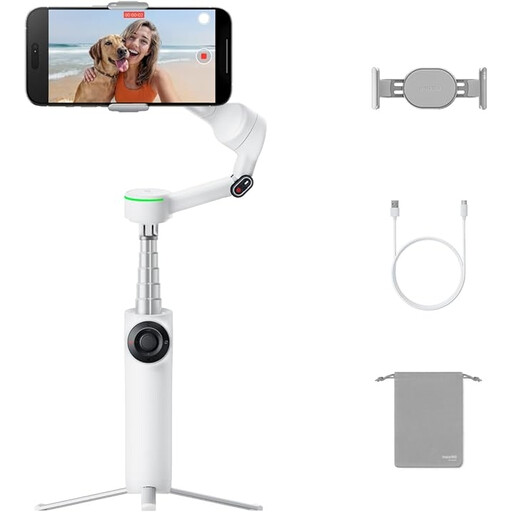
For whom ? For those who want top-tier technology: ultra-high-performance AI subject tracking (even when zooming), and a complete ecosystem with a remote and lighting for a professional finish.
It avoids the complexity trap with rapid deployment and an AI that handles tracking on its own. Its 10-hour battery life (manufacturer's claim) protects you from running out of power mid-shoot.
Cutting-edge AI tracking (effective even at 15x zoom, according to Insta360) and an all-in-one package: tripod, selfie stick, remote, and light.
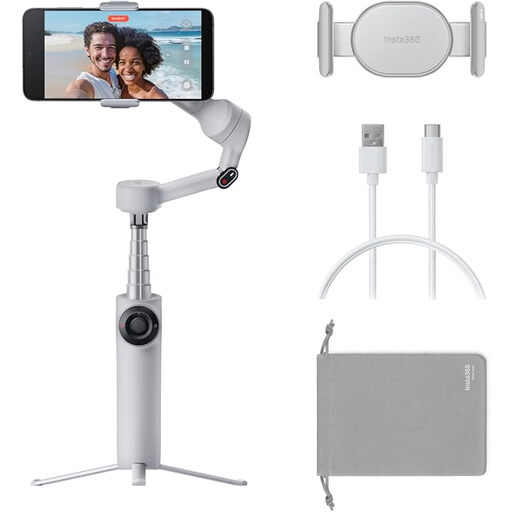
For whom ? The perfect tool for travellers and vloggers who prioritize an all-in-one, easy-to-carry setup that's ready to use in an instant, without being weighed down by accessories.
Its foldable design and integrated tripod/selfie stick combo make it incredibly self-sufficient. No more overflowing bags! Its "unfold and shoot" philosophy directly tackles the problem of complexity.
High-performance 3-axis stabilization in a pocket-sized format. The AI tracking and gesture control are perfect for filming yourself.
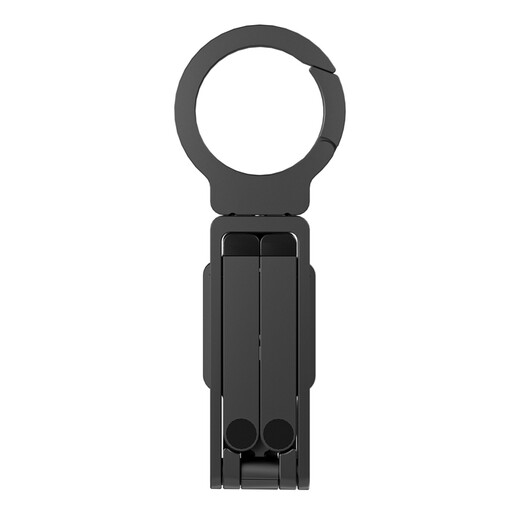
For whom ? Ideal for stabilizing static shots, timelapses, video calls, or selfies, without the complexity (and cost) of a motorized stabilizer.
It completely sidesteps the trap of complex and expensive gimbals. This is the ultimate smart tool: simple, ultra-portable, and affordable, it solves a core need—keeping your phone steady.
Instant magnetic MagSafe attachment (for compatible iPhones). A 3-in-1 concept (grip, mini-stick, tripod) made of aluminium, making it both lightweight and sturdy.
Discover our full selection of mounts and stabilizers, tested and approved by our editors for their reliability and ease of use.
A 2-axis stabilizer corrects up/down (tilt) and left/right (pan) movements. The improvement over handheld shooting is already noticeable. But a 3-axis model adds roll correction (rotation on its axis), which is crucial for smoothing out the swaying motion of walking. The result is an incomparably smoother, professional-looking video.
This is a point you can't overlook. Before buying, check two things: the clamp width (in mm), to ensure your smartphone fits, and the payload (in g), so the motors can support the total weight (device + case). Most recent models are very flexible, but it never hurts to double-check.
Older models could be a real headache, requiring tedious manual balancing. Today, modern stabilizers like the ones in our selection are designed to be almost instantaneous. Thanks to powerful motors and smart clamps (magnetic or self-centering), you just need to clip on your phone to start shooting in seconds.