
Livraison le jour même ou le lendemain

Qualité garantie

Débloquez vos offres de bienvenue: Livraison GRATUITE | Jusqu'à -80 % | 30 jours d'essai gratuits à JoyPlus
Téléchargez l'application
A body composition scale, better known as a smart scale, promises much more than just your weight on a screen. It breaks down your body composition, from fat mass to muscle mass, and syncs everything to your smartphone. But faced with an overwhelming number of options and sometimes misleading marketing claims, it's easy to feel lost. As a product expert at Joybuy, my mission is to cut through the noise and help you identify the criteria that truly make a difference.
The market is flooded with models, each with more enticing features than the last. To ensure your purchase doesn't end in disappointment, keep an eye out for these three common traps.
To avoid these setbacks, focus on a few key technical specifications. They are the true hallmark of a quality and relevant body composition scale.
The heart of the device relies on Bioelectrical Impedance Analysis (BIA). A very low-intensity electrical current passes through the body to estimate the composition of different masses (fat, muscle, water). For a reliable measurement, check these points?:
A smart scale is nothing without a high-quality digital ecosystem.
Beyond the technical specs, the scale's design and materials directly impact its durability and everyday ease of use.
Rather than an exhaustive list, here are a few models that meet specific needs, based on the reliability and relevance criteria we've just discussed.
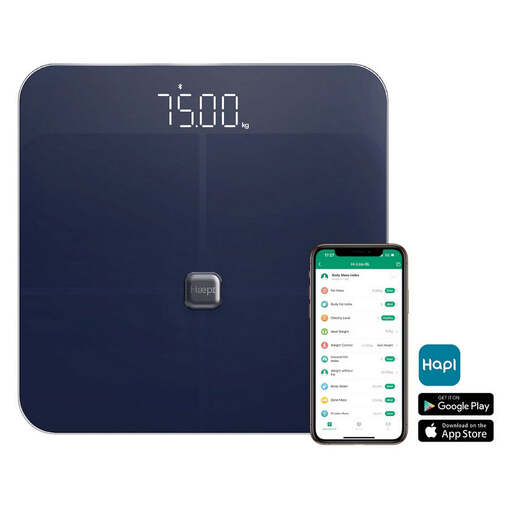
Why it's a great choice : Perfect for families thanks to its simple multi-profile management via the OntoFit app. Its 15 key indicators provide a complete view of body composition for every member of the household.
It focuses on 15 relevant indicators without falling into metric overload. The app, designed for clear tracking and intuitive multi-user management, avoids the frustration of a convoluted interface.
15 body data points analysed (BMI, fat, bone, muscle, water). Bluetooth sync with the OntoFit app. Batteries included and a 15-year warranty.
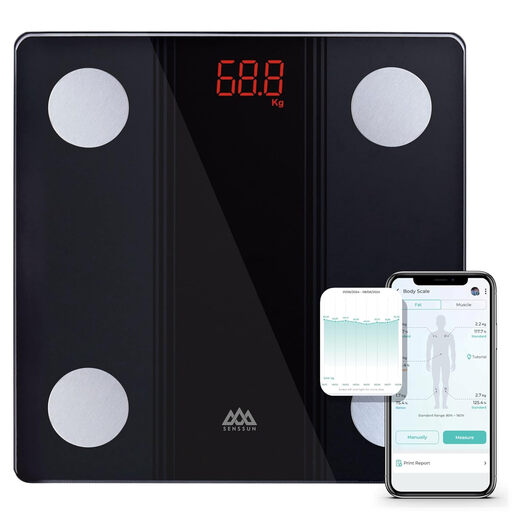
Why it's a great choice : Perfect for getting started with body analysis. This model gets straight to the point (14 metrics, Bluetooth connection, dedicated app) at a very accessible price, without sacrificing precision (0.1 kg increments).
It proves that an entry-level price doesn't mean a gimmick. The MovingLife app is simple, and its four precision sensors ensure consistent measurements, which is essential for serious tracking.
14 indicators analysed (BIA technology). Syncs with the MovingLife app. 5 mm tempered glass platform and management for up to 15 users.
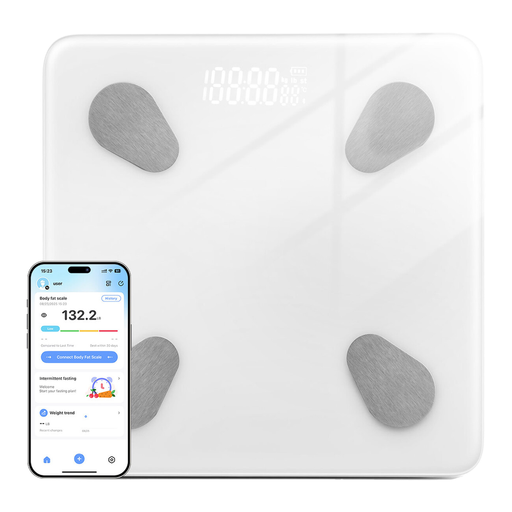
Why it's a great choice : For those who won't compromise on precision or design. Its precision down to 50 grams (0.05 kg) is a real plus for athletes or people on a strict diet, where every variation counts.
It bets everything on the quality of its sensors to avoid the trap of imprecision. Rather than piling on gimmicky features, it ensures an ultra-reliable base measurement, which makes the data calculated by the (okok) app all the more relevant.
Very high precision (50 g). Bluetooth connection to the okok app. Highly readable LED screen and minimalist design. Max weight: 180 kg.
We've put together a complete selection of scales that meet our quality criteria and the expectations of the most demanding users.
A classic scale only measures your total weight. A body composition scale goes further: it uses Bioelectrical Impedance Analysis (BIA) technology to estimate the distribution of this weight among different masses (fat, muscle, bone, and water). It also calculates indicators like BMI (Body Mass Index).
Consumer-grade scales provide an estimate, not a medical-grade measurement. Their main benefit is for tracking trends over the long term. To get consistent results, the golden rule is to always weigh yourself under the same conditions: in the morning on an empty stomach, after using the restroom, and always on the same surface. Consistency is more important than the absolute value displayed.
Absolutely, and this is a crucial point that is often overlooked. To ensure the accuracy of the sensors, a scale, whether digital or body composition, must be placed on a hard, perfectly flat surface, like tile or hardwood floors. Absolutely avoid carpets, rugs, or soft flooring, which will systematically skew the measurements.