
Same-day & Next-day Delivery

Quality Guaranteed

Unlock Your Welcome Offers: FREE Delivery | Up to 80% OFF | Free 30-day JoyPlus trial
Download the APP
Whether you're bulking up, on a strict diet, or simply want to eat better, the smart nutrition scale has become an essential tool. The problem? The market is saturated with models making enticing marketing promises, and it's easy to end up with a gadget that complicates your life instead of simplifying it. Our mission: to help you see things more clearly and avoid the pitfalls so you can make the right choice.
Before you even dive into the spec sheets, let's identify the deal-breakers that can turn your purchase into a daily headache.
To avoid these pitfalls, focus on the fundamentals that separate a gimmick from a genuine tracking tool.
This is the non-negotiable criterion. There are two main levels of precision:
Also, remember to check the max capacity (usually 5?kg, which is more than enough) and the minimum weight it can detect, which is a good indicator of the sensors' sensitivity.
All the "intelligence" of the scale depends on the quality of its app. A good app must offer:
The promise of a nutritional analysis scale is to translate weight into concrete information. The smartest models don't delegate everything to the app. Some have a built-in screen that displays key data in real time. No more need to pull out your smartphone for every weigh-in. This is a huge time-saver and makes for a much more convenient daily experience.
Instead of an endless catalogue, here are three models that meet specific needs and avoid the pitfalls we've mentioned.
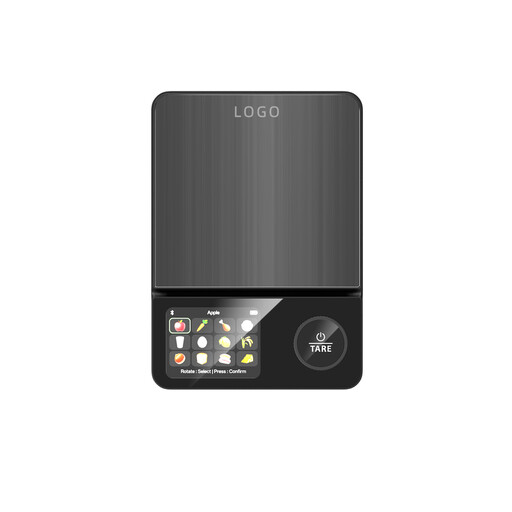
Why we recommend it: Perfect for athletes and anyone on a strict diet. Its detailed analysis of 30 nutrients and high precision allow for meticulous intake tracking, which is essential for achieving performance or health goals.
Its 2.8-inch TFT colour screen displays macros directly on the scale. No more total reliance on the app. Its offline analysis function for 12 common foods makes it autonomous, even without a smartphone nearby.
0.1g accuracy (for weights under 1 kg) for surgical precision. Integrated screen to check calories, protein, fat, and carbs at a glance.
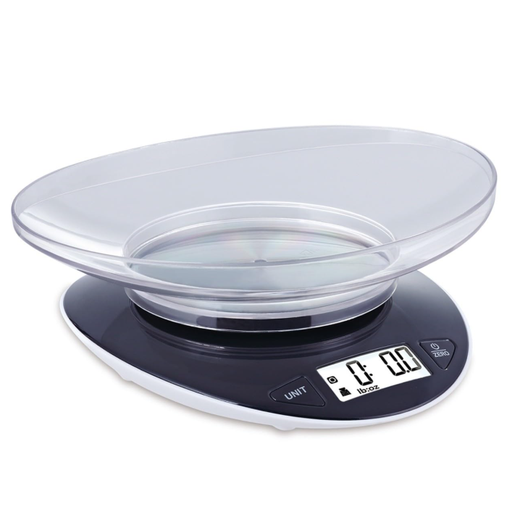
Why we recommend it: Perfect for those who just want to control their daily portions without the complexity of an app. Simple, reliable, and ready to use out of the box with its included bowl.
This model gets straight to the point: it weighs things, and that's it. It avoids the trap of superfluous features and clunky apps by forgoing connectivity altogether.
0.8L removable bowl included, ideal for liquids or loose ingredients. Tare function and a large LCD screen for perfect readability.

Why we recommend it: Designed for home baristas and demanding bakers, it offers formidable accuracy and dedicated features (timer, flow rate measurement) that are crucial for a perfect pour-over coffee or a delicate recipe.
It doesn't claim to be a nutrition scale, and that's its strength. It excels in one specific area: high-precision weighing. It thus avoids the trap of false versatility by focusing on what it does best.
0.1g accuracy and ultra-responsive sensors. Integrated timer and flow rate indicator. Minimalist design and a USB-C rechargeable battery.
Explore our full selection of products that meet our quality criteria and current safety standards.
For weighing a 150g chicken breast, 1g accuracy is more than enough; the margin of error is negligible. However, for measuring 2g of yeast, 0.5g of a spice, or tracking your carb intake to the gram, a scale with 0.1g accuracy becomes essential. Without it, the risk of measurement errors can ruin a recipe or throw off a nutritional plan.
Generally, no. Most scales operate in a closed ecosystem, using the manufacturer's proprietary app. It is therefore crucial to evaluate the quality of that app before you buy, as you won't be able to switch to a different one.
A few golden rules: always place it on a flat, stable surface. Clean the platform with a soft, damp cloth (never submerge it!). Avoid exceeding its maximum capacity and dropping objects on it. A little care is all it takes to preserve the accuracy of its sensors for years to come.