
Livraison le jour même ou le lendemain

Qualité garantie

Débloquez vos offres de bienvenue: Livraison GRATUITE | Jusqu'à -80 % | 30 jours d'essai gratuits à JoyPlus
Téléchargez l'application
Persistent condensation on windows, laundry that takes too long to dry or a musty smell in the basement: these are often signs of excess humidity. A smart dehumidifier helps improve the air quality in a room while allowing you to control it remotely through an app.
However, product specifications can sometimes combine theoretical extraction capacity, covered area and noise levels measured under different conditions. Here are the key points to review before buying, along with a selection of models suited to several common uses in France.
A rating such as “12 L/day” or “20 L/day” generally refers to measurements taken at 30°C and 80% relative humidity. In a cool bedroom or a poorly heated basement, the amount of water collected will often be lower.
The stated coverage area should therefore be treated as a guideline, not a guarantee. A dehumidifier rated for 24 m² will not necessarily perform the same way in a room open to a hallway, surrounded by cold walls or with limited ventilation.
A quiet dehumidifier will naturally be more comfortable to use in a bedroom, but noise levels vary depending on the operating mode. You should distinguish between sleep mode, maximum fan speed and the occasional sounds produced by the compressor.
Start-up noises, vibrations on uneven flooring and fan airflow also affect perceived noise. A rating of 32 or 35 dB cannot therefore be compared directly with a measurement taken under different conditions.
A small tank means more frequent emptying, especially when the appliance is used to dry laundry. For regular use, it is better to choose a model with continuous drainage, provided you can install the hose with a consistent downward slope to a suitable drain.
Automatic shut-off when the tank is full is equally essential. It prevents the appliance from continuing to operate when the reservoir can no longer collect water.
For a standard-sized room, a 12L dehumidifier may be suitable for an area rated at up to 24 m². In a large living room, a particularly damp home or several interconnected rooms, a 20L dehumidifier rated for 40 m² will provide more capacity to spare.
Published figures must be considered in context: temperature, initial humidity and air circulation all directly affect performance. Keep the windows closed while the appliance is running, and leave enough clearance around it to ensure proper airflow.
A dehumidifier with WiFi control generally lets you set a target humidity level, schedule operating periods and start a cycle remotely. Check that the app is compatible with your smartphone, and whether it requires a 2.4 GHz WiFi network.
The most useful features include:
Automatic mode does not eliminate the need to monitor humidity independently. Depending on their location and the way air circulates, sensors may display noticeably different readings.
Electrical power provides an initial indication of energy consumption, but it is not enough to calculate the total running cost. A 195 W appliance running for 5 hours theoretically consumes around 0.975 kWh. The actual cost then depends on your electricity tariff and the appliance’s effective operating time.
To find a low-energy dehumidifier, compare power consumption, the quality of its automatic regulation and its scheduling options. Maintenance is just as important: clean the filter regularly and allow it to dry completely before reinstalling it.
Models that use R290 refrigerant must remain upright. After transporting the appliance on its side or at a steep angle, consult the manual and observe the recommended waiting period before plugging it in. In all cases, leave at least 20 cm of clearance around the air inlets and outlets.
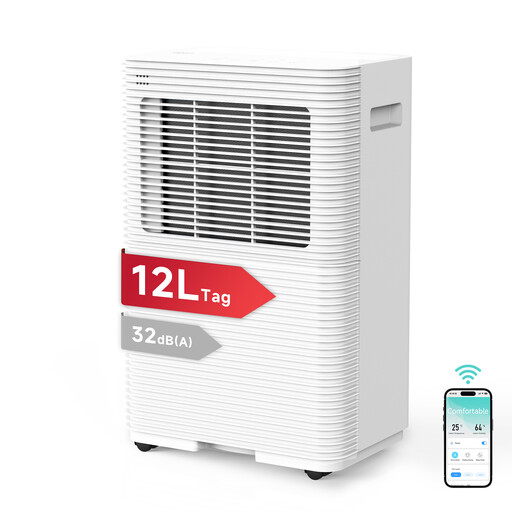
Why this model may be a good fit: it is designed for rooms of up to 24 m², such as a bedroom, home office or small living room, and can be controlled through an app.
Its 1.8 L tank can be paired with continuous drainage. The specifications also distinguish sleep-mode noise from the stated 38 dB(A) rating.
Rated extraction of up to 12 L/day, 195 W rated power, automatic, laundry-drying and sleep modes, dedicated app and child lock.
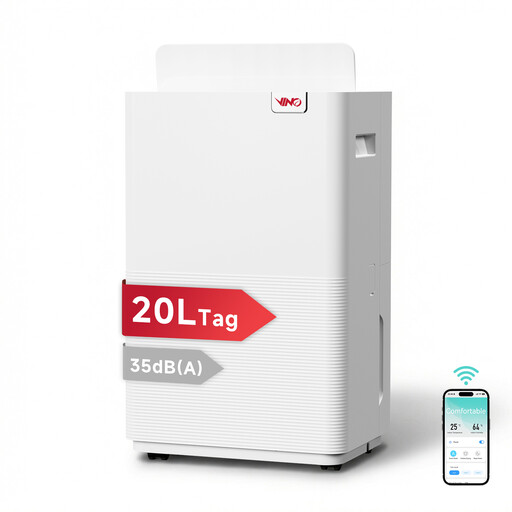
Why this model may be a good fit: its stated capacity of 20 L/day is intended for rooms of up to 40 m², damp living spaces and regular laundry-drying sessions.
Its 2.5 L tank can be supplemented with hose drainage. Sleep-mode noise should be distinguished from the 40 dB(A) figure stated in the specifications.
365 W rated power, app with 24-hour scheduling, antibacterial PET filter, automatic internal drying, castors and child safety lock.
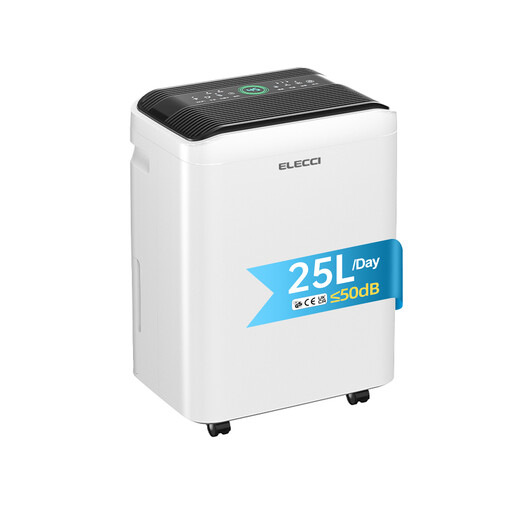
Why this model may be a good fit: it is aimed at users looking for high extraction capacity for a basement, garage, office or large room rated for up to 50 m².
The large-capacity tank reduces the need for emptying, while the hose provides continuous drainage. Automatic defrosting is designed for less-heated rooms.
Rated extraction of up to 25 L/day, stated operating noise of 36 dB, three speeds, 24-hour timer, laundry mode and a two-year warranty.
We have brought together an up-to-date selection of appliances and accessories to make it easier to manage collected water and everyday humidity.
It depends on the appliance’s power rating, the temperature, humidity level and number of hours in use. Automatic mode can limit operating cycles by switching off the compressor once the target humidity has been reached. To estimate consumption, multiply the power in kilowatts by the operating time, then by the price per kilowatt-hour charged by your provider.
Yes, provided you choose a model with a sleep mode and check the corresponding noise level in the specifications. Place it on a stable surface, away from the bed and textiles, without blocking the ventilation grilles. Scheduling it to run for a few hours overnight can also prevent continuous operation.
A setting between 50 and 60% relative humidity is a good starting point for most homes. Adjust it according to the season, temperature and how the room feels. A dehumidifier helps reduce ambient humidity, but it does not replace ventilation, repairing a leak or addressing an underlying structural issue.