
Livraison le jour même ou le lendemain

Qualité garantie

Débloquez vos offres de bienvenue: Livraison GRATUITE | Jusqu'à -80 % | 30 jours d'essai gratuits à JoyPlus
Téléchargez l'application
A smart body composition scale is a powerful tool for tracking your progress, whether you're looking to lose weight or improve your physical condition. But with a crowded market, it's easy to be swayed by misleading marketing claims. As the Head of Product Recommendations at Joybuy, my role is to help you cut through the noise and identify the criteria that truly make a difference.
Before you buy, here are 3 pitfalls to avoid at all costs:
To avoid these disappointments, focus on the fundamentals. These are what guarantee the quality and usefulness of your future smart scale.
The heart of a body composition scale is its ability to perform a Bioelectrical Impedance Analysis (BIA). A very low-intensity electrical current, which is imperceptible and harmless (unless medically contraindicated), passes through your body. The resistance it encounters (the impedance) is used to estimate your body composition.
The "smart" component is what sets it apart from a classic scale. The Bluetooth connection should be simple and fast.
A smart scale is also an object that becomes part of your daily life. Its design should be as practical as it is durable.
To help you get started, here are a few models that meet specific needs, all selected according to the criteria we've just detailed.
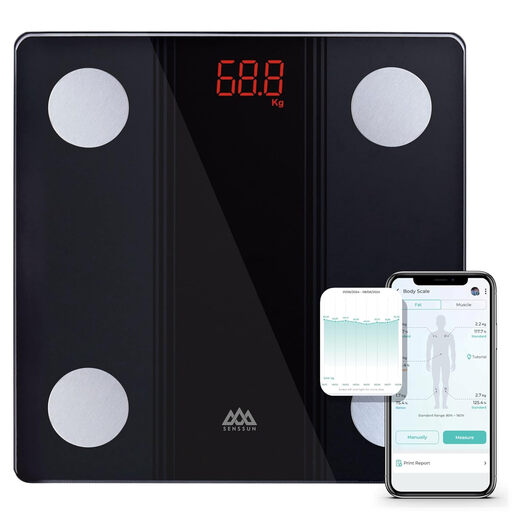
Why we chose it: Perfect for getting started with body composition tracking without breaking the bank. It focuses on the essentials and connects to the MovingLife app to easily visualise your progress.
It focuses on 14 key metrics, without overwhelming the user with superfluous data. Its simple app allows for crystal-clear progress tracking.
An unbeatable feature-to-price ratio. Support for 15 users is a real bonus, which is rare in this segment.
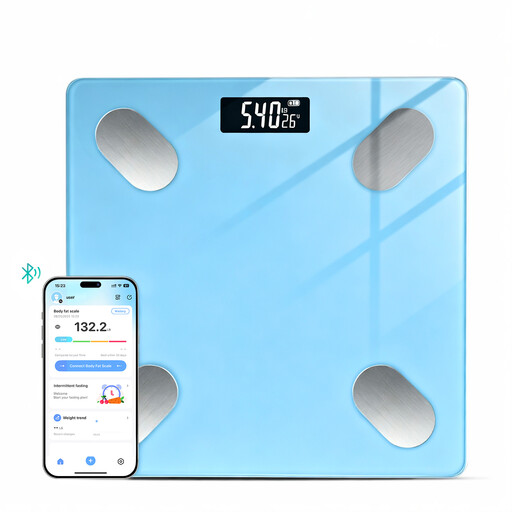
Why we chose it: The quintessential family model. Its automatic user recognition simplifies tracking for everyone, without having to fiddle with profiles in the app for each weigh-in.
The OKOK app, designed for shared use, is highly intuitive. It avoids complexity by displaying each user's trends clearly and distinctly.
Automatic profile recognition. Tracking 13 essential health metrics provides a comprehensive overview.
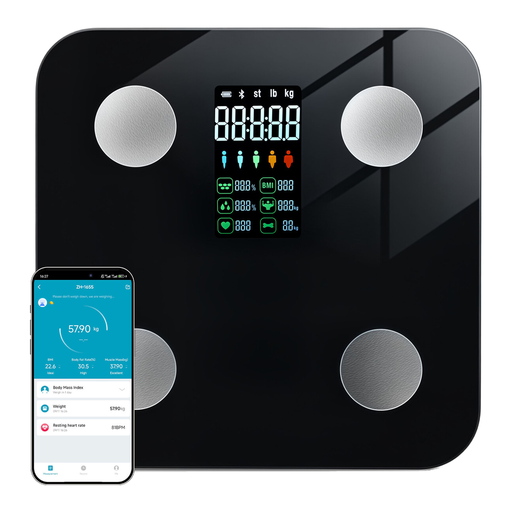
Why we chose it: Designed for athletes and anyone who wants maximum info at a glance. Its colour screen displays weight, body fat, and even heart rate directly on the scale.
It eliminates the frustration of having to open the app every time by displaying key data on its colour screen. The Tuya app becomes a tool for long-term tracking, not a daily chore.
Colour LCD screen with heart rate measurement. High precision of 0.05 kg for accurately tracking fitness goals.
We have curated a complete, up-to-date selection of scales that meet our strict selection criteria and current standards.
For reliable measurements, follow these simple rules:
No, almost all smart scales work with a free app provided by the manufacturer (such as OKOK, MovingLife, Tuya, etc.). These apps provide the essentials: synchronisation, viewing metrics, and tracking progress charts. Be wary of the rare models that require a paid subscription to access your own data—this is a practice to avoid.
BIA technology provides a very useful estimate for tracking trends, but it has its limitations. The results may be less accurate for certain profiles: elite athletes, the elderly, growing children, or pregnant women. Most importantly, the use of the body composition feature is strictly contraindicated for individuals with electronic medical implants (such as pacemakers). For these users, the scale can be used in a simple weight-only mode. In all cases, only a healthcare professional can provide a reliable medical interpretation of this data.