
Livraison le jour même ou le lendemain

Qualité garantie

Débloquez vos offres de bienvenue: Livraison GRATUITE | Jusqu'à -80 % | 30 jours d'essai gratuits à JoyPlus
Téléchargez l'application
Weighing yourself is no longer just about a number. For anyone who truly wants to understand their body, track their fitness progress, or adopt a healthier lifestyle, weight alone is far too limited. This is where the smart body composition scale comes in: it offers a complete analysis, turning a simple morning routine into a comprehensive health dashboard.
But with so many options on the market, how do you choose the right one? Our guide is here to break down the key criteria and introduce you to the best models available, so you can find the perfect partner for your digital weight management journey.
To find the scale that’s right for you, you first need to understand what sets one model apart from another. Here are the three key points to consider before making your choice.
The real power of a body composition scale is its ability to provide a detailed picture of your body makeup. Going far beyond just weight, these scales estimate a multitude of metrics using a very low-intensity electrical current that passes through the body. The most common data points include:
Some models go even further by measuring your resting heart rate, adding valuable data about your cardiovascular health.
The 'smart' aspect is the core of the experience. A Bluetooth-connected scale automatically syncs with a dedicated app on your smartphone (iOS or Android), dramatically increasing its usefulness. The benefits are clear:
Be sure to check the app's usability and reviews: it will become your daily digital health coach.
The reliability of the measurements is directly linked to the quality and number of sensors. Most consumer-grade scales are equipped with 4 electrodes on the platform. For a more detailed and segmented analysis (arms, legs, torso), more advanced models feature 8 electrodes, thanks to a handle you hold during the weigh-in.
Precision also comes down to the measurement increments (usually 50g or 100g). Finer increments are a real plus for rigorously tracking even the smallest changes, which is especially motivating when on a diet or fitness programme.
To put theory into practice, here is our selection of models that caught our eye. From simple family tracking to advanced body analysis, there's an option for every user.
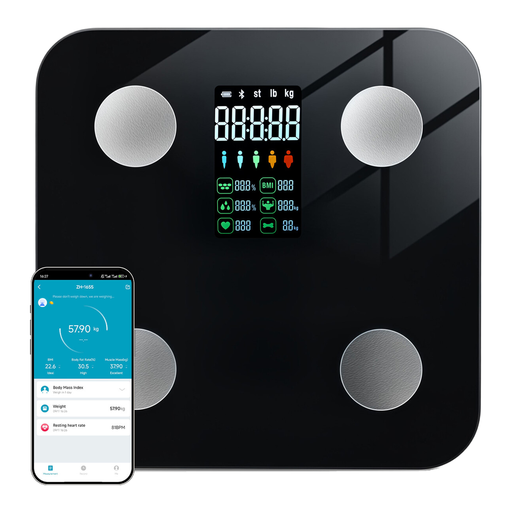
Key features: The Sparoma ZJ08 stands out with its large colour LCD screen, which displays key data (weight, body fat, heart rate) without you even needing to pull out your phone. It's a great feature for a quick check-in right out of bed. Its Bluetooth connectivity via the Tuya app ensures simple and effective tracking for the whole family.
Pros:
Best for: Ideal for families and anyone who wants comprehensive tracking with immediate visual feedback, without always depending on their smartphone.
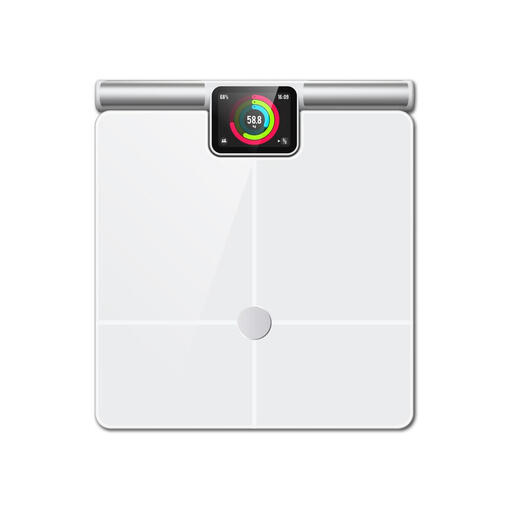
The next level: This is where we step up to the next level. With its 8-electrode technology (4 on the platform, 4 on the handle), this scale performs a dual-frequency bioelectrical impedance analysis (BIA) for ultra-detailed segmental measurement. Add a 3.36-inch TFT colour screen and dual Wi-Fi + Bluetooth connectivity, and you have a cutting-edge tool for the most demanding users.
Pros:
Best for: Athletes, fitness enthusiasts, and anyone who wants the most detailed body analysis possible to optimise their training and nutrition.
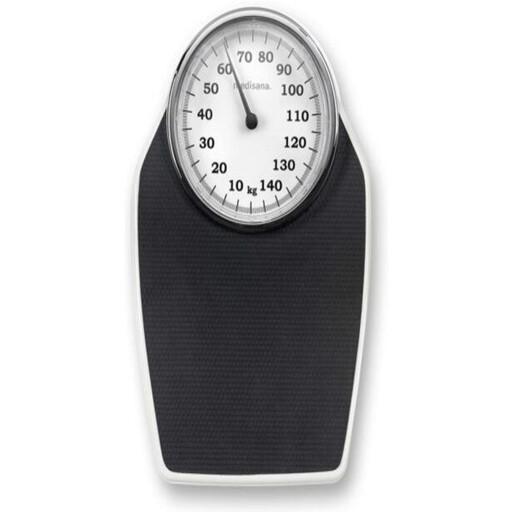
Back to basics: Going completely against the grain, the Medisana PSD focuses on pure simplicity. Entirely mechanical, it does away with batteries and apps. With its retro design, sturdy metal housing, and large analogue dial, it's a beautiful object that is as practical as it is decorative.
Pros:
Best for: For purists who value simplicity, reliability, and aesthetics, or for anyone who just wants to know their weight without drowning in data and apps.
Our selection gives you a starting point, but choosing a scale is a very personal decision. If you haven't found the perfect fit yet, or if you're simply curious to see other designs and features, feel free to explore our full catalogue.
? Discover our full range of bathroom scales to find the model that's right for you.
The principle is simple: the scale sends a very low-intensity electrical current—completely imperceptible and harmless—through your body via electrodes. This current travels at different speeds through fat, muscle, and bone. By measuring this resistance (called impedance) and combining it with data like your age, sex, and height, algorithms estimate your body's composition.
Let's be clear: consumer-grade models provide an estimate, not a medical-grade measurement. Their real strength lies in consistency. For tracking to be meaningful, the golden rule is to always weigh yourself under the same conditions: at the same time (ideally in the morning, before eating), on the same flat, hard surface. What matters isn't the number of the day, but the long-term trend that emerges.
Not necessarily; it all depends on the model. Standard Bluetooth scales require the app to be open (or running in the background) on your smartphone for instant syncing. However, more advanced models, especially those with Wi-Fi, are more autonomous: they can store multiple weigh-ins and automatically sync them to your account as soon as they connect to the network, even if your phone isn't nearby.