Buying priorities
Start with the dimensions and opening clearance, then match the capacity to the amount of laundry you actually produce before deciding whether mechanical drying is essential.
| Priority |
What to check |
Your needs |
| Footprint and clearance |
Compare the model's width, height and depth with its dimensioned plan. Check the opening of the door or lid, neighbouring furniture and the available walkway. A slim front-loading model is approximately 33 to 45 cm deep; a top-loading model is approximately 40 to 46 cm wide, according to UFC-Que Choisir. |
I want the appliance to remain usable once installed, without blocking a door, piece of furniture or the route used to load the laundry. |
| Washing capacity |
For one or two people, use the 5 to 7 kg guideline cited by UFC-Que Choisir. Also check the permitted loads for each programme and avoid choosing a drum based solely on its stated maximum capacity. |
I want a capacity suited to everyday laundry, bedding and towels, without having to run lots of small washes. |
| Mechanical drying |
With a washer-dryer, compare the washing and drying capacities separately. Check the duration and details of the wash-and-dry cycle if you plan to use it regularly. |
I need to be able to dry some laundry at home without installing a second appliance. |
| Use, noise and maintenance |
Compare the energy rating, energy consumption per 100 cycles, water consumption per cycle, programme duration and noise level on the EU label. Also check access to the filter, detergent drawer and door seal. |
I want to compare consumption and noise without relying solely on the stated capacity. |
Brand guide
This section includes guidance on comparing appliance formats, capacities and installation requirements across brands, so you can choose the best option for your space.
Joybuy products
Joybuy options for a small home: narrow top-loading models, front-loading washing machines with reduced depth and washer-dryers combining both functions in a single appliance.
 Image unavailable
Haier T Series 7 THASN276TM6-S, 7 kg top-loading model
This top-loading model may suit spaces where width and clearance in front of the appliance are limited.
Stated width of 405 mm, 7 kg capacity, 1200 rpm spin speed, A rating and 40 kWh/100 cycles.
It does not offer mechanical drying. Check the clear height needed to open the lid, as well as the dimensioned plan, before buying.
Joybuy
 Image unavailable
Candy TCA464TM4-S ProWash 500, 6 kg top-loading model
Its top-loading design and stated width of 40.5 cm make it suitable for a narrow alcove or bathroom.
6 kg capacity, 1400 rpm spin speed, B rating, 17 programmes and quick cycles from 14 to 59 minutes.
Without integrated mechanical drying, it requires a separate drying solution. The stated spin noise level is 79 dB(A); also check the clear height above the lid.
Joybuy
 Image unavailable
Hisense WF5I8043BWF, 8 kg front-loading model
This front-loading washing machine is designed for installations where alcove depth is more restricted than width.
8 kg capacity, stated depth of 470 mm, 1400 rpm spin speed, A rating, 33 kWh/100 cycles, 38 L/cycle and 72 dB(A) during spinning.
It does not include mechanical drying. Check the width of 595 mm and the clearance required in front of the door.
Joybuy
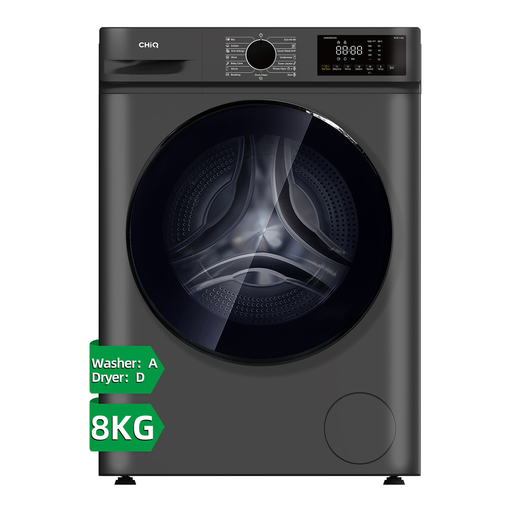 Image unavailable
CHiQ JW85882HG, 8 kg / 5 kg washer-dryer
This washer-dryer may suit homes where you need to wash and dry without reserving space for a second appliance.
Stated capacity of 8 kg for washing and 5 kg for drying, 530 mm drum, BLDC motor, 1400 rpm spin speed and 16 programmes.
The drying load is limited to 5 kg. Check the dimensioned plan: the title states a width of 465 mm, while the detailed dimensions give 600 × 520 × 847 mm.
Joybuy
 Image unavailable
Samsung WD10HG6U34BEU3, 10 kg / 6 kg washer-dryer
This model combines washing and mechanical drying in a single cabinet for homes without room for two appliances.
Stated capacity of 10 kg for washing and 6 kg for drying, with steam programmes, Air Wash, drum cleaning and a Digital Inverter motor.
Its stated dimensions are 600 × 850 × 590 mm; compare the depth and clearance in front of the door with your installation. Adjust combined loads to the 6 kg drying limit.
Joybuy
Frequently asked questions
What measurements should you take before ordering?
Measure the width, height and depth of the alcove, then check the delivery route and the clearance required for opening. For a front-loading model, allow space in front of the door; for a top-loading model, check the clear height above the lid. Then consult the dimensioned plan and the manual for the exact model.
Can you wash a full load and then dry everything in a washer-dryer?
Yes, but only if the amount of laundry is also within the drying capacity, which is lower than the washing capacity. Otherwise, remove some of the laundry before drying or run separate cycles; the product details should show both capacities.
How do you read the energy label on a washing machine or washer-dryer?
In France, the European Union energy label uses a scale from A to G and shows, among other details, energy consumption per 100 cycles, water consumption per cycle, duration and noise level. For a washer-dryer, look at the data for the programme you actually use, particularly the wash-and-dry cycle if you dry laundry regularly.
Is an airer always a good alternative in a studio flat?
Not necessarily. ADEME states that drying laundry indoors releases a great deal of moisture. Choose a large, well-ventilated room or one fitted with mechanical ventilation extraction. Without suitable ventilation, an airer may not always meet your drying needs.
What should you check about the electrical installation?
Check with the landlord, the appliance manual and, if necessary, an installer that the location is compatible with the existing installation. French regulations for new homes require, among other things, an earth connection, but this alone is not enough to establish whether an older home complies.


