People with a very narrow space
If there’s little width between two units or in your bathroom, a top-loader is worth measuring up. Que Choisir puts the width of this format at between 40 and 46 cm; you’ll also need enough clearance to open the lid.


Start with the measurement that actually limits your installation: a top-loading washing machine is best for a lack of width, while a slim front-loader is better when depth is the issue. If you have around 60 cm of width and want to fit the machine under a worktop, look at compatible front-loaders. If no standard size will fit, a compact model may work for smaller loads, but it may not be suitable for bulky items. In every case, check the door clearance, connections and capacity in the model’s instructions.
If there’s little width between two units or in your bathroom, a top-loader is worth measuring up. Que Choisir puts the width of this format at between 40 and 46 cm; you’ll also need enough clearance to open the lid.
If you have around 60 cm of width but a standard machine would stick out too far into the room, a slim front-loader may be an option. A reduced depth doesn’t mean you can overlook the clearance needed for the door or the space for the hoses.
A front-loader may suit a fitted kitchen if the width, depth, clearance under the worktop and space in front of the door are all suitable. Check the instructions for your chosen model to confirm that it can be installed this way.
Your space constraints determine which format to consider. Then compare the capacity and practical features of the machines that can actually be installed.
Consider this if: the available width limits your options and you can easily access the top-loading door.
Bear in mind: the lid needs clearance above the machine, which can make fitting it under a worktop difficult.
Consider this if: you have around 60 cm of width and want to fit the machine under a worktop.
Bear in mind: you’ll need extra space beyond the machine’s dimensions for the door and connections.
Consider this if: there’s enough width for a front-loader, but not enough depth for a standard model.
Bear in mind: capacity varies by model, and the stated depth alone doesn’t tell you how much space you’ll need for installation.
Consider this if: neither a top-loader nor a standard front-loader will fit, and you only have small loads to wash.
Bear in mind: the mini washing machines described by Que Choisir may not be suitable for bulky items.
| Criteria | What to check before buying | Who this matters to |
|---|---|---|
| Overall size and door clearance | Measure the available width, depth and height, then check the machine’s overall dimensions, door clearance and space for connections in the instructions. | If the machine could block a walkway, I need to make sure it will fit and that I can open it first; around 36% of consumers would make size their top priority. |
| Washing capacity | Compare the rated capacity with your usual loads and any bulky items you need to wash. | If my laundry regularly exceeds small loads, I want to avoid running extra cycles; capacity would be the top priority for around 29% of consumers. |
| Fitting under a worktop and front access | Check in the instructions that the machine is suitable for under-worktop installation, and make sure there’s enough height and clearance for the door. | In a fitted kitchen, I want to keep the worktop without making loading difficult; around 21% of consumers would prioritise this installation option. |
| Energy use, noise and durability | For models that fit your space, check the energy label and the durability index applicable to the model. | When several machines fit the space, I also want to compare their energy use, stated noise levels and durability; this would be the top criterion for around 14% of consumers. |
A top-loader mainly takes up less width; a slim front-loader mainly reduces depth while generally keeping the width of a standard front-loader. So one measurement alone won’t tell you whether the machine will fit in the space.
Measure all three dimensions and compare them with the model’s overall dimensions, rather than relying on labels such as ‘slim’ or ‘compact’.
A front-loader might fit under a worktop but still not have enough room for its door to open. A unit above a top-loader could also block the lid.
Before ordering, check the area needed to open the door in front of the machine or the lid above it.
The mini washing machines featured by Que Choisir have capacities of 2 to 3 kg and may not be suitable for large items.
Check the size of your usual loads, especially sheets and bulky items, before choosing this format.
Loads that won’t fit may mean running extra cycles or finding another way to wash them.
Kinked or trapped hoses can affect the water supply or drainage. Bosch also advises removing the transit bolts and levelling the machine.
Follow the instructions for your model and make sure the connections remain accessible once the machine is in place.
A model worth considering if you need a narrow top-loader: according to the manufacturer’s product information, the freestanding EW6T1265CA has a 6 kg capacity and measures 890 × 400 × 600 mm.
A brand to look at for top-loaders: according to the manufacturer’s product information, the 7 kg TDLRSX7232BSFR measures 40 cm wide, 90 cm high and 60 cm deep.
A brand to consider if you’re looking for a slim front-loader because depth is limited: Candy describes its slim and compact models as having depths of 33 to 46 cm, depending on the model.
This front-loading model is for shoppers looking for a 9 kg capacity. Before choosing it for a small room, check its overall dimensions and the space needed in front of the door: the product information gives different depth measurements.
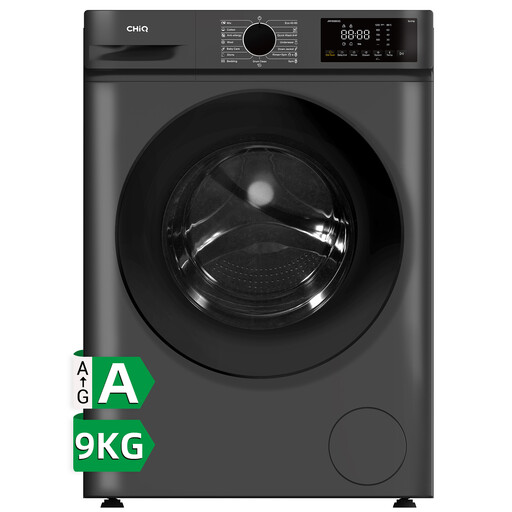 Image unavailable
Worth considering if you need a 9 kg capacity and have clear space in front of the door.
The title states a spin speed of 1 400 rpm and a 530 mm drum.
Check the overall dimensions in the JW95883G documentation: the stated measurements of 465 mm for the chassis and 57,7 cm for the casing aren’t enough on their own to confirm the depth you’ll need in your room. Also check whether the machine can be fitted under a worktop if you’re considering this installation.
Width points to a top-loader if that’s the main constraint; depth points to a slim front-loader if you have enough width for a front-loader. Que Choisir gives a width of 40 to 46 cm for top-loaders and a depth of 33 to 45 cm for slim front-loaders. In either case, check the dimensions and door clearance for the specific model.
Yes, if the model’s instructions allow it and you meet the requirements for height, ventilation and access to connections. You’ll also need enough space in front of the door to load the laundry.
Check that the cold-water tap, waste outlet and electrical supply are accessible and compatible with the instructions for your chosen washing machine. In its support information for the hose, Electrolux specifies a connection to a cold-water tap with a 3/4-inch gas thread; this doesn’t replace the requirements for your model.
It provides extra information to help you compare machines that already fit your space. According to the French Ministry for Ecological Transition, the index began to be introduced for washing machines on 8 April 2025, gradually replacing the repairability index. Check the score out of 10 displayed for the model you’re considering.