Someone who does a weekly shop
You need a capacity suited to one person and must decide whether 100 to 150 L is enough for your shopping habits. Que Choisir gives this range as a guide for one person.


Start by measuring the available height, width and depth, then check the manual for the required ventilation clearances and door-opening space. For one person, 100 to 150 L is a useful capacity guide according to Que Choisir; a model with a separate freezer compartment becomes more suitable if frozen food is part of your weekly shop.
You need a capacity suited to one person and must decide whether 100 to 150 L is enough for your shopping habits. Que Choisir gives this range as a guide for one person.
You need to install a freestanding appliance in a compact space, taking into account the unpackaged dimensions, door swing and airflow requirements specified in the manual.
You need to distinguish between a small freezer compartment and a genuinely suitable freezing space for the volume and frequency of your frozen-food purchases.
Measure the actual space first, then choose the capacity and type of freezer before comparing the energy labels of appliances with a similar capacity.
| Priority | What to check | Your needs |
|---|---|---|
| Fitting the available space | Unpackaged dimensions; door-hanging side and swing; model-specific ventilation instructions. | I want the fridge to fit and open without blocking a unit, wall or access to the socket. |
| Fresh and frozen capacity | Usable fridge litres; freezer litres and star rating; shopping frequency. | My shopping should fit without choosing an appliance that is too large. Que Choisir gives 100 to 150 L as a guide for one person; I will check separately how much space I need for frozen food. |
| Noise and energy use | Annual kWh; energy class; comparable capacity; airborne noise emissions in dB and noise class. | In a room that opens onto the sleeping area or living room, I will compare the stated noise level as well as electricity consumption. |
| Food storage | Temperature setting; internal layout; enough room for cold air to circulate. | I want to store food without overloading the appliance. Anses recommends a temperature of 0 to +4 °C at the coldest point. |
An appliance may fit the available width but still be difficult to ventilate, level or open properly. Installing an appliance without sufficient airflow around it can affect its performance.
Measure the height, width, depth, skirting boards, socket, obstacles and opening side, then check the clearances specified in the model’s manual.
The most compact format may not reach the 100 to 150 L guide given by Que Choisir for one person. An overfilled fridge also restricts the circulation of cold air.
List the contents of a week’s shopping before choosing the capacity; keep the very smallest formats for modest needs or very frequent shopping.
A limited freezer compartment reduces the space available for fresh food and may not be suitable for regularly storing portions or frozen food.
Check the freezer compartment’s litre capacity and star rating on the label or technical specification before choosing a model.
The energy class alone does not tell you the usable capacity, freezing capability or noise level. The European Commission also requires annual kWh, capacity and noise emissions to be shown on the label.
Compare appliances of a similar size and capacity using the class, annual kWh, litres and displayed decibel levels.
The range includes freestanding table-top fridges, including the TSE1284N with a small top freezer compartment.
The KTR15NWEA is a table-top format focused on keeping fresh food properly stored.
The brand offers table-top and under-counter fridges; the COT1S45EW is a compact example with a freezer compartment.
These Joybuy options are compact or narrow fridges suited to a studio flat or first home, with different requirements for fresh and frozen food storage.
 Image unavailable
This model is suitable when width is limited but weekly shopping with fresh and frozen food calls for two separate compartments.
153 L fridge capacity, 74 L four-star freezer capacity, stated width of 54 cm, height of 176 cm, depth of 55 cm, reversible door and stated noise level of 39 dB.
The total capacity may be excessive for very limited shopping. Check the ventilation clearances and door swing in the manual; the Low Frost freezer requires periodic manual defrosting.
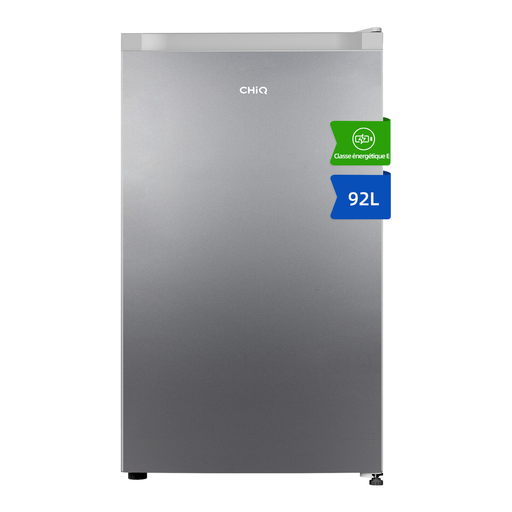 Image unavailable
This option is designed for a very narrow kitchen and frequent or modest shopping, with a freezer compartment intended for occasional use.
Stated capacity of 92 L, width of 47 cm, reversible door, adjustable feet, adjustable glass shelves and salad crisper.
At 92 L, it falls below the 100 to 150 L guide for one person. Check the freezer compartment’s capacity and star rating, along with the full dimensions and installation instructions.
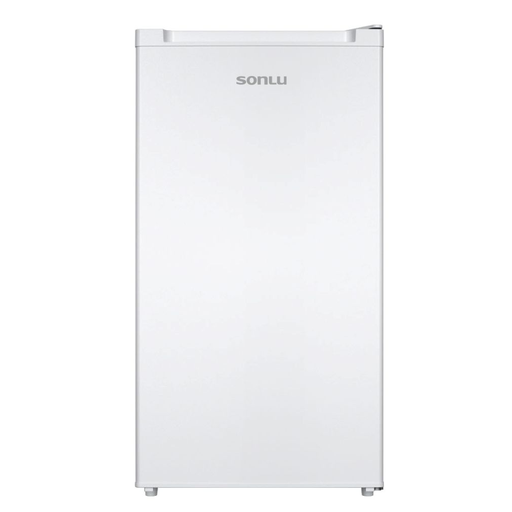 Image unavailable
This format is best suited to frequent shopping focused on fresh food, without a regular need for frozen storage.
82 L capacity, no freezer compartment, adjustable shelves, salad crisper, LED lighting, 40 dB and stated annual consumption of 84 kWh.
The capacity is below the 100 to 150 L guide for one person. Check the external dimensions, opening direction and required clearances before installation.
Use 100 to 150 L of usable capacity as a starting point for one person, based on Que Choisir’s guidance. Then adjust this according to how often you shop and whether you need frozen storage: sufficient fridge space does not replace a separate freezer compartment.
Yes, but only if the unpackaged dimensions, door opening and ventilation clearances match the actual space. Follow the manufacturer’s installation instructions and allow air to circulate around the appliance.
At a minimum, compare the A to G class, annual consumption in kWh, the capacity of the fresh and frozen compartments, as well as the noise level and its class. The European Commission states that this information appears on the labels of fridges and freezers.
Anses recommends a temperature between 0 and +4 °C at the coldest point. Check it after installation or after loading the appliance heavily, and avoid overfilling it so that cold air can circulate.
When an equivalent new appliance is sold, retailers must take back the old appliance free of charge under the one-for-one take-back scheme, according to the DGCCRF. Check the practical arrangements for collection and disconnection with the seller before delivery.