Anyone fitting a machine beneath a worktop
A front-loader may fit if its height, width and depth once connected allow for installation, while leaving enough room to open the door and access the connections.


To fit beneath a fixed worktop, consider a front-loading washing machine, provided there’s enough room for the installed appliance and to open the door. If width is limited, a slim top-loading model may work, as long as you can open its lid. If depth is the issue, compare slim front-loaders, which are generally close to 60 cm wide. Que Choisir describes mini washing machines as an option to consider when a standard machine can’t be installed; if you choose one, check that its capacity is suitable for your usual loads.
A front-loader may fit if its height, width and depth once connected allow for installation, while leaving enough room to open the door and access the connections.
If width is limited, compare slim top-loading washing machines. If the appliance would stick out too far into the room, consider slim front-loaders instead, remembering to allow space in front of the door.
A mini washing machine may be an option, but its capacity, connections and programmes need to suit the loads you actually wash.
First identify which dimension is preventing installation, then compare the space available with the instructions for the model you’re considering.
| Priority | What to check | Based on my needs |
|---|---|---|
| Fitting beneath a worktop | Measure the height, width and depth, including the connections. Check the instructions for the position of the hoses and the space needed to open the door; a top-loader’s lid must be able to open above the appliance. | My washing machine needs to fit beneath a fixed worktop without blocking loading or access to the connections. |
| Available width | Que Choisir gives a width of 40 to 46 cm for top-loading washing machines. Also check their depth and the clearance above the lid. | The space is too narrow for a front-loader; I can keep the area above the appliance clear. |
| Available depth | According to Que Choisir, slim front-loaders are generally 33 to 45 cm deep while remaining close to 60 cm wide. Compare the depth once the hoses are in place, and check there’s enough room in front of the door. | I have enough width, but an appliance that’s too deep would get in the way. |
| Washing capacity | Compare the capacity in kg with your usual loads, particularly sheets and towels. For a mini washing machine, also check the connections, spin cycle and programmes. | Saving space shouldn’t make my usual washing harder to manage. |
| Use and maintenance | If the appliance is near a living area, compare the stated spin noise level in dB. Check that you can access the filter after installation. In France, the Ministry for Ecological Transition presents the washing machine durability index, rated out of 10, as a guide that covers factors including parts, maintenance, ease of dismantling and resistance. | In a small room, I want to be able to maintain the appliance and take spin noise into account. |
A washing machine may fit in its space while the door, lid or connections remain difficult to access.
Draw a plan showing the worktop, back wall, room door, water supply, drainage and socket. Compare it with the dimensions and installation instructions for the exact model.
A slim front-loader mainly reduces depth; according to Que Choisir, its width generally remains close to 60 cm.
If width is your main constraint, compare narrow top-loaders. If the appliance would stick out too far into the room, measure slim front-loaders with the connections in place and the door open.
Its capacity or operation may not suit your usual loads, particularly bulky laundry.
Work out what you need to wash, then check the capacity, connections, spin cycle and programmes of the model you’re considering.
Promotelec advises against using an extension lead or multiway adaptor with a washing machine because of the risk of overloading. In a bathroom, the position of the socket in relation to the shower or bath also needs careful consideration.
Plan for the appliance to plug directly into a dedicated wall socket. Have the installation checked if it’s old, has been modified or is in a bathroom.
The front-loading WGE02409FR is an example of a model whose dimensions you can compare with the space beneath a worktop.
The TDLR6242SFR/N shows what a top-loading model can offer when width is limited.
The front-loading ProWash 500 BR 47SBL8-S is a useful example of the trade-offs involved with a shallower model.
Its slim range helps show the difference between saving depth and saving width.
This model is worth considering if limited depth leads you to a slim front-loading washing machine. Check its installed dimensions and the space needed in front of the door against your available space.
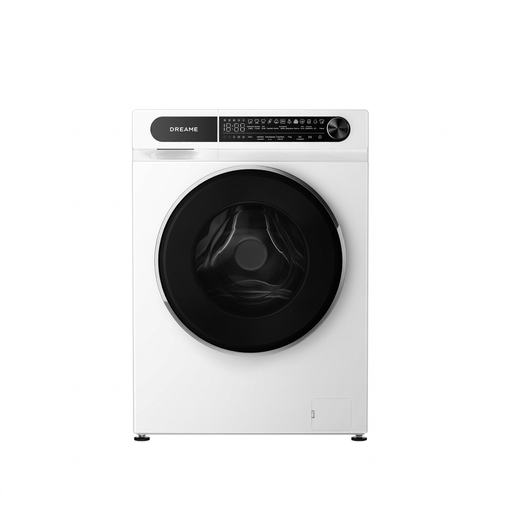 Image unavailable
Worth considering when depth limits your installation options: compare its overall dimensions with your space and allow room to open the door. The model name indicates an 8 kg capacity; check the instructions for the clearance and connections required.
Not if the worktop prevents the lid from opening: top-loaders are loaded from above. Instead, consider a front-loader whose dimensions, connections and door clearance suit the space, then check the instructions.
A top-loader mainly saves width and opens from above; according to Que Choisir, top-loading models are around 40 to 46 cm wide. A slim front-loader mainly saves depth, generally measuring 33 to 45 cm, while remaining close to 60 cm wide.
Only if its capacity and operation suit your usual loads. Que Choisir presents it as an option when it’s impossible to install a standard washing machine; check in particular that it can handle the sheets and towels you need to wash, and check the connections, spin cycle and programmes.
Promotelec recommends plugging it directly into a dedicated wall socket rather than using a multiway adaptor, which could be overloaded. If there isn’t a suitable socket where you plan to put the appliance, have the installation checked before setting it up.
First check the position of the socket in relation to the bath or shower. Promotelec says sockets must be outside the safety zones and mentions a distance of more than 60 cm from the edge, as well as 30 mA residual current protection. Have the positioning checked against the layout of your room.