What should you check first?
First rule out any formats that won’t fit in the space or open properly. Then compare their capacity and installation requirements.
| What matters |
What to check before buying |
Who it matters to |
| Space available |
Measure the machine’s overall dimensions and allow room behind it for the hoses. A top-loader is mainly suited to a narrow space; a slim front-loader is mainly suited to a shallow one. |
When the alcove is very narrow, I want to know whether the machine will actually fit before comparing its programmes. Around 36% of consumers would prioritise checking its measured footprint first. |
| Access to the drum |
Check that there’s room to open a front-loader’s door, or enough clearance above a top-loader’s lid, especially if it will sit beneath a worktop. |
If space is tight or there’s a worktop above the machine, I need to be able to load the laundry without blocking the way. This would be the top priority for around 29% of consumers. |
| Washing capacity |
Compare the capacity in kg with the size of your usual loads, including bulky items. Que Choisir says slim models generally hold around 4 to 6 kg, while compact front-loaders hold less than 5 kg. |
When space is limited, I don’t want a drum that means I have to run more cycles for my regular laundry. Capacity would come first for around 21% of consumers. |
| Installation |
Check access to the water supply, drain and electrical supply, then consult the model’s instructions for the hoses, levelling and transit bolts. |
Before delivery, I need to know whether the machine can be connected and installed securely in the space. Around 14% of consumers would make this their main concern. |
Washing machines to consider on Joybuy
These two models are worth considering for different needs: top-loading for a narrow space, and a different capacity to compare with the amount of laundry you wash and the space available.
 Image unavailable
Candy TCA464TM4-S ProWash 500, 6 kg top-loader
Worth considering if limited width points you towards a top-loader and a 6 kg capacity suits your usual loads. The product name indicates a spin speed of 1,400 rpm. Check that there’s enough clearance above the machine to open the lid, and leave room for the connections.
View on Joybuy
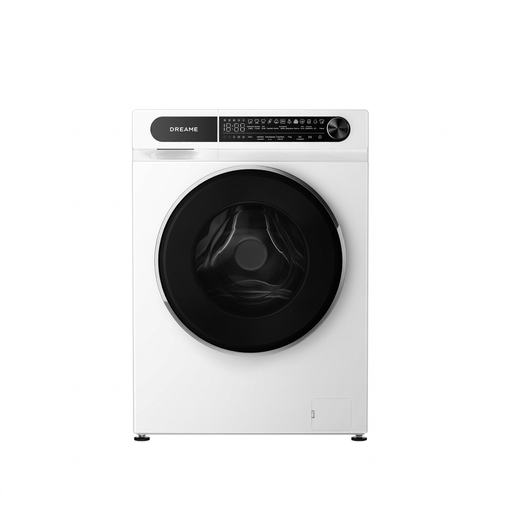 Image unavailable
Dreame DRWASHS8KG Washing Machine S, 8 kg, white
Worth considering if you need an 8 kg capacity but still need to keep an eye on the available space. Before planning to install it under a worktop or in an alcove, check the full dimensions, loading type, clearance for opening and hose routing in the model specifications.
View on Joybuy
Frequently asked questions
Will a top-loading washing machine suit any small room?
No. It’s mainly a good option when width is limited, provided there’s room to open the lid. Que Choisir says top-loaders are commonly between 40 and 46 cm wide. If the machine will sit beneath a fixed worktop, consider a front-loader with a suitable height and enough room in front of the door.
Is a slim washing machine enough when space is limited?
Not necessarily. A slim model mainly saves depth, but you’ll still need to check its width, door clearance and space for the hoses. Que Choisir says these models generally have a capacity of around 4 to 6 kg, so compare the capacity of the specific model with the size of your laundry loads.
What capacity should one or two people look for?
Que Choisir suggests 5 to 7 kg for one or two people, while ADEME says that 7 kg is usually enough. Choose according to the laundry you actually wash: a drum that’s too small can mean extra cycles, particularly for bulky items.
What should you check before installing a machine in an alcove?
Check the full dimensions and clearance for opening, then make sure there’s access to the water supply, drain and electrical supply. The model’s instructions will also explain levelling and removing the transit bolts. Make sure the hoses can be routed without kinking or getting trapped.


