Homes with a narrow space
If width is limited, consider a top-loading model. If depth is the main issue, look at slim front-loaders, remembering to leave enough room in front of the door.


Start by choosing a machine that fits the available space, leaving enough room to open it and move around. A top-loading model is best if width is the main constraint, while a slim front-loader saves space in depth. If it needs to go under a worktop or behind a kitchen door, check that the model is designed for that type of installation. Then compare the capacity with your usual laundry loads and, for a bathroom or stacked installation, check the installation requirements before you buy.
The main constraint — width, depth or the layout of your kitchen units — can help you narrow down the format before comparing models.
If width is limited, consider a top-loading model. If depth is the main issue, look at slim front-loaders, remembering to leave enough room in front of the door.
Choose a capacity that suits your usual loads, particularly for bedding and towels. A very small machine is only worth considering if its capacity meets your needs and there’s no room for a larger model.
In a bathroom, the position of the electrical supply needs particular attention. If you plan to stack a tumble dryer on top, check that both appliances and the stacking kit are compatible.
Measure the space and access routes first, then compare capacity and the requirements for your planned installation.
| Criteria | What to check | Depending on your needs |
|---|---|---|
| Width and access | Measure the clear width of the space and the route leading to it. According to Que Choisir, top-loading washing machines are generally 40 to 46 cm wide. Also check there’s enough room above the lid. | “My space is narrow, but I still need to be able to open the machine and reach the laundry.” |
| Depth and room to move | Compare the machine’s depth, how much space the door takes up when open and the room needed for connections. For the LG F72SJ62WH, LG lists a machine depth of 455 mm and a depth of 980 mm from the back to the open door. Dimensions should be checked for each model. | “I can fit the machine in, as long as its door doesn’t block the way.” |
| Capacity | Match the stated capacity in kilograms to your laundry loads and how often you wash. ADEME says that 7 kg is sufficient most of the time, but you should still consider your own needs. | “I need to fit my bedding and regular laundry in without having to run extra cycles.” |
| Under-worktop or integrated installation | Check the model’s height, ventilation requirements and installation instructions. For an integrated machine, also check the dimensions of the space and the fittings for the furniture door. | “I want to install the machine under the worktop or behind a kitchen door.” |
| Noise and energy use | As ADEME recommends, compare the energy label figures for kWh per 100 cycles, water per cycle, spin performance and noise. | “The machine will be near a living area, so spin noise matters to me.” |
| Bathroom and stacking | For a bathroom, have the machine’s position and electrical protection checked. For a stacked installation, check the compatible references for both machines and the kit. Electrolux limits one of its kits to front-loaders with a depth of 47 to 60 cm. | “I need to confirm that the space and appliances will actually allow the planned installation.” |
A front-loader may fit in its space, but its open door could block the way. Hoses and access to the filter also take up room.
Measure the machine, the open door, the connections and the space needed to move around separately. Then compare these measurements with the model’s installation diagram.
A worktop may stop you from opening a top-loader’s lid. And when stacking, the appearance of the two appliances alone doesn’t confirm that they’re compatible.
If the installation requires front access, choose a front-loader instead. Then check the instructions and the compatible references for the kit and both machines.
A compatible stacking kit may need to be purchased separately.
A smaller capacity may mean more cycles if you regularly wash bulky items.
Work out the size of your usual loads before comparing a compact model, a top-loader and a slim front-loader that might fit in the space.
The machine’s position in relation to the shower or bath and the protection of the electrical circuit matter just as much as its dimensions.
Before buying, have the layout and electrical installation checked if you can’t confirm that they meet the safety requirements.
These examples show different configurations to compare. Dimensions and installation requirements vary from model to model.
The French range includes top-loading washing machines and front-loaders with a reduced depth.
The WIW24348FF is an example of a fully integrated washing machine designed for a kitchen unit.
Candy features a range of slim washing machines on its French website.
Compare these three front-loading models with the space available and your laundry needs. Their product names alone don’t tell you how much room you’ll need to open the door or install them in a stack.
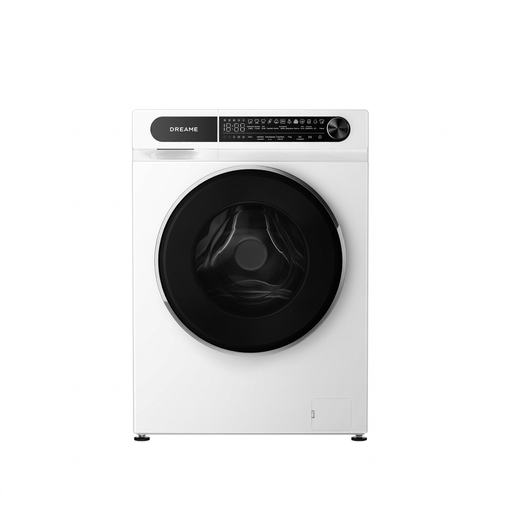 Image unavailable
Its stated 8 kg capacity is worth comparing with the size of your usual loads. Before choosing it for a small room, check its installation dimensions, the space needed to open the door and, if required, whether a stacking kit is compatible.
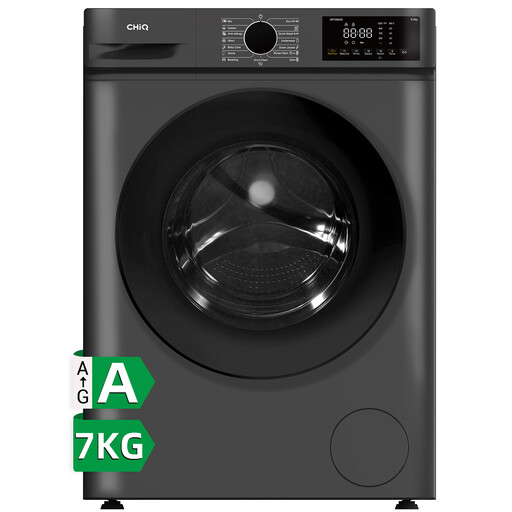 Image unavailable
This front-loader has a stated capacity of 7 kg, an A energy rating and a spin speed of 1,200 rpm. Check its full dimensions and the space needed in front of the door before choosing it for a fitted space.
 Image unavailable
This model has a stated capacity of 7 kg, a spin speed of 1,400 rpm and an A energy rating. If you’re installing it under a worktop or in a small bathroom, check the height, the depth with the door open and the installation requirements for this model.
Measure the available width, height and depth, as well as access routes, space for connections and the room needed with the door open. The depth of the machine alone isn’t enough: LG lists a depth of 455 mm for its slim front-loader, the F72SJ62WH, and 980 mm from the back to the open door.
Not if the worktop stops you opening the lid fully: top-loaders are loaded from above. For installation under a fixed worktop, consider a front-loader or an integrated model whose instructions allow for the planned installation.
Check the machine’s position in relation to the shower or bath, as well as the earthing and protection of the electrical circuit. Promotelec recommends, in particular, installing it beyond zone 2 and using a circuit protected by a 30 mA residual-current device. Have your layout checked if these requirements aren’t clear.
No. Check the model references for both appliances, their dimensions and the approved kit. Electrolux specifies one of its kits for front-loading appliances with a depth of 47 to 60 cm and advises checking compatibility with the relevant models.
Compare the noise information, energy consumption in kWh per 100 cycles, water use per cycle and spin performance on the energy label. ADEME recommends checking these figures rather than assuming noise levels or energy use from the washing machine’s format alone.