Studios with a very narrow alcove
You may be restricted by the available width, height or depth, so compare the full dimensions before choosing between a top-loader, slim model and compact machine.


Start with the installation constraint that matters most: a top-loading machine mainly reduces the width required and avoids needing clearance for a door, a shallow front-loading model is suitable when depth is limited, while a compact model is designed for spaces where more standard sizes will not fit. For a one- or two-person household, Que Choisir recommends using 5 to 7 kg as a guide; then compare the full dimensions, door or lid opening, energy label, spin noise and the durability index of the exact model.
You may be restricted by the available width, height or depth, so compare the full dimensions before choosing between a top-loader, slim model and compact machine.
You need to keep a clear passage in front of the appliance and check whether a door can open comfortably. A top-loader reduces the width required, while a slim front-loader mainly reduces the depth.
You want a space-saving appliance without choosing a drum that is too small for your usual washing. A capacity of 5 to 7 kg is a useful guide, but adapt it to the amount of laundry you actually have.
Consider it: if the passage is narrow and a front-opening door would obstruct movement.
Allow for: clearance above the lid; a narrower width does not necessarily mean less depth.
Consider it: if a standard width will fit but the room does not have much depth.
Allow for: clear space in front of the door to load and unload the laundry.
Consider it: when neither a standard top-loader nor a standard front-loader will fit in the alcove.
Allow for: a smaller capacity, and check that it can handle sheets, towels and bulky laundry.
| Priority | What to check | Your needs |
|---|---|---|
| Overall size and opening | Measure the width, depth and height of the alcove. Allow for the door to open in front of a front-loader, or for the vertical clearance needed by a top-loader. | I want the appliance to fit without blocking the passage. According to UFC-Que Choisir, top-loaders are approximately 40 to 46 cm wide, while slim front-loaders generally remain 60 cm wide and are 33 to 45 cm deep. |
| Usable capacity | Compare the capacity in kg with your usual laundry loads, particularly sheets, towels and bulky items. Do not choose based on the appliance size alone. | I want to avoid extra cycles without installing an unnecessarily large drum. UFC-Que Choisir recommends 5 to 7 kg as a guide for one- or two-person households. |
| Spin noise | For comparable appliances, compare the spin noise level in dB(A) and the noise class on the energy label. Also follow the installation instructions. | I want to minimise disturbance when the washing machine is close to a living area or neighbours. Spin noise can vary from one model to another, regardless of the machine category. |
| Energy use and lifespan | Check the energy class, kWh per 100 cycles, water consumption per cycle and the durability index shown for the model sold in France. | I want to compare everyday running costs and repairability, not just the size. ADEME states that the energy label includes information such as energy use, water consumption and the noise class. |
A top-loader may be approximately 40 cm wide while still being close to 60 cm deep and requiring the lid to open upwards. A slim front-loader mainly reduces the depth, often retains a width of around 60 cm and needs space in front of the door.
Compare all three dimensions of the exact model and map out the space needed to open it in the room before ordering.
A drum that is too small may mean running more cycles, while an oversized appliance may be used inefficiently if it is not filled sufficiently.
For one- or two-person households, start with the 5 to 7 kg guide cited by UFC-Que Choisir, then adjust it based on your towels, sheets and other bulky items.
Running more cycles can increase water and electricity use when the capacity is insufficient.
Spin noise can be disruptive in every category and varies by model. The noise class is a useful guide, but it should be considered alongside the dB(A) figure.
In a flat, compare the spin noise and noise class of similar models. Some unusual noises may also be caused by the installation.
The legal guarantee of conformity covers new, second-hand and refurbished goods sold by a professional to a private individual, according to economie.gouv.fr. A commercial warranty must be assessed separately, including its terms and exclusions.
Before paying for an extended warranty, check who is responsible for the sale, the claims process, exclusions, transport and the applicable terms.
A paid commercial warranty may partly duplicate legal protections that already apply.
Worth exploring if you are looking for a 40 cm-wide top-loader for a small home, with capacities of around 6 kg on the French models mentioned.
A brand to consider for a standard front-loader when a 60 cm width, front loading and under-counter installation are compatible with the room.
An option to consider when a standard top-loader or standard-width front-loader will not fit, with a compact 5 kg model available.
These Joybuy options include a top-loader for width restrictions and a shallow front-loader when limited depth is the main challenge.
 Image unavailable
Worth considering for a narrow alcove and everyday laundry for a one- or two-person household.
Advertised width: 40,5 cm; advertised depth: 60 cm. Advertised capacity: 6 kg. Advertised spin noise: 79 dB(A), class C; also allow the clearance needed above the lid.
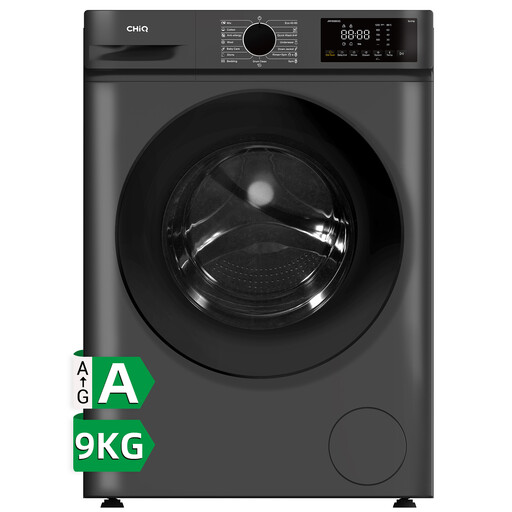 Image unavailable
Worth considering if depth is limited, provided you still have the width required for a front-loader and enough clearance for the door.
Advertised depth: 465 mm. Advertised capacity: 9 kg; 16 programmes and a 15-minute quick cycle advertised. Check the dimensional drawing, spin noise, water consumption and durability index for the exact model.
Measure the width, depth and height of the alcove, as well as the space needed in front of a door or above a top-loader. UFC-Que Choisir states that front-loaders are generally around 60 cm wide, slim models mainly reduce the depth, and top-loaders are approximately 40 cm wide.
No. For one- or two-person households, UFC-Que Choisir recommends 5 to 7 kg as a guide and points out that a drum that is too small can mean running more cycles. A 5 kg compact model may be suitable for everyday laundry, but check your needs for sheets, towels and bulky items.
At a minimum, compare the energy class, kWh per 100 cycles, water consumption per cycle, the duration of the reference programme and the noise level. ADEME explains that the energy label includes the noise class, energy consumed per 100 cycles and water consumed per cycle.
Yes. The French ministry responsible for ecology states that the durability index has been gradually replacing the repairability index for washing machines since 8 April 2025. This score out of 10 helps you compare repairability, maintenance, spare parts and resistance to wear.
When buying from a professional seller, the legal guarantee of conformity applies to new, second-hand and refurbished goods, according to economie.gouv.fr. Also check the product’s condition, which parts have been replaced and the return or collection terms offered by the seller.