Living alone with limited space
If you do your washing regularly, don’t choose a machine’s capacity based on its size alone. UFC-Que Choisir says that 5 to 7 kg is generally enough for one or two people, depending on their washing habits.


For regular washing, choose a top-loading or front-loading washing machine if you have enough space and the necessary connections. A top-loader is best if width is limited, while a slim front-loader can help when depth is the issue. According to UFC-Que Choisir, a mini washing machine is a backup option for small loads when it isn’t possible to install a standard machine.
If you do your washing regularly, don’t choose a machine’s capacity based on its size alone. UFC-Que Choisir says that 5 to 7 kg is generally enough for one or two people, depending on their washing habits.
A top-loading washing machine lets you load your laundry from above, so you don’t need to leave room for a front-loading door to open. You will, however, need enough clearance above the machine to lift the lid.
A mini washing machine can be useful for small, occasional loads. UFC-Que Choisir puts the capacity of this type of machine at around 2 to 3 kg. Check what the model you’re considering can actually wash before relying on it as your only option.
Consider this if: width is limited but there’s room to open the lid above. UFC-Que Choisir gives a width of 40 to 46 cm for this type of machine.
Bear in mind: you’ll need clear space above the machine. This design won’t solve problems with depth or connections on its own.
Consider this if: depth is the main issue and there’s room to open the door. According to UFC-Que Choisir, a slim front-loader is around 33 to 45 cm deep and roughly 60 cm wide.
Know the difference: a compact machine is also narrower, but its capacity is under 5 kg, according to UFC-Que Choisir.
Best suited to: small, occasional loads when it isn’t possible to install a standard washing machine.
Limitation: UFC-Que Choisir gives a capacity of 2 to 3 kg for this type of machine, making it unsuitable for bulky items.
| What to consider | What to check | What I need |
|---|---|---|
| Dimensions | Measure the available width, depth and height. Check that the lid or door can open and that the machine will fit through the route used for delivery. | I want to be able to open the machine without blocking the way around my studio flat. |
| Capacity | Compare the load in kg of dry laundry with the programme you’ll use. UFC-Que Choisir explains that the maximum load shown is for the cotton or eco 40-60 programme and may be lower for other programmes. | I want to fit my usual washing in the machine without having to run extra cycles for a few items. |
| Spin and noise | Compare the spin and noise information for each model. For domestic washing machines, ADEME recommends checking the energy label. | The machine will be close to my living space, and I may need to dry clothes indoors. |
| Installation | Check the water supply, drainage and electrical supply against the model’s instructions. Electrolux France points out that installers don’t necessarily carry out plumbing or electrical work. | Before I order, I need to know whether the machine can be connected where I plan to put it. |
A low-capacity machine may mean running more cycles for your usual laundry. On the other hand, a large-capacity machine may not suit someone who mainly washes small loads.
Think about the items you wash and how often you do your laundry. UFC-Que Choisir gives 5 to 7 kg as a general guide for one or two people, but you should adjust this to suit your needs.
These designs don’t reduce the same dimensions, and their capacities differ too. A slim front-loader may still be too wide, while a mini washing machine is only suitable for small, occasional loads.
First work out what’s actually limiting your choice: width, depth, room to open the machine or whether you can install a standard model.
A machine may fit in your studio flat but still be close to your living space. ADEME also notes that air-drying clothes indoors adds moisture to the air.
Check the noise and spin information, then plan to dry your clothes in a well-ventilated room or one with mechanical ventilation (VMC) extraction, as ADEME recommends.
Suitable dimensions aren’t enough if the connections or access route for installing the machine aren’t right.
Check the space against the model’s instructions and make sure the necessary connections are in place. If installation involves making changes to a rented home in France, ANIL says you need the landlord’s written permission.
Plumbing or electrical work may be needed before installation, so check who can carry it out.
This mini washing machine is intended for small, occasional loads when it isn’t possible to install a standard machine. It isn’t one of the top-loading or front-loading models discussed above.
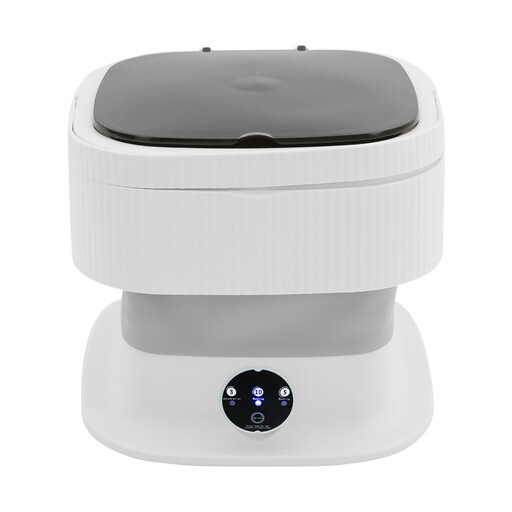 Image unavailable
Its foldable, portable design is worth considering for small, occasional loads. The product is listed with a 10 L capacity, three cycle times of 2, 5 and 10 min, a 40 W motor, a speed of 320 RPM, a draining basket and suction cups. The capacity in litres doesn’t tell you the load in kg or how well the machine spins clothes. Check these details, the dimensions when open and folded, the connections and the noise level before choosing.
UFC-Que Choisir says that 5 to 7 kg is generally enough for one or two people. This capacity refers to a load of dry laundry on the cotton or eco 40-60 programme. Check the maximum load for any other programmes you plan to use.
It’s generally not suited to regular washing that includes bulky items. UFC-Que Choisir describes mini washing machines with a capacity of 2 to 3 kg as a backup option when it isn’t possible to install a standard machine.
Check the dimensions, access route, water supply, drainage, electrical supply and the model’s instructions. If you’re making changes to a rented property or its fittings in France, ANIL says you need the landlord’s written permission. An installation service may not include any necessary additional work.
Choose a suitable place for damp clothes: ADEME recommends a large, well-ventilated room or one with a mechanical ventilation (VMC) extraction vent. If you usually dry clothes indoors, compare the spin performance of the machines you’re considering too.
Look at electricity use per 100 cycles, water use per cycle, cycle duration, spin performance and noise level. The European Commission explains that the regulated consumption and duration figures are based on the eco 40-60 programme, so use the same programme when comparing two machines.