If width or clearance in front of the machine is limited, consider a top-loading washing machine, provided you can open the lid. If depth is the main issue, compare slim front loaders and remember to allow room for the door to open. A standard front loader, an integrated model or a washer-dryer stack will only work if you’ve confirmed the dimensions and access, and, for a stack, that the appliances and stacking kit are compatible. Then choose a drum capacity to suit your household’s laundry and compare the information on the energy label.
Who are these options for?
People with a narrow walkway or shallow alcove
The dimension restricting movement will determine which type to consider: a top loader if width is limited, or a shallower front loader if the machine would stick out too far into the room. Either way, make sure you can still load the laundry once the machine is in place.
Households planning a fitted kitchen
If the washing machine needs to sit behind a kitchen cupboard door, check the dimensions of the space, how the front panel opens and the installation requirements for the model. A freestanding machine doesn’t become an integrated model just because it fits under a worktop.
Households considering a washer-dryer stack
Stacking the appliances can save floor space if you have enough height. Check the model numbers of the washing machine, tumble dryer and intended stacking kit before choosing this layout.
What should you check before choosing?
First, identify the dimension that really limits installation. Then check how the machine opens, its capacity and the requirements for using the model you have in mind.
| Priority | What to check | What I need |
|---|
| Width and top loading |
According to Que Choisir, top-loading washing machines are generally 40 to 46 cm wide. Also measure the height needed to open the lid fully and make sure the top remains accessible. |
In a narrow room, I want to load the laundry without a door sticking out into the walkway. A top loader won’t help if a worktop prevents the lid from opening. |
| Depth and door clearance |
Que Choisir describes slim front loaders as 33 to 45 cm deep, while front loaders are generally around 60 cm wide. Check the model’s overall depth, connections and the space in front of the door. |
The available width works for me, but a machine that’s too deep would obstruct the walkway. I also need to be able to open the door and take out the laundry. |
| Standard or integrated front loader |
For a standard front loader, Que Choisir gives approximate dimensions of 60 cm wide and 85 cm high. If it’s going under a worktop or behind a decorative door, check the space, connections and installation instructions for the exact model. |
I’d like to keep a worktop or integrate the machine into the kitchen, without assuming that every front loader will fit the existing cupboard. |
| Drum capacity |
Estimate your usual laundry load and any bulky items you need to wash. Que Choisir gives 5 to 7 kg as a guide for one or two people; ADEME says 7 kg is usually enough, but that doesn’t mean it’s right for every household. |
I’m interested in a compact model, but I don’t want to run extra cycles because the drum is too small for my laundry. |
| Noise and energy use |
Compare the water and electricity consumption, spin cycle and noise levels shown on the energy labels of the models you’re considering. ADEME recommends using this information to help you choose a suitable appliance. |
The machine will be near the living areas, so noise matters to me just as much as how much space it takes up in the kitchen or bathroom. |
| Stacking |
Check the available height and whether the model numbers of both appliances are compatible with a specific stacking kit. For the WTZ2741X kit, Bosch specifies a full-size washing machine with a depth of more than 55 cm; this requirement doesn’t apply to every kit. |
I’d like to install a tumble dryer without giving it a separate spot on the floor, but only if the appliances and installation are compatible. |
| Bathroom location |
Before choosing a spot near a bath or shower, have the location and electrical connections checked. For a bathroom cupboard, Promotelec distinguishes, among other things, between locations in zones 2 and 3. |
There seems to be space in my bathroom, but I want to know whether the planned installation can actually be carried out there. |
What mistakes should you avoid?
-
Choosing the smallest machine without considering your laundry
A drum that’s too small for your household’s needs could mean running more cycles. A large capacity isn’t useful either if you rarely wash a full load.
Before choosing a compact model, compare the capacity of machines that fit the room with your usual laundry and any bulky items you need to wash.
-
Measuring the space but not the opening clearance
A front loader might fit in its space but block the walkway when its door is open. A top loader can be difficult to use if the lid hits something above it.
Measure both the installation space and the area needed for loading, then compare them with the dimensions and clearances in the model’s manual.
-
Assuming any tumble dryer can go on top of any washing machine
Stacking requirements depend on the appliances and the kit. Bosch says to check that the model numbers are compatible; for its WTZ2741X kit, the washing machine must be more than 55 cm deep.
Check both model numbers, confirm which kit is suitable and follow the instructions for levelling, alignment and securing the appliances. If you’re not confident about the installation requirements, ask a qualified professional to do the work.
Remember to include the kit and installation in your plans for a washer-dryer stack.
-
Treating a bathroom cupboard like any other alcove
A bath or shower may mean the electrical location needs to be checked. Promotelec defines electrical zones for washing machines installed in bathroom cupboards.
Have the location and connections checked before buying or changing the installation. A cupboard door alone doesn’t mean the space is suitable.
Which brands and models should you consider?
These models and accessories can help you narrow down the format or features to check. They don’t indicate the dimensions of other models from the same brand or guarantee availability.
Bosch
For a stacked installation, Bosch provides information about stacking kits whose compatibility must be checked against the appliance model numbers.
- Bosch’s product details for the WTZ2741X kit say it can be used with a full-size washing machine more than 55 cm deep.
- This requirement applies to this Bosch kit only; it doesn’t confirm that other appliances or accessories are compatible.
Electrolux
The EW6T4613HA top loader is worth considering when width is the main constraint.
- Its top-loading design means you’ll need to check that there’s enough room to open the lid.
- Check the dimensions and opening clearance for the model you’re considering; you can’t assume these details from the brand name alone.
AEG
The LTR8C7331A top loader is an option to explore for a narrow kitchen or bathroom.
- A top loader is worth comparing with front loaders if you need to keep the area in front of the machine clear.
- Check the width, clearance above the open lid and capacity of this specific model before deciding whether it will fit your space.
Whirlpool
The TDLR6253BFR top loader is worth considering if a top-loading design suits the layout of your room.
- A top loader means you don’t need to leave space in front of a door for loading.
- Check the depth, height with the lid open and capacity of this specific model.
A front-loading washing machine option on Joybuy
This front-loading model is an option for households considering a 7 kg capacity. In a small room, whether it’s suitable depends on its full dimensions and the space available in front of the door. It isn’t a top-loading, integrated or stacking solution.
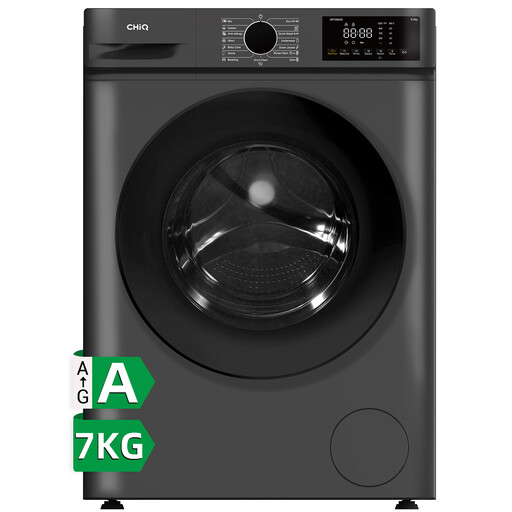 Image unavailable
CHiQ JW75883G, 7 kg front-loading washing machine, dark grey
Its stated 7 kg capacity should be considered in relation to your household’s laundry needs. The product description lists an A energy rating, a 1 200 tr/min spin speed, 16 programmes and a 530 mm drum. Before choosing it for an alcove or narrow walkway, check its full width, depth and height, as well as the connections and door clearance, in the product details and manual.
View on Joybuy
Frequently asked questions
What should I measure before ordering a washing machine for a small room?
Measure the width, depth and height of the space, then check how much room is needed to open the door or lid and access the laundry. Also check the connections and clearances required in the manual for your chosen model: measuring the alcove alone isn’t enough.
Is a top-loading washing machine suitable for every small bathroom?
No. It’s mainly a solution when width or the space in front of the machine is limited, provided the lid can open. Que Choisir says top loaders are generally 40 to 46 cm wide. If depth is what restricts the walkway, it’s worth comparing a slim front loader instead.
Can you stack any tumble dryer on top of any washing machine?
No. Check that both model numbers are compatible with the stacking kit, then follow the manufacturer’s installation instructions. Bosch specifies that its WTZ2741X kit is for a full-size washing machine more than 55 cm deep; this requirement shouldn’t be applied to all stacking kits.
What should I compare if the machine will be near a living area?
Compare the noise levels shown on the energy labels of the models you’re considering, along with their water and electricity consumption and spin performance. ADEME recommends checking this information as well as choosing a capacity that suits the laundry you actually wash.
Does durability matter if space is very limited?
Yes, but it doesn’t replace checking the dimensions and access. ADEME explains that the durability rating takes factors such as reliability and repairability into account. Compare ratings across the models that genuinely suit your installation.


