Very narrow alcove
If the machine needs to fit between two units or in a narrow bathroom, consider top-loaders. Bear in mind, though, that the lid needs enough clearance to open fully above the appliance.


First, measure the alcove and the delivery route, then choose a format based on the dimension that’s actually limited: a top-loader to save width, a slim front-loader to reduce depth, or a front-loader suitable for installation under a worktop if the alcove can accommodate this format. Consider a compact model if standard sizes won’t fit or a smaller wash capacity is enough. In every case, check the door or lid clearance, connections and model instructions too.
In a small space, the challenge can vary: it may be limited width, limited depth or the requirements for fitting a machine under a worktop.
If the machine needs to fit between two units or in a narrow bathroom, consider top-loaders. Bear in mind, though, that the lid needs enough clearance to open fully above the appliance.
If you have enough width for a front-loader but it might protrude into a walkway or in front of a door, compare the depths of slim models. Allow space for the connections and for the door to open too.
If your alcove can accommodate a front-loader, there’s no need to opt for a compact model straight away. Look for a model the manufacturer confirms is suitable for under-worktop installation, then check its dimensions against the full alcove.
Each of the four formats suits different constraints. Start by measuring the dimension that could prevent installation, then narrow down your options based on wash capacity and the space needed to load your laundry.
Consider this when: the alcove is too narrow for a front-loader and there’s enough clearance above the machine.
Trade-off: saving width doesn’t necessarily mean a shallower appliance; the lid means it can’t be installed under a fixed worktop.
Consider this when: there’s enough width for a front-loader, but its depth could obstruct the walkway.
Trade-off: you’ll still need space in front of the door; the term ‘slim’ doesn’t replace checking the exact model dimensions.
Consider this when: the available height or space rules out both a top-loader and a standard front-loader.
Trade-off: a smaller wash capacity could mean running more cycles for the same amount of laundry.
Consider this when: the alcove can accommodate a front-loader and wash capacity remains a priority.
Trade-off: under-worktop installation must be approved for the model you choose; don’t assume the top can be removed.
| Constraint | What to check | Who this matters to |
|---|---|---|
| Alcove width | Measure the narrowest part of the opening and the clearance above the lid. Que Choisir says top-loaders are generally 40 to 46 cm wide. | If the machine needs to fit between two units, my main priority is to reduce the width it takes up without giving up a full-size domestic washing machine. Around 29% of consumers would make width their priority. |
| Available depth | Compare the exact model’s depth with the space needed behind the machine and in front of the door. | In a narrow walkway, I don’t want a washing machine to protrude too far into the room. Depth would be the top priority for around 29% of consumers. |
| Under-worktop installation and capacity | Measure the entire alcove and check the instructions for under-worktop installation. If you’re planning a stacked installation, check the kit and the model numbers of both appliances. | If my alcove can fit a front-loader, I’d rather keep a capacity that suits my laundry than choose a compact model just to be safe. Around 24% of consumers would prioritise this option. |
| Very limited space | Check the appliance dimensions, the packaged dimensions for delivery and the wash capacity, which is separate from any drying capacity. | If standard sizes won’t fit, I’m happy to accept a smaller load so I can install a machine. This would be the top priority for around 18% of consumers. |
A top-loader can be narrow while still having a depth similar to a front-loader. A slim front-loader, on the other hand, is designed to protrude less into the room.
Note down the available width, depth and height separately, then compare them with each model’s dimensions rather than relying on its range name alone.
A machine may fit in its intended space but still be difficult to get through a doorway, up stairs or round a corner. Once installed, its door or lid also needs to open fully.
Check the delivery route using the packaged dimensions where available, then make sure the door or lid can open in the final position.
Whether an appliance can be installed under a worktop or stacked depends on the model numbers and their installation requirements, not simply on similar dimensions.
Check the instructions before removing a top or choosing a stacking kit that’s suitable for both appliances.
A stacking kit compatible with both appliances may be required.
Available space alone doesn’t determine whether a location is suitable: proximity to water and the electrical installation matter too.
Before buying, get the proposed position and electrical supply checked if you’re unsure. Promotelec highlights the need for earthing and a 30 mA residual-current device.
These models illustrate different formats; their features won’t necessarily apply to every model from the same brand.
Worth considering if you’re comparing front-loaders where depth is a key factor.
Worth considering if the narrow width of a top-loader addresses your main constraint.
Worth considering if you’re looking for a front-loader that’s specifically designed for under-worktop installation.
An example of a compact appliance to consider if standard formats aren’t suitable.
These two 8 kg washing machines let you compare full-size wash capacity for a space with limited room. To find out which one could be installed in your home, check the model’s dimensions, door clearance and installation requirements against your available space.
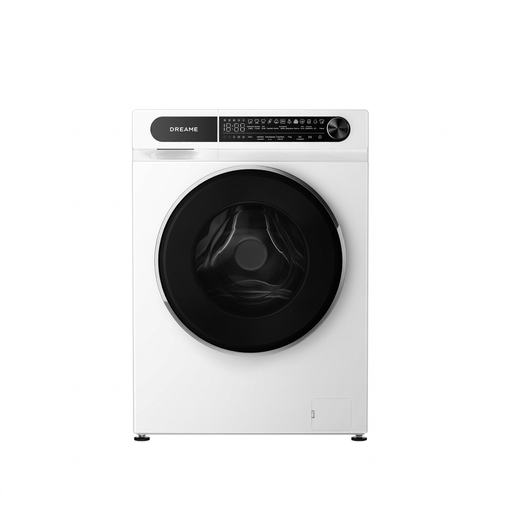 Image unavailable
Worth considering if you want to keep an 8 kg wash capacity in a space where depth is a concern.
Before choosing this model, check its loading type, the clearance required and the instructions for any potential under-worktop installation.
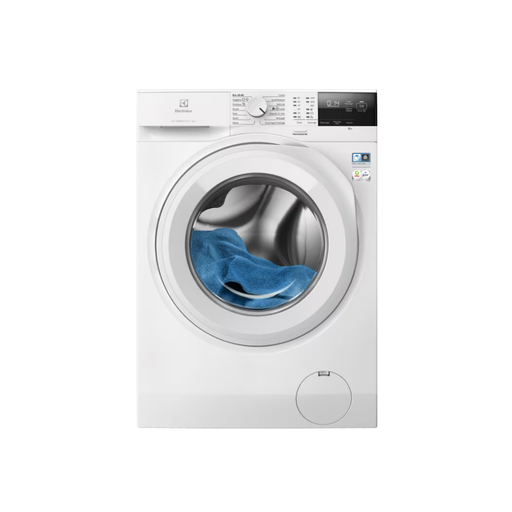 Image unavailable
Consider this front-loader if your space can accommodate its size and you’re looking for an 8 kg wash capacity.
This model is described as freestanding. Check whether it’s suitable for under-worktop installation before considering this option, and allow space for the door and connections.
Measure the width, height and depth at the tightest points, then compare them with the model’s dimensions. Allow space for the connections, the door or lid to open and the delivery route, using the packaged dimensions where available.
No: it mainly solves a lack of width. Que Choisir says top-loaders are generally 40 to 46 cm wide, but you’ll still need to check their depth and leave enough space above the machine to open the lid.
Yes, provided the location and electrical installation are suitable. Promotelec highlights the need for earthing and a 30 mA residual-current device. If you’re unsure, ask a professional to check the appliance’s position and the existing installation.
No. Choose a model the manufacturer explicitly approves for this type of installation and follow the instructions. The fact that Bosch has a range with removable tops doesn’t mean other models are suitable.
Only if the stacking kit is compatible with both models and their dimensions. For example, Electrolux says its STA8GW4 kit is for front-loading appliances with a depth of 47 to 60 cm, and asks customers to check compatibility using the PNC number.