Student in a studio flat or shared house
If you mainly reheat portions and defrost food, start by looking at solo models. Check that your plates and containers fit inside the cavity and that the appliance leaves you enough room to prepare meals.


In a studio flat or holiday home, a solo microwave covers the essentials: reheating and defrosting. Consider a grill model if you often brown or gratinate dishes, or a combination microwave if you also cook meals that need oven-style cooking. Whichever model you choose, check that it will fit on your worktop and follow the installation instructions in its manual.
UFC-Que Choisir lists student accommodation and holiday homes among the situations where your choice of microwave depends on the meals you prepare there.
If you mainly reheat portions and defrost food, start by looking at solo models. Check that your plates and containers fit inside the cavity and that the appliance leaves you enough room to prepare meals.
A solo model covers reheating and defrosting. If you also plan to cook meals that need oven-style cooking, consider a combination microwave and check its installation requirements rather than choosing on capacity alone.
A grill model is useful for browning dishes. For convection cooking, look for combination models that specifically offer this function, then check their dimensions against the space available.
Start with the meals you plan to prepare in your home, then match the useful functions to the appliance’s dimensions and the requirements in its manual.
| Factor | What to check | Think about your needs |
|---|---|---|
| Reheating and defrosting | Check that it has a defrost function and that the cavity or turntable can accommodate your usual containers. | I mainly reheat portions or leftovers, and I’d like to avoid changing containers when my dish is suitable for use in the appliance. |
| Grill or oven-style cooking | A grill is for browning or gratinating; for convection cooking, check that this is listed as a function on the combination model you’re considering. UFC-Que Choisir distinguishes between these uses in its buying guide. | Gratins feature regularly in my meals, so a grill could be useful. If I also cook dishes that need oven-style cooking, I’ll consider a combination model. |
| Available space | Compare the appliance’s external width, depth and height with the space on your worktop. Allow for the clearances specified in the manual for the exact model: its capacity in litres won’t tell you these measurements. | I also use my worktop to prepare meals, so I want to know how much space will be left once the appliance is in place. |
| Installation and connection | Check the manual for the model’s ventilation requirements and electrical specifications. Make sure your chosen location and connection meet them. | In a home that’s already equipped, I need to be able to install the appliance where I want it without overlooking the manufacturer’s requirements. |
| Cleaning and moving | Check how easy it is to access the cavity and clean the accessories. If you’re moving out, look into take-back or collection options for your old appliance. | I’d rather plan ahead for everyday cleaning and know what to do with the microwave when I move. |
If you mainly need oven-style cooking rather than reheating or defrosting, compare other compact cooking appliances too, based on the meals you plan to make and the space you have available.
Two appliances with different capacities can have very different installation requirements. Panasonic lists dimensions of 443 × 330 × 258 mm for its 20 L NN-E20JW solo model; Darty’s listing for the 32 L Samsung MC32DB7746KE combination model gives dimensions of 523 × 330 × 515 mm and a weight of 20.4 kg. These measurements apply to these specific models, not to all solo or combination microwaves.
Measure your worktop, then check the external dimensions, weight and clearances required in the manual for the model you’re considering.
Convection cooking isn’t the same as simply reheating food. If you don’t prepare meals that need oven-style cooking, you may never use this function.
Make a note of the meals you’ll actually prepare at home: choose a solo model for reheating and defrosting, a grill if you gratinate dishes, or a combination model if you also use oven-style cooking.
According to Electrolux France, the fan may continue to cool the components after use on some models.
Check your appliance’s manual to see what’s normal and what to do if it behaves differently.
Used microwaves should be taken to a collection point for electrical and electronic equipment.
In France, the Ministry for Ecological Transition distinguishes between “one-for-one” take-back, linked to buying a product of the same type, and “one-for-zero” take-back, which depends on the shop. Check the take-back arrangements or contact a suitable collection point.
These examples can help you compare specific configurations; a model’s features don’t necessarily apply to the whole brand.
The NN-E20JW is an example of a freestanding solo microwave. Panasonic France lists a capacity of 20 L, microwave power of 800 W, a defrost function and external dimensions of 443 × 330 × 258 mm.
Among the models listed by Darty, the 32 L MG32DG4524AG has a grill, while the 32 L MC32DB7746KE offers other cooking modes.
Whirlpool France describes the MWF259SG as a freestanding combination microwave without a turntable. The brand explains that combination microwaves bring together microwave and convection cooking.
These models offer solo and grill options for reheating, defrosting or gratinating in a kitchen with limited facilities. When choosing between two sizes, also check the available space and the installation requirements for the exact model.
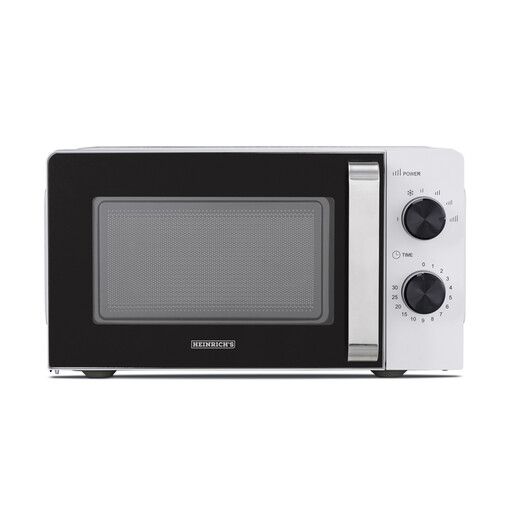 Image unavailable
For reheating and defrosting in a small home, this 20 L solo model offers six power levels, a 30-minute timer and a turntable. Before choosing where to put it, check the manual for ventilation and connection requirements.
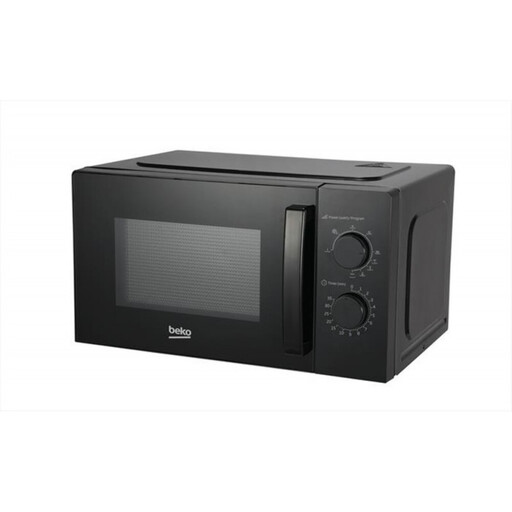 Image unavailable
This model combines reheating and defrosting with a grill for browning dishes. Its listed microwave power is 700 W. The product details specify clearance at the sides and rear; check the manual for all installation and connection requirements.
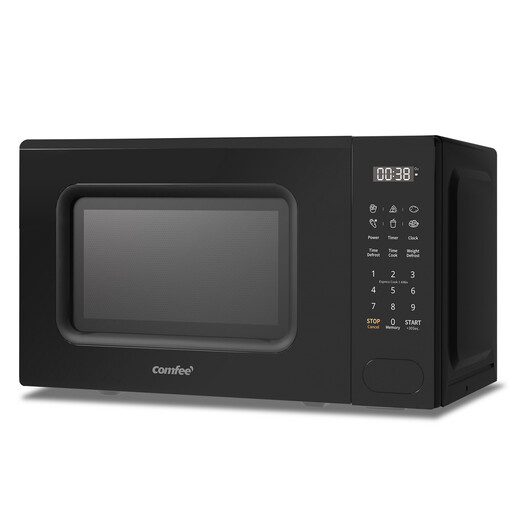 Image unavailable
A 700 W solo model for reheating and defrosting, with digital controls, six pre-set menus and eleven power levels listed in its name. Before installation, check the manual for the required clearances and connection specifications.
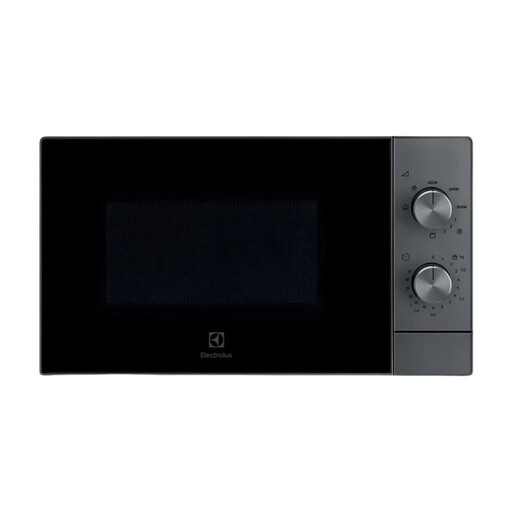 Image unavailable
Worth considering if you want to gratinate as well as reheat and defrost. Its listed microwave power is 800 W. The stated dimensions of 55 × 42 × 34 cm mean you’ll need to measure your worktop carefully; also check the clearances and connection requirements for this model.
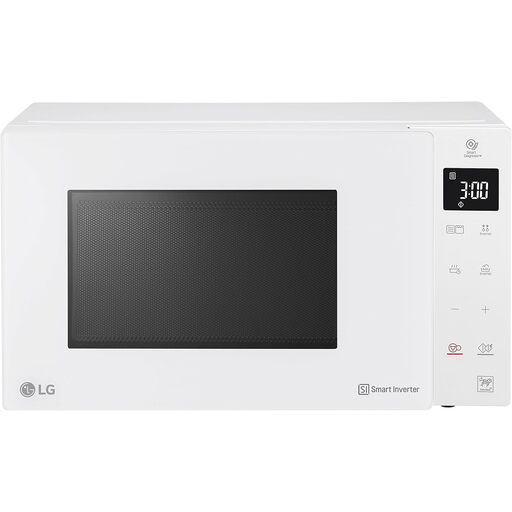 Image unavailable
The grill adds a browning option alongside reheating and defrosting. It has a listed capacity of 25 L and a digital display. Compare its dimensions with your worktop and check the manual for ventilation and connection requirements.
Yes, if you mainly use it for reheating and defrosting. However, check that its dimensions suit your worktop and your usual containers fit inside the cavity. A solo model doesn’t offer a grill or convection cooking.
Choose a grill if you regularly brown or gratinate dishes at home. It serves a different purpose from reheating, but a grill on its own doesn’t provide convection cooking.
A combination model is worth considering if you also prepare meals that need oven-style cooking and have enough space for it. UFC-Que Choisir distinguishes this use from that of a solo model; check the functions, dimensions and manual for the specific model before deciding.
Measure the available width, depth and height, rather than relying on the capacity in litres alone. The manual for the exact model specifies the ventilation clearances and connection requirements for your chosen location.
Take it to a suitable take-back or collection point for electrical and electronic equipment. According to the Ministry for Ecological Transition, “one-for-one” take-back is linked to buying a product of the same type, while “one-for-zero” take-back depends on the shop. Check the local arrangements.