What should you check before choosing?
Start with the space you can actually use, then compare formats based on how much room you need for fresh and frozen food.
| Priority | What to check | To suit your needs |
|---|
| Format |
Compare the space taken up by a tabletop fridge, a compact fridge-freezer and a freestanding fridge-freezer. For an integrated model, start with the installation dimensions of the housing unit. |
I live alone and don’t cook much: a tabletop fridge may suit me. If I regularly freeze food, I’ll look at a fridge-freezer with two compartments that meet my shopping needs. |
| Usable capacity |
As a guide, Que Choisir recommends a usable capacity of 100 to 150 L for one person, then around 50 L for each additional person. Adjust this to how often you shop. |
My shopping needs to fit without taking up unnecessary space in the kitchen. If several people use the appliance, I’ll also allow room for their food. |
| Freezer space |
Check the capacity in litres of the fridge and freezer separately. Make sure the model has a separate freezer compartment, rather than a small compartment inside the fridge. |
I often buy frozen food: the total capacity doesn’t tell me how much space is set aside for it. |
| Positioning |
Measure the width, height and depth, as well as the door clearance. For an integrated model, check the housing unit, door fixing system and ventilation requirements in the model’s installation plan. For a freestanding model, check the specified clearances. |
I want to be able to open the door and move around without bumping into a cabinet. If my kitchen has a housing unit, I’ll check it’s compatible before choosing an appliance. |
| Energy |
According to the European Commission, the label shows details including the energy class, energy consumption and storage volumes. Compare annual consumption in kWh between appliances with a similar format and capacity. |
I want to take energy use into account without comparing only the letter shown on two appliances that are very different in size. |
| Noise |
Check the noise level and noise class shown on the EU energy label. First compare appliances that meet your capacity needs. |
In a studio flat or open-plan kitchen, the fridge is close to my living space, so noise matters when I’m choosing. |
A guide to the brands
No brand information to display.
Fridges to consider on Joybuy
These models include freestanding fridge-freezers for kitchens without a suitable housing unit, as well as integrated appliances to compare with your cabinet dimensions. First, check where they’ll fit and how much space they provide for fresh and frozen food.
 Image unavailable
CHiQ JR227LSE, 227 L silver fridge-freezer
If you have a narrow space for a freestanding appliance and need room for both fresh and frozen food, check the door clearance and the gaps required in the manual too.
Listed width of 54 cm; 153 L for the fridge and 74 L for the freezer. Reversible door, Low Frost technology and energy class E. The freezer needs to be defrosted manually.
View on Joybuy
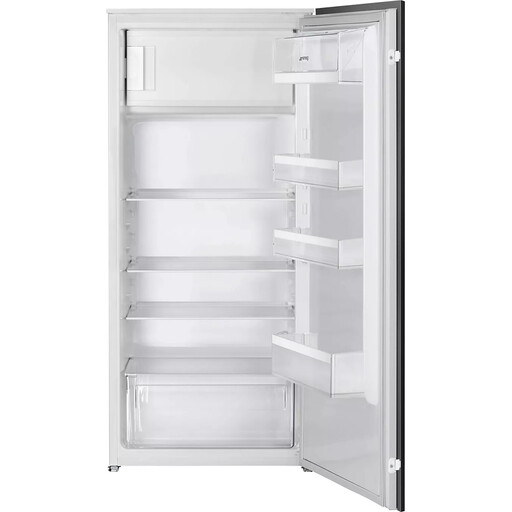 Image unavailable
SMEG S4C122E, 188 L integrated fridge-freezer
Worth considering for a fitted kitchen, but only after checking the housing unit and door fixing system against the model’s installation plan.
A single-door model with a freezer compartment at the top, in energy class E. Check whether this compartment offers enough room for your frozen food. You’ll also need a compatible cabinet door.
View on Joybuy
 Image unavailable
Hisense RB3B250SAWC, 252 L integrated fridge-freezer
This integrated fridge-freezer offers separate storage for fresh and frozen food in a fitted kitchen, provided you have a compatible housing unit and door system.
No Frost technology, an Inverter compressor and energy class C are listed in the model name. The appliance dimensions alone aren’t enough to confirm compatibility: check the installation plan for the housing unit and ventilation requirements.
View on Joybuy
 Image unavailable
CHiQ JR263LGE, 262 L black fridge-freezer
If your kitchen is short on width, measure the available height, door clearance and specified gaps for this freestanding model too.
Listed width of 54 cm and height of 176 cm; 70/30 split and Low Frost technology. The freezer needs to be defrosted manually.
View on Joybuy
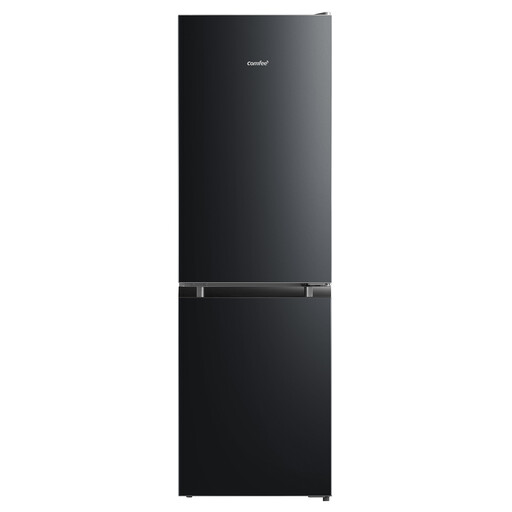 Image unavailable
Comfee' by Midea RCB230BL2EU(E), 174 L fridge-freezer
This freestanding fridge-freezer is worth considering if you need separate spaces for fresh and frozen food in a small home. Before choosing, check its dimensions and the clearance requirements in the manual against the space available.
Low Frost technology, an adjustable thermostat, LED lighting and a reversible door are listed in the product name. To compare it with other models, check its annual energy consumption and noise level too.
View on Joybuy
Frequently asked questions
What capacity should one person or a small household look for?
As a guide, Que Choisir recommends a usable capacity of 100 to 150 L for one person, then around 50 L for each additional person. Adjust this to how often you shop, and check separately how much room you need for frozen food.
Can you put a freestanding fridge in a housing unit?
Not without checking the ventilation and door clearance: a freestanding appliance isn’t installed in the same way as an integrated model. Whirlpool France recommends leaving 5 cm above and 10 cm behind freestanding fridges. Also check the manual for the model you’re considering and measure the housing unit.
What should you measure before buying an integrated fridge?
Measure the usable width, height and depth of the housing unit, then check the ventilation and door fixing system. Bosch lists several possible heights for some ranges designed for a 56 cm-wide housing unit. Check the installation plan for the exact model to confirm it’ll fit.
What should you look for on the energy label in a small kitchen?
According to the European Commission, the fridge label shows details including the energy class, energy consumption, storage volumes and noise level. Compare these figures between appliances with a similar format and capacity, taking the space you have available into account.
What temperature should you keep food at in the fridge?
Anses recommends keeping food between 0 and +4 °C at the coldest point in the fridge. Check this area when you set the appliance temperature, and leave space for air to circulate around the food.


