First, choose a fridge that fits the available space and has a freezer suited to your shopping habits. A table-top fridge is best for keeping a small supply of fresh food, while a fridge freezer offers more room for frozen food you buy regularly. For a built-in model, also check the housing and door fixing system. Then compare the capacity of each compartment, noise level, energy label and cooling system.
Who are these formats suited to?
If you live in a studio or have a small kitchen
If space is very limited and you often buy fresh food, start by measuring the available area. UFC-Que Choisir lists a table-top fridge as an option for a studio, though its capacity must still meet your freezing needs.
If you do a weekly food shop
If you need to keep both fresh and frozen food for the week, compare the capacity of the two compartments separately. A small freezer compartment won’t meet the same needs as the freezer in a fridge freezer.
If your kitchen has an existing housing unit
If your new appliance needs to be built in, check the housing dimensions, door panel and door fixing system. Bosch installation instructions and the specifications for built-in Whirlpool and Electrolux models show that requirements vary depending on the model you choose.
Which criteria should you check first?
Measure the space first, then assess your needs for fresh and frozen food separately. Your shopping routine and ease of use will help you decide between the formats that fit your kitchen.
| Criteria |
What to check |
Who is it for? |
| Size and installation |
Measure the height, width and depth, as well as the delivery route. Check the door opening and the clearances specified in the instructions. For a built-in model, also check the housing and door panel fixing system. |
In a narrow kitchen, I need to be able to open the door without blocking the way. Around 31% of consumers put the appliance’s size or installation compatibility at the heart of their decision. |
| Space for fresh and frozen food |
Compare the usable capacity of each compartment rather than just the total. UFC-Que Choisir gives an average guide of 100 to 150 L of usable capacity for one person, plus 50 L for each additional person. Adjust this to suit your habits. |
If I regularly buy frozen food, I need a separate space for it without sacrificing room for fresh food. Around 31% of consumers prioritise this balance. |
| How often you shop |
Think about what you keep between shops: fresh food, bottles, ready meals and frozen food. Then choose a format with enough capacity to cover that interval. |
When I leave longer between shops, I want to be able to store everything I need for the week without choosing an appliance that’s too big for my space. Around 23% of consumers prioritise finding a fridge that suits their shopping routine. |
| Noise, energy and maintenance |
Check the noise level, noise class and energy consumption details on the model’s label. Also check its cooling system and maintenance instructions. Compare energy use between appliances with similar capacities and formats. |
If the fridge is near my living area or bed, its noise matters every day. Maintenance and energy consumption can also influence my choice. Around 15% of consumers prioritise these comfort and practical considerations. |
Mistakes to avoid
-
Comparing only the total capacity
Two fridges with a similar total capacity can offer very different amounts of space for frozen food. For example, Whirlpool and Electrolux specifications show that freezer compartment sizes vary by model.
Start with your usual shopping and compare the fridge and freezer capacities separately.
-
Measuring only the width of a built-in model
A width that looks right doesn’t guarantee that the housing, ventilation, door panel or door fixings will be compatible.
If you’re replacing an old appliance, note down its model number, then compare the housing and cabinet with the installation diagram for the new model.
If the appliance isn’t compatible, you may need to adapt the cabinet or find another installation solution.
-
Assuming No Frost solves every food storage issue
The system reduces frost build-up, but Whirlpool points out that the drier air in a fan-assisted fridge can dry out uncovered food.
If avoiding defrosting is a key reason for your choice, check which compartment has the system and cover delicate foods in line with the manufacturer’s instructions.
-
Ignoring noise where the appliance will be installed
The stated noise level matters more when the fridge is near your living area or bed, but it can’t tell you exactly how noisy the appliance will seem in your home.
Compare the stated noise levels of models that meet your capacity needs and think about the room where the appliance will be running.
Brands to consider by format
Liebherr
The KTe500 is an example of a table-top fridge to consider when space is limited and you mainly need room for fresh food.
- Liebherr lists a total capacity of 110 L, dimensions of 85 × 50 × 60.7 cm and a noise level of 35 dB for the KTe500.
- Check your needs for frozen food separately: this model’s specifications don’t represent the entire Liebherr range.
Bosch
The brand offers freestanding fridge freezers, among other options. Its installation documentation helps you check the requirements for each model.
- Bosch lists a fridge capacity of 193 L and a freezer capacity of 89 L for the KGN33NWEB, in an appliance measuring 176 × 60 × 66 cm.
- Its stated noise level is 42 dB. Don’t assume these capacities, dimensions or noise levels apply to another Bosch model.
Whirlpool
The ARG7342FR is an example of a built-in, single-door fridge for a kitchen with a compatible housing unit.
- Whirlpool lists 171 L of fridge capacity and an 18 L, 4-star freezer compartment for this model.
- Think about how much frozen food you need to store in this small compartment. Also check the housing and sliding door fittings before choosing the appliance.
Electrolux
The ENS3LE18S is an example of a built-in fridge freezer for a kitchen with a suitable housing unit, when you need more freezer space than a small compartment can offer.
- Electrolux lists a total capacity of 271 L, including 73 L of freezer space, for this model, which is designed for a 1780 mm housing unit.
- The specifications state that the freezer needs to be defrosted manually. Check that the full installation is compatible, not just the height of the housing.
Fridge freezers for fresh and frozen food
These models combine fridge space with a freezer, for food shops that include both fresh and frozen food. The selection includes freestanding appliances and one built-in model. Check the installation requirements before comparing capacities.
 Image unavailable
CHiQ JR227LSE, 227 L silver fridge freezer
Worth considering for a weekly food shop that includes frozen food, if the appliance’s overall size suits your kitchen.
The model specifications list 153 L of fridge capacity, 74 L of freezer capacity, a width of 54 cm, a reversible door, Low Frost and an E energy rating.
Check the height, depth and clearances required in the instructions. Low Frost may not eliminate the need to defrost.
View on Joybuy
 Image unavailable
Bosch KGN33NLEB, 282 L stainless steel fridge freezer
Consider this model if you’re looking for a fridge freezer with a bottom freezer to store fresh and frozen food between shops.
The model name indicates a total capacity of 282 L and an E energy rating.
Check the KGN33NLEB specifications for the capacity of each compartment, noise level and clearances needed for installation.
View on Joybuy
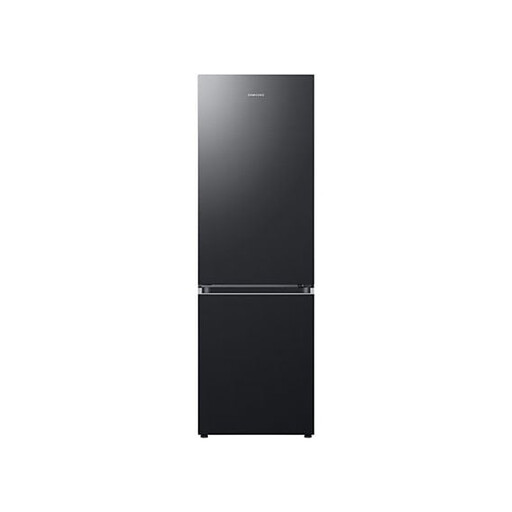 Image unavailable
Samsung RB34C704DB1, 344 L black fridge freezer
Worth comparing if you need a total capacity of 344 L and your kitchen can accommodate this size.
This model is listed with a D energy rating.
Before choosing, check its full dimensions, the space needed to open the door and the stated noise level for this model.
View on Joybuy
 Image unavailable
AEG NSC6M18FES, white built-in fridge freezer
Worth considering for a kitchen that already has a housing unit, provided the appliance and cabinet door are compatible.
This model is listed with TwinTech No Frost, an E energy rating and a total capacity of 249 L.
Check the NSC6M18FES specifications for the capacity of each compartment, the housing dimensions and the door panel fixing system.
View on Joybuy
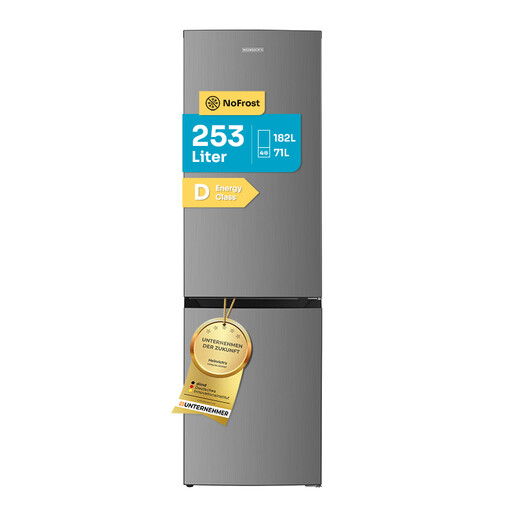 Image unavailable
Heinrich´s, 253 L fridge freezer with a stainless steel finish
Worth considering for keeping fresh food separate from frozen food during a weekly shop, once you’ve checked the available space.
The product name lists 182 L of fridge capacity, 71 L of freezer capacity, a noise level of 39 dB and No Frost.
Check the full dimensions and ventilation clearances in the model documentation.
View on Joybuy
Frequently asked questions
What capacity should one person allow for in a small kitchen?
UFC-Que Choisir gives an average guide of 100 to 150 L of usable capacity for one person. Then tailor your choice to how often you shop and how much space you really need for frozen food, rather than focusing on the total capacity alone.
Can a built-in model replace a freestanding one of a similar size?
Not based on the external dimensions alone. Check the housing, required ventilation, door panel and door fixing system in the installation diagram for the model you’re considering. Bosch recommends checking the instructions specific to the appliance.
Should you choose No Frost to avoid defrosting?
No Frost is worth considering if reducing frost build-up is important to you, but check which compartment benefits from it on the model you choose. Whirlpool notes that the drier air in a fan-assisted fridge can dry out uncovered food.
What should you compare on a fridge’s energy label?
For an appliance sold in France, compare its energy efficiency class, energy consumption details and noise information. ADEME highlights the value of the label for these criteria. Also consider the capacity of the models you’re comparing before weighing up their energy use.


