What should you look for?
Start with the space available and the washing-up you need to do. Then compare compatible models using their energy labels and installation instructions.
| Feature |
What to check |
Who is it for? |
| Noise |
Compare the dB(A) figures and noise class for the exact model on its energy label, rather than relying on a marketing claim. |
If the dishwasher runs near the living room, I want to be able to use the space without being too disturbed by its noise. Around 31% of consumers put a quiet operation at the top of their list. |
| Size and installation |
Measure the width, height and depth, as well as the door clearance. For an integrated model, also check the housing unit, plinth and door panel. |
In a fitted kitchen, my main priority is an appliance that fits the space and has room for its door to open. Around 31% of consumers prioritise whether it will fit their available space. |
| Capacity |
Compare the stated number of place settings with the dishes, utensils and containers you usually wash. |
When meals quickly fill the sink, I’d rather avoid a size that means running several cycles. The right capacity is the main priority for around 23% of consumers. |
| Energy use and cycle time |
On the energy label, compare kWh per 100 cycles, litres per cycle and the Eco programme duration on a like-for-like basis. |
If I use the appliance regularly, I want to know how much energy and water it uses and how long the Eco cycle takes before I choose. Around 15% of consumers prioritise these practical considerations. |
The European Commission says that dishwasher energy labels show information including capacity, noise and the consumption figures for the Eco programme. These details help you compare models, but the number of place settings alone won’t tell you whether your larger frying pans or serving dishes will fit in the baskets.
Worktop dishwashers on Joybuy
These worktop models are best suited to smaller loads and kitchens with limited floor space. Before choosing one for an open-plan kitchen, make sure its capacity suits your meals and check the noise level of the exact model.
 Image unavailable
Heinrich's HTG 8840 Schwarz, 6 place settings
This worktop model is worth considering if 6 place settings suit the washing-up you usually have. Its listing mentions seven programmes and 47 dB. Check the noise level on the model’s label, as well as its dimensions, before setting aside space on your worktop.
View on Joybuy
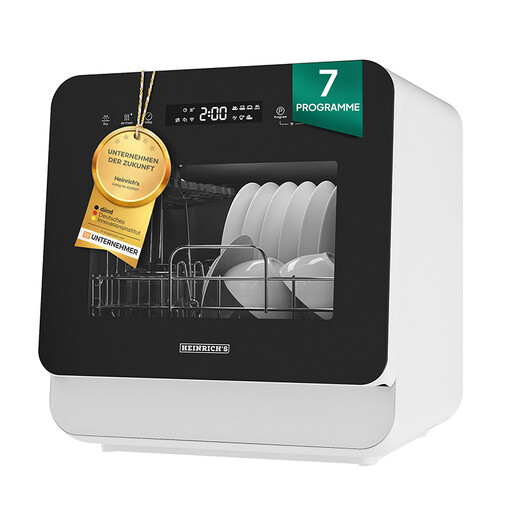 Image unavailable
Heinrich's HTG 8855, 3 place settings
Its stated capacity of 3 place settings is designed for very small loads. Remember to count dishes and utensils before choosing this size. The listing mentions seven programmes and 56.3 dB. For an open-plan kitchen, compare this figure with the model’s energy label. Also check the dimensions and the water supply option that suits your space.
View on Joybuy
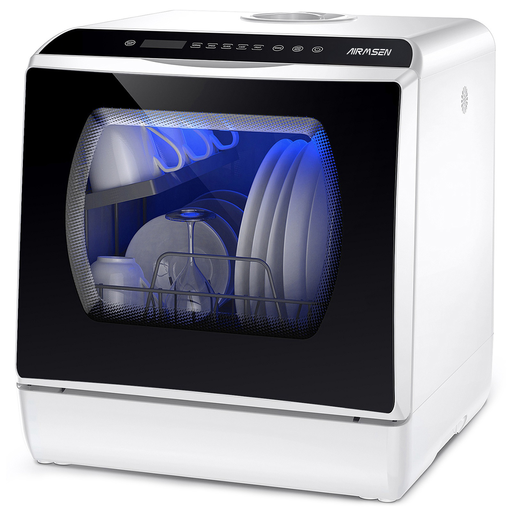 Image unavailable
AIRMSEN worktop dishwasher, 5 L tank
The stated built-in tank may suit a kitchen where you’d rather not connect the appliance directly to the water supply. The listing also mentions ‘5+1’ cycles. Check the usable capacity, dimensions, drainage and noise level before planning to install it near your living area.
View on Joybuy
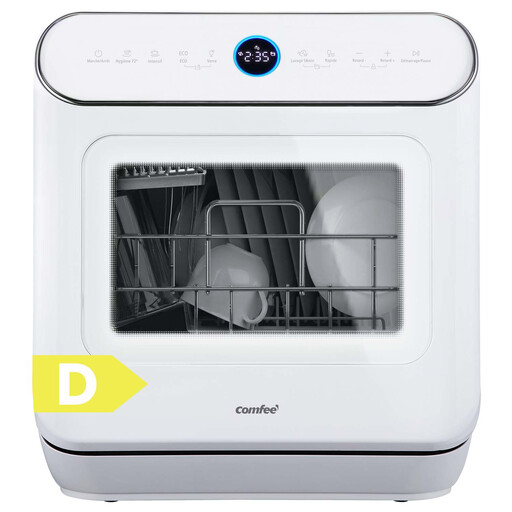 Image unavailable
COMFEE CDWMT305WD, 3 place settings, white
This stated capacity of 3 place settings is worth considering if your loads are small. The listing mentions seven programmes and a 24-hour delay start. Before choosing it, check the space needed to fill and drain the appliance, as well as the model’s noise level and energy use.
View on Joybuy
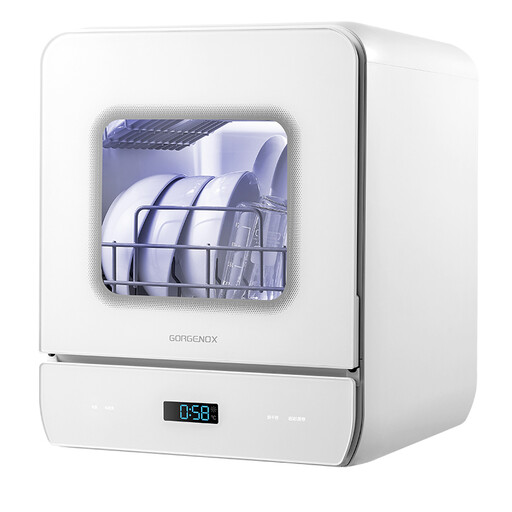 Image unavailable
GORGENOX DW5-D40A, 3-Set capacity
This worktop model is worth considering for small loads. Compare its stated 3-Set capacity with the dishes and containers you usually use. The listing mentions hot-air drying. Check the dimensions, water supply option and noise level before choosing where to put it.
View on Joybuy
Frequently asked questions
What should you compare when choosing between two dishwashers for an open-plan kitchen?
Start by comparing their noise levels in dB(A) and noise classes, followed by their capacity and dimensions. The European Commission says the energy label also shows the Eco programme’s energy use per 100 cycles, water use per cycle and duration. These figures can help you choose between models that fit your space.
Is a compact worktop dishwasher big enough for a small household?
Yes, if it can genuinely fit the washing-up you usually have, including dishes and utensils. UFC-Que Choisir describes worktop models with a capacity of 6 place settings. If that’s not enough for you, and would mean too many loads, also look at slimline models that fit your kitchen.
What should you check before ordering an integrated dishwasher?
Measure the housing unit and check the door panel, plinth, door system and installation diagram for the model you’ve chosen. Bosch explains that installation and fitting the door panel vary depending on the appliance and the available space. Get any uncertain modifications or connections checked before installation.
Is a ‘quiet’ label enough to help you choose?
No. Compare the dB(A) figure and noise class for each model. UFC-Que Choisir highlights how important noise is in an open-plan kitchen; a marketing claim is no substitute for the figures on the label.
Where can you check the specifications for a particular model?
Check its product page, instruction manual and energy label. The European Commission also provides access to the EPREL public database, which contains information declared for relevant models sold in the European Union. Make sure the reference and version match the appliance you’re considering exactly.


