How do the different sizes compare?
A countertop model, a 45 cm model and a standard-sized appliance each suit different spaces. First decide where you can install the dishwasher, then check that its capacity suits the dishes you actually use.
Countertop model
Consider it if: you have no floor space, but do have room on the worktop and are near a drain. A built-in water tank may mean you don’t need a fixed water supply, but only on models designed with one.
Bear in mind: the appliance takes up worktop space. If it has a tank, you’ll also need to fill it and deal with drainage for every cycle.
Slimline 45 cm model
Consider it if: you have a suitable permanent space, particularly if a small countertop model may not fit your dishes and pans.
Bear in mind: you’ll need to plan for the connections and check the space available. An integrated model also needs a compatible door panel and cabinet.
Standard 60 cm model
Consider it if: you have enough room and regularly have lots of washing-up, or use large utensils.
Bear in mind: its width makes it unsuitable for a kitchen without a compatible space.
| What to consider |
Checks to make before buying |
What matters to shoppers |
| Space and installation |
Measure the height, width, depth and door clearance. Check the water supply, drainage and power requirements of the model you’re considering. |
With no spare appliance space, I want to know whether it can stay on my worktop and how the water will drain away. Around 46% of consumers would put this first. |
| Usable capacity |
Compare the stated place setting capacity with the room available in the racks for your dishes, pans and food containers. |
If I cook often, I don’t want to have to run another cycle because my larger utensils won’t fit. Capacity would be the top priority for around 27% of consumers. |
| Noise |
Check the dB level and noise rating on the label for the exact model, especially if your kitchen opens onto your living space. |
In a studio flat or open-plan kitchen, I want to run the appliance without it getting in the way of what I’m doing. Around 18% of consumers would put noise first. |
| Consumption |
Compare the kWh per 100 cycles, litres per cycle and Eco programme duration, then consider how many cycles you’ll need to run at home. |
I want to keep an eye on water and electricity use without choosing an appliance that makes me run more washes. This would be the top priority for around 9% of consumers. |
Countertop models available on Joybuy
These countertop models are aimed at kitchens short on floor space. Some have a stated water tank; for each one, compare its footprint, loading capacity and drainage method with your kitchen setup.
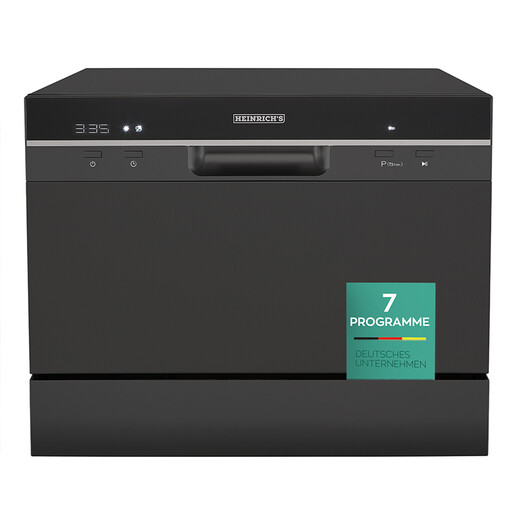 Image unavailable
Heinrich's HTG 8840 Schwarz, 6 place settings
Worth considering if you’re looking for a countertop model with 6 place settings and can plan for its water supply and drainage.
The title states 7 programmes and 47 dB. Measure all three dimensions and check the door clearance before choosing a spot for it.
View on Joybuy
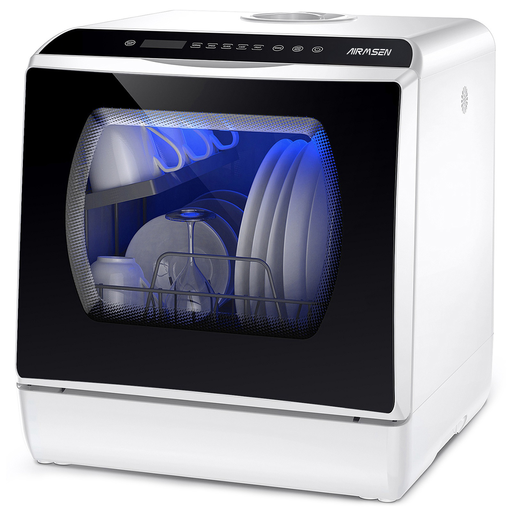 Image unavailable
AIRMSEN Portable, 5 L tank
Worth considering if a fixed water supply would be difficult to use, provided you can arrange drainage.
The title states a built-in 5 L tank and 5+1 wash cycles. Check the dimensions, noise level and space needed for the drain hose in your kitchen.
View on Joybuy
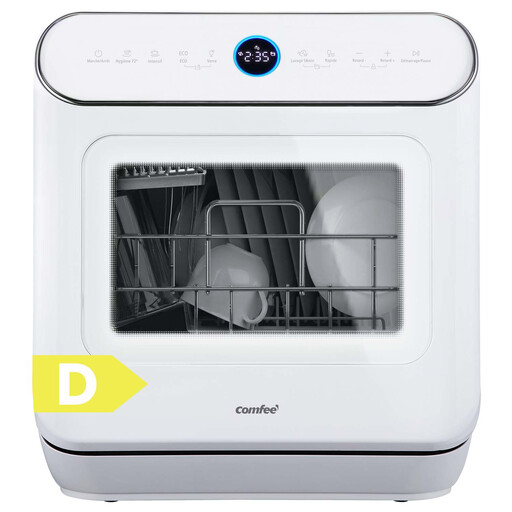 Image unavailable
COMFEE CDWMT305WD, white mini dishwasher
Worth considering for smaller loads of washing-up, but check that the racks can also fit your bulkiest utensils.
The title states 7 programmes and a 24-hour delay start. Check the instructions for this exact model, particularly for installation and drainage.
View on Joybuy
 Image unavailable
Comfee CDWMTO201D(W), 5 L tank
Worth considering if you’d like a countertop model with a tank, once you’ve worked out where the wastewater will go.
The title states a built-in 5 L tank and 6+3 programmes. Check how the interior fits your dishes and how this model drains.
View on Joybuy
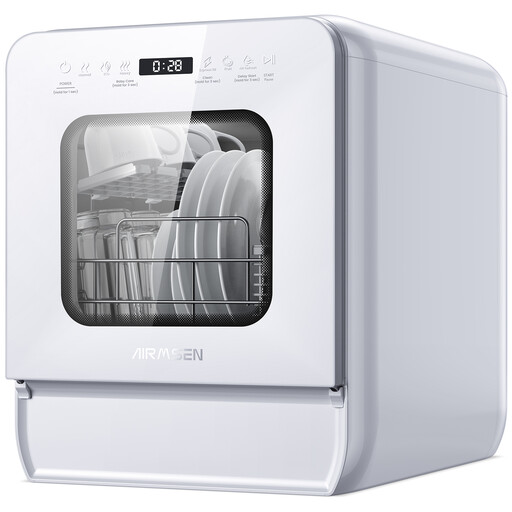 Image unavailable
AIRMSEN Tabletop, 5 L tank, 37 × 50 cm
Worth considering if worktop width is a key factor and you can plan for drainage from a model with a tank.
The title lists dimensions of 37 × 50 cm and a 5 L tank. Also check the height, door clearance and programmes available on the model being sold.
View on Joybuy
Frequently asked questions
Can a mini dishwasher work without a water supply or drain?
Not necessarily. Only a model specifically designed with a tank can avoid a fixed water supply. You’ll still need to arrange drainage; on some mini models, that means putting a hose in the sink for every wash.
What should I check before installing a dishwasher permanently?
Check the water supply, drainage, power supply and clearances specified in the model’s instructions. Promotelec recommends a dedicated electrical circuit for the dishwasher socket; have your installation checked if you’re unsure.
Is a 6-place-setting appliance enough for two people?
It may be, if all the dishes you produce between cycles fit in the racks, including any cookware you want to wash. If you often cook with large dishes, compare their dimensions with the interior before ruling out a 45 cm model.
How can I compare water and electricity use?
Look at the kWh per 100 cycles, litres per cycle, Eco programme duration and capacity together on the label. According to the ADEME, these figures let you compare appliances on a consistent basis, but they don’t describe every other programme on their own.
How much noise should I expect in an open-plan kitchen?
Compare the dB levels and noise ratings of models that already meet your space and capacity needs. UFC-Que Choisir points out that noise deserves particular attention when your kitchen shares your living space. Also consider when you plan to run the cycles.


