How do the sizes compare?
Start by checking the space and connections, then see how the capacity compares with the dishes you actually use. If the space you’d lose matters more than the time you’d save on washing up, you can always stick with your current routine without a dishwasher.
| Factor |
What to check |
Who it matters to |
| Available space |
Measure the width, depth and height, as well as the door clearance. Compare the worktop space it takes up with the floor space or niche it needs. |
If I often cook in a small space, losing worktop or storage space could be more inconvenient than making room on the floor. Around 25% of consumers would prioritise usable surface area. |
| Capacity and loading |
Compare the stated place settings with your pots, pans and large dishes, and check how the baskets are arranged. |
When everyday dishes quickly fill a small appliance, I want to avoid running another cycle because there’s no room left. Capacity would be the main priority for around 31% of consumers. |
| Noise in your living space |
Check the dB(A) level and the noise class for the exact model on its product page or label. |
If the dishwasher runs while I’m in the living space, noise matters more than the appliance’s size alone. Around 25% of consumers would put quiet operation first. |
| Installation and use |
Check the water supply, drainage and electrical supply. To compare running costs, use the Eco programme figures on a like-for-like basis. |
Before choosing, I want to know whether the appliance can be installed in my home and which usage figures to compare between models. This would be the main concern for around 19% of consumers. |
According to ADEME, the energy label includes details such as energy use per 100 cycles, water use per cycle, capacity and noise class. These figures help you compare models, but they don’t replace checking that an appliance can be installed in your kitchen.
Brands and models to consider
These examples show three different installation types. Their features don’t apply to every appliance from the same brand.
Candy
For a countertop option, Candy France lists the Rapido CP 6E51LW as a 6-place-setting dishwasher measuring 550 × 501 × 443 mm.
- This model has a half-load option.
- It takes up worktop space, and its direct connection to the water supply needs to suit your plumbing.
Bosch
The freestanding Bosch SPS2HMI02E is an example of a slimline model: Bosch lists its dimensions as 845 × 450 × 600 mm.
- Its product details state that it has an adjustable upper basket and uses 8,9 L of water per Eco cycle.
- Its height and depth mean you’ll need suitable floor space, as well as the connections specified in the instructions.
Electrolux
For a fitted kitchen, the Electrolux EES42210L is a fully integrated 45 cm model, rated for 9 place settings and 44 dB(A), according to Electrolux France.
- Its product details let you check the stated capacity and noise level for this exact model.
- It needs a suitable niche and door panel. Electrolux states that it’s supplied without a furniture door and can’t be installed at height.
Countertop dishwashers on Joybuy
These countertop models are for kitchens where you can give up part of your worktop permanently. For each one, check the available space, useful capacity and how to connect and drain the water. They aren’t the freestanding or integrated 45 cm options covered above.
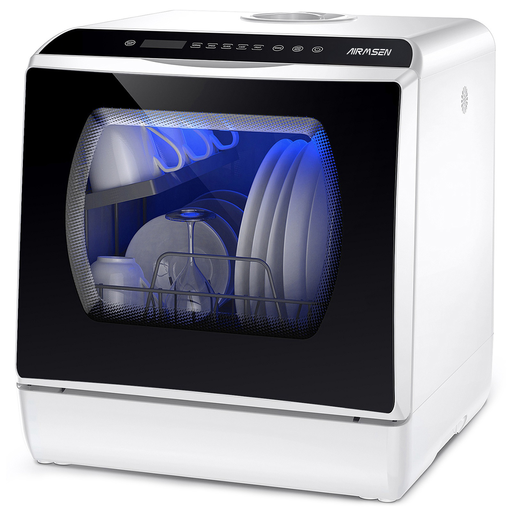 Image unavailable
AIRMSEN, 5 L tank countertop dishwasher
Worth considering if you can set aside a permanent spot on your worktop. The product title lists a built-in 5 L tank and 5 + 1 wash cycles. Before choosing, check the internal capacity, noise level and drainage setup.
View on Joybuy
 Image unavailable
Comfee' CDWMTO201D(W), white countertop dishwasher
Consider this if a countertop appliance suits your food-preparation space. The product title lists a 5 L tank and a D energy rating. Check the loading capacity and noise figures, and make sure your tap is compatible if you choose this water supply method. The tap adapter is listed as not included.
View on Joybuy
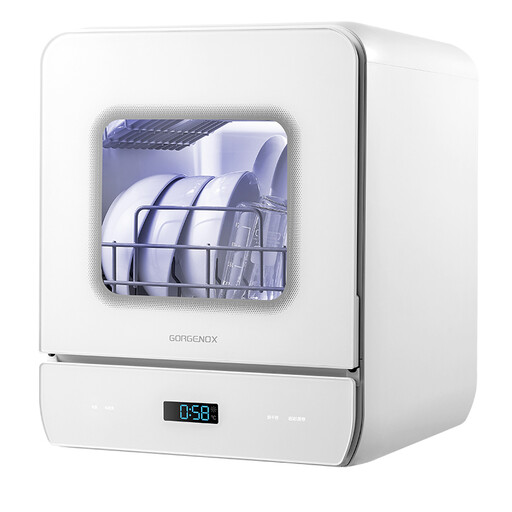 Image unavailable
GORGENOX DW5-D40A, 3-place-setting countertop dishwasher
Worth considering if a stated capacity of 3 place settings is enough for your usual dishes. Check how much room there is for pots and large dishes, along with the drainage requirements and noise figures for the model.
View on Joybuy
 Image unavailable
Heinrich's HTG 8840 Schwarz, 6-place-setting countertop dishwasher
Consider this if you’re looking for a stated capacity of 6 place settings without needing floor space. The product title lists 7 programmes, a D energy rating and 47 dB. Check the overall dimensions, the noise class on the label and the connections required.
View on Joybuy
Frequently asked questions
What should I check before installing a dishwasher?
Check that the water supply, drainage and electrical supply are suitable for the model you’ve chosen. The instructions will explain the installation and access requirements. An integrated model may also need a niche, a door panel or preparatory work.
Can a countertop dishwasher always run without a water connection?
No. The countertop design alone doesn’t determine how the appliance is supplied with water. For example, Candy France specifies a direct water connection for the CP 6E51LW. Also check the drainage setup required for the model you’re considering.
How can I compare water and electricity use?
Compare the models on a like-for-like basis, including energy use per 100 cycles and water use per Eco cycle as shown on the label. These figures don’t automatically tell you how much a quick programme uses.
Is the repairability index useful when choosing?
Yes. It gives you another point of comparison when several appliances are suitable for your kitchen. According to France’s Ministry for Ecological Transition, dishwashers are among the products covered by this index in France. Check the score for the exact model, but don’t treat it as a guarantee of a successful future repair.


